

For most vehicle owners, Smartliner delivers WeatherTech-level containment and Husky-level flexibility in one custom-fit liner, at a price closer to the value tier than the premium one. The decision between WeatherTech vs Husky Liners usually comes down to whether you’re paying for a name and rigid engineering, or for a mat that flexes, cleans easily, and still holds a spill. Smartliner’s laser-measured, 100% recyclable TPE liners give you deep channel walls and a precise fit without the premium markup either legacy brand charges.
This pick fits three kinds of buyers especially well:
- Daily commuters who want reliable spill and mud protection without paying premium-brand pricing.
- Families with kids or pets who need forgiving, easy-clean material that won’t crack in a hot trunk or stiffen in a cold garage.
- Outdoor enthusiasts hauling gear, tools, or muddy boots who need a deep-channel liner that contains real volume, not just splashes.
Key Takeaways
The strongest floor liner choice matches material flexibility and fit precision to your actual climate and driving habits, not just brand recognition.
| Point | Details |
|---|---|
| Material drives real-world performance | Flexible TPE resists cold cracking and cleans easier than rigid HDTE, which scuffs more visibly over time. |
| Fit varies by trim, not just model | Confirm exact year, make, model, and trim before ordering to avoid anchor or gap issues. |
| Containment depends on channel depth | Deeper reservoir walls handle spills and mud better than flat-bottomed mats regardless of brand. |
| Warranty claims differ in practice | Both brands offer lifetime coverage, but reported claim experiences vary between them. |
| Smartliner covers the value-performance middle | Laser-fit, recyclable TPE liners and cargo liners give WeatherTech-style containment near Husky-level pricing. |
Table of Contents
- WeatherTech Versus Husky Liners: A Quick Side-by-Side
- What Are Floor Liners Made Of, and Does It Matter?
- How Precise Is the Fit, and What Should You Expect During Installation?
- Which Liner Holds Up Better Under Heavy Spills and Daily Abuse?
- How Do You Clean and Maintain a Floor or Cargo Liner?
- What Do Warranty Terms and Pricing Actually Look Like?
- What Backs Up This Recommendation?
- How Should You Actually Buy: Front-Only, Full Set, or Cargo Liner?
- Durability Across Different Climates and Uses
- Why the “Premium Always Wins” Assumption Doesn’t Hold Up
- Where to Get Custom-Fit Liners That Match This Comparison
- Sources
WeatherTech Versus Husky Liners: A Quick Side-by-Side
Before getting into specs, it helps to see where these two brands actually diverge. Neither one is universally “better.” They’re built around different priorities, and that shows up the moment you touch the material.
- Fit precision: Both brands use digital scanning for custom fit, but tolerances shift by trim level and cab configuration, occasionally leaving gaps near the firewall or pedals.
- Material and feel: WeatherTech’s FloorLiner uses a rigid HDTE compound; Husky’s WeatherBeater line runs on flexible TPE, which is closer to what Smartliner uses across its lineup.
- Containment: Deep-channel designs on both brands manage standing water, but rigid liners tend to hold their wall shape slightly better under heavy load.
- Cleaning: Flexible TPE liners generally wipe cleaner and resist embedded grime better than rigid liners, based on independent testing from Car and Driver.
- Warranty: Both offer lifetime coverage, though claim experiences differ, according to AutoGuide’s comparison.
- Price: WeatherTech is priced higher, while Husky and Smartliner are positioned more affordably.
The material trade-off is the real story here: rigid containment wins on raw structural stiffness, but flexible workhorse materials win on everyday livability, cleaning ease, and cold-weather comfort. Smartliner’s lineup is built to hit both needs, offering deep-channel protection with the flexible feel that daily drivers actually prefer.
What Are Floor Liners Made Of, and Does It Matter?
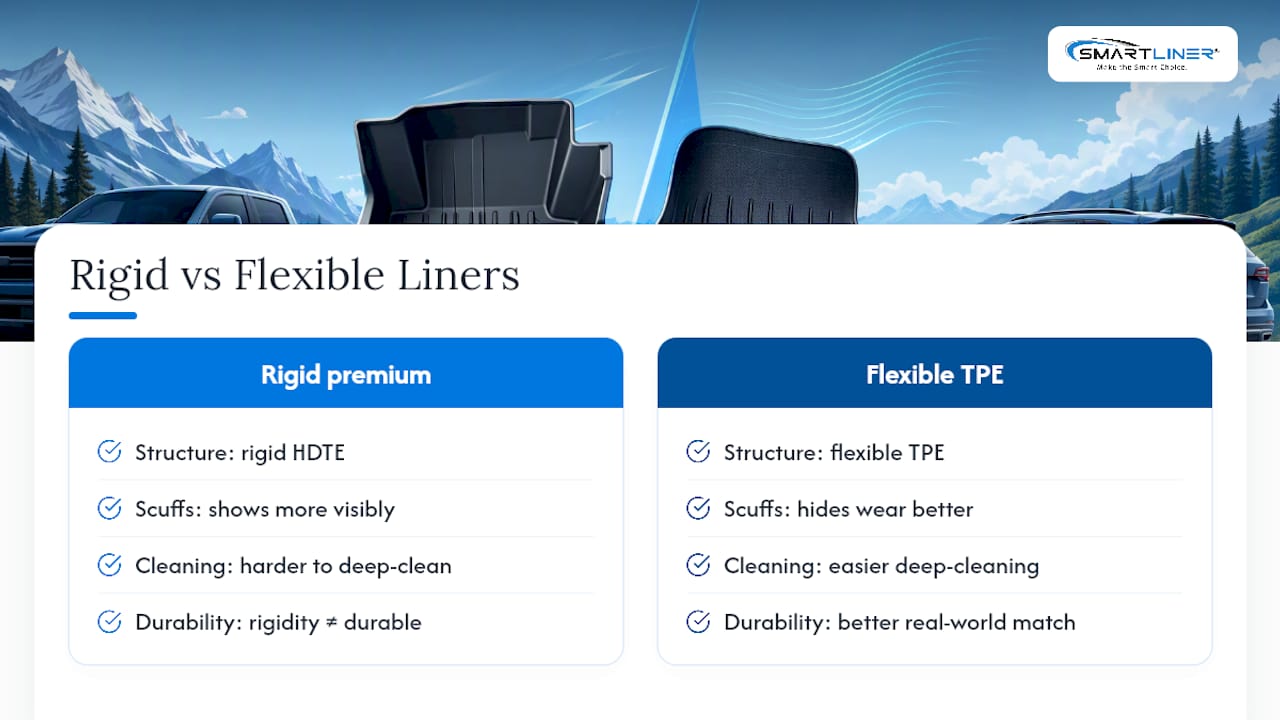
Material is the single biggest factor separating a liner that lasts five years from one that cracks in two winters. TPE (thermoplastic elastomer) stays flexible in cold temperatures, resists odor buildup, and tends to spring back into shape after being rolled or folded for storage. HDTE (high-density thermoplastic elastomer), WeatherTech’s proprietary compound, trades some of that flexibility for a stiffer, more rigid wall structure.
According to AutoStore’s materials breakdown, TPE generally outperforms recycled PVC in longevity and comfort, while TPO leans toward industrial-grade rigidity. Here’s what that means in practice:
- Cold-weather resilience: TPE resists cracking and stiffening in freezing temperatures better than rigid or PVC-based liners.
- Odor: Low-odor TPE compounds off-gas less than cheaper PVC mats, especially in a closed vehicle on a hot day.
- Scuff resistance: Rigid HDTE liners can show scuffs and embedded marks after repeated cleaning cycles that are harder to buff out than flexible TPE surfaces.
Smartliner builds its floor and cargo liners from 100% recyclable TPE, which supports both the flexibility buyers want and a lower environmental footprint than PVC-heavy competitors. A liner that recycles cleanly at the end of its life is a genuine differentiator, not just a marketing line.
How Precise Is the Fit, and What Should You Expect During Installation?
Custom-fit liners start with a laser or 3D digital scan of a specific make, model, and trim. That’s how manufacturers replicate the exact contours of a floor pan, including hump height, pedal clearance, and factory anchor points. But “custom fit” doesn’t mean identical fit across every trim of the same model. Cab configuration, seat style, and optional flooring can all shift the tolerances enough to matter, a pattern confirmed across multiple fit-testing comparisons between WeatherTech and Husky.
Common fit issues include:
- Minor curling at the edges during the first few days as the material settles into shape.
- Small gaps near the firewall or pedal box on trims with nonstandard flooring.
- Anchor misalignment when a vehicle has multiple floor-hook configurations across trim years.
Smartliner addresses this by mapping fits down to specific trim details, including dual front floor hooks on models like the 2010-2011 Equinox and Terrain, so you order the exact configuration your vehicle actually has.
Pro Tip: Let a new liner sit in your vehicle for 24 to 48 hours before judging the fit. Thermoplastic materials often relax into the floor pan’s contours after the first day of ambient temperature exposure.
Which Liner Holds Up Better Under Heavy Spills and Daily Abuse?
Edge height and channel geometry decide how much liquid a liner can hold before it spills onto your carpet. Deeper channels create a reservoir effect, letting mud, snowmelt, or a spilled coffee sit contained instead of sloshing over the lip the moment you brake.
- Reservoir depth: Liners with taller channel walls and a raised outer lip contain significantly more volume than flat-bottomed mats.
- Underside grip: Nib or ridge patterns molded into the underside reduce sliding on carpet, though grip performance varies by carpet texture and mat weight.
- Cold-weather flexibility: Field reports on extreme cold exposure show flexible TPE compounds resist curling and cracking better than stiffer materials once temperatures drop well below freezing.
- Heavy-use durability: Under repeated boot traffic, cargo loading, and pet claws, flexible liners tend to resist permanent creasing better than rigid designs, which can develop stress lines at high-flex points.
For families hauling kids, gear, and muddy boots on the same trip, a deep-channel, flexible liner like Smartliner’s tray design tends to handle the daily grind better than a rigid liner optimized purely for showroom stiffness.
How Do You Clean and Maintain a Floor or Cargo Liner?
Cleaning routine matters almost as much as material choice, since even a well-designed liner will look worn if you skip basic upkeep.
- Remove the liner and hose it off outdoors to knock loose dried mud and debris.
- Scrub with a soft brush and mild soap, focusing on channel corners where grime settles.
- Rinse thoroughly and let it air-dry flat, away from direct sun exposure.
- Reinstall only once fully dry to prevent trapped moisture and odor buildup.
Rigid, high-gloss liners tend to show scuffs and embedded scratches faster than flexible textured surfaces, an outcome consistent with Car and Driver’s testing. Avoid harsh solvents. They can dull the surface finish over repeated use. For broader interior care between liner cleanings, this dashboard cleaning guide covers safe products that won’t degrade nearby trim.
Pro Tip: Skip the tire shine or silicone-based sprays on floor liners. They create a slippery surface underfoot and can actually attract more dust over time.
What Do Warranty Terms and Pricing Actually Look Like?
Both major brands advertise lifetime coverage, but the practical experience of filing a claim differs. Husky’s warranty is often described as more straightforward in practice, while WeatherTech’s limited lifetime warranty is standard but sometimes reported as stricter about qualifying conditions.
Price bands generally break down like this:
- Front-only sets: Entry-level pricing for a single row of protection.
- Full front-and-rear sets: A meaningfully higher price for complete cabin coverage.
- Cargo liners: Priced separately, reflecting the larger material footprint and trunk-specific molding.
Buyer guides consistently note that mid-tier brands deliver roughly comparable protection at a lower price point than premium options, with the price gap typically significant for similar coverage. If your vehicle sits in a covered garage and sees light use, a value option like Smartliner covers your needs without the premium tax. If you’re running a work truck through mud season every year, paying more for maximum rigidity might earn its keep.
What Backs Up This Recommendation?
Smartliner’s case for value-conscious buyers rests on more than price. The manufacturing process and material choices map directly onto the comparison points that matter most in a WeatherTech vs Husky Liners debate.
- Laser-measured, 3D digital-fit manufacturing ensures each liner matches factory floor contours instead of relying on generic templates.
- 100% recyclable TPE construction supports the flexibility and cold-weather resilience that flat, rigid liners often lack.
- Limited-lifetime warranty coverage backs the same durability claims premium brands make, without the premium price tag.
- Model-specific coverage spans everything from the Silverado and Sierra HD extended cab to the Mazda CX-9.
A liner is only as good as the fit behind it. Precision measurement matters more to long-term satisfaction than brand recognition alone.
Full-size SUV owners, crossover drivers, and truck owners can all find a mapped fit in Smartliner’s catalog rather than settling for a “universal” compromise.
How Should You Actually Buy: Front-Only, Full Set, or Cargo Liner?
Buying the right liner setup takes four quick decisions, not a guessing game.
- Measure your usage pattern first. Commuters often need front-row coverage only; families and outdoor users usually need full front-and-rear sets.
- Enter your exact year, make, model, and trim. Fit tolerances shift enough between trims that guessing here causes most fitment complaints.
- Choose front-only versus a full set based on rear-seat traffic. Kids, pets, and cargo runners all argue for complete coverage.
- Add a cargo liner separately if your trunk or bed sees regular loading. A dedicated cargo liner protects a different footprint than floor mats and shouldn’t be treated as optional for hauling-heavy households.
If you’re routinely dealing with deep mud, standing water, or heavy work gear, a stiffer, HDTE-style liner’s raw rigidity might justify its premium. For nearly everyone else, a flexible, precisely fitted TPE liner covers the job without the extra cost.
Durability Across Different Climates and Uses
Climate exposure is where liner material shows its real character. In freezing regions, rigid compounds can stiffen and become prone to cracking at the edges when driver traffic bends them repeatedly against a cold floor pan. Flexible TPE liners, by contrast, tend to retain pliability in cold weather, resisting the same stress cracking that rigid mats develop after a few winters.
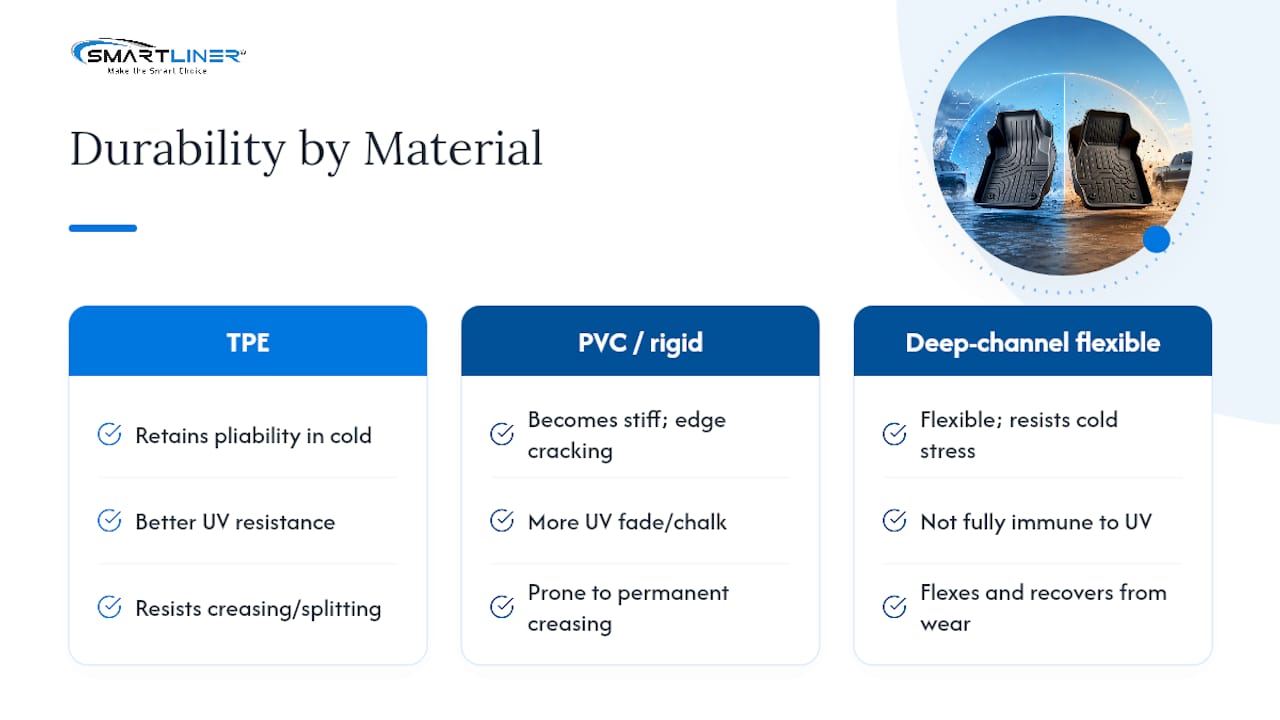
In hot, high-UV climates, the concern shifts to surface degradation. Prolonged sun exposure through a windshield can fade or chalk a liner’s surface finish over years of daily parking. TPE compounds generally resist UV degradation better than PVC-based mats, though no plastic liner is fully immune to years of direct sun.
Heavy-use scenarios add a third variable: mechanical wear from boots, tools, and cargo. A liner used daily for job-site gear or outdoor equipment sees far more abrasive stress than one protecting a commuter’s occasional grocery run. Deep-channel, flexible liners tend to resist permanent creasing and edge splitting better under this kind of repeated mechanical load, since the material can flex and recover rather than holding a stress fracture.
The practical takeaway: match the liner to your actual climate and use case rather than defaulting to whichever brand has the biggest name. A liner engineered for showroom rigidity doesn’t necessarily win in a Minnesota winter or a Phoenix summer.
Why the “Premium Always Wins” Assumption Doesn’t Hold Up
The conventional wisdom on WeatherTech vs Husky Liners treats brand recognition as a proxy for quality, and that’s where most buying guides get lazy. Independent testing shows the rigid HDTE compound that makes WeatherTech’s FloorLiner feel so structurally impressive is also the reason it scuffs more visibly and resists deep cleaning less effectively than flexible TPE alternatives. Rigidity and durability aren’t the same thing, and treating them as interchangeable is where a lot of buyers overpay for the wrong attribute.
What gets underestimated is fit precision at the trim level. Two vehicles with the same model name can need different liner geometries depending on cab configuration or floor hardware, and no brand name fixes a mismatched anchor point. The fix is verifying your exact trim before comparing materials, not after.
If there’s one priority to fix first, it’s this: decide what your vehicle actually does (commuting, hauling, weather exposure) before comparing spec sheets. A flexible, laser-fit TPE liner from a value-focused maker like Smartliner will outperform a rigid premium mat for most real-world driving, simply because it matches how people actually use their vehicles.
— Marty
Where to Get Custom-Fit Liners That Match This Comparison
You’ve seen how flexible TPE outperforms rigid HDTE on cleaning ease and cold-weather comfort, and how fit precision matters more than brand recognition. Smartliner builds exactly that combination: laser-measured floor liners and cargo liners made from 100% recyclable TPE, priced in the value tier instead of the premium one. Truck owners can check coverage for models like the Ram 2500 Mega Cab with bucket seats, while SUV owners running larger vehicles can find fits like the Lexus LX 600 seven-passenger configuration. UTV owners get the same containment logic with UTV-specific floor mats, and the full floor liner catalog covers most car, truck, and SUV trims sold in recent years. Enter your vehicle details and confirm your exact fit before you check out.
Sources
Recommended
- Smart Trim™ Floor Liners For 2007-2014 Tahoe / Yukon | Smartliner USA
- Smart Trim™ Floor Liners For 2007-2014 Tahoe / Suburban / Yukon / Yukon XL / Denali (No Hybrid Models) | Smartliner USA
- Smart Trim™ Floor Liners for 2007-2014 Suburban / Yukon XL | Smartliner USA
- Smart Trim™ Floor Liners For 2007-2014 Suburban / Yukon XL | Smartliner USA