

Choose a waterproof, tray-style under-sink mat with a reinforced raised lip. This style contains active drips at the source and lifts out clean for emptying, so a slow leak never gets the chance to soak into cabinet wood.
Containment plus easy removal is what prevents the slow, expensive damage that flat mats and paper liners cannot stop.
Before you buy anything, take these steps:
- Measure the cabinet interior width, depth, and height to the P-trap.
- Note the position of pipes, shutoff valves, and any garbage disposal housing.
- Check for obstructions that could keep a rigid tray from sitting flush.
Key Takeaways
A lipped, tray-style under-sink mat with a reinforced edge and a precise fit prevents the slow leaks that cause the most cabinet damage.
| Point | Details |
|---|---|
| Pick tray-style over flat sheets | Raised, reinforced lips contain active drips; flat sheets only catch light splashes. |
| Confirm lip height and stiffness | Look for a minimum 0.5-inch lip that stays rigid under a few inches of standing water. |
| Measure before you trim | Record width, depth, height to the P-trap, and pipe positions to avoid gaps at the corners. |
| Match material to cabinet use | Choose food-grade, BPA-free silicone or rubber for cabinets storing food or pet supplies. |
| Consider precise-fit designs | Smartliner’s pre-cut under-sink mats keep the lip intact on all sides without manual trimming. |
Table of Contents
- What Makes an Under Sink Mat With a Lip Actually Work
- How Do You Measure and Fit a Mat Under the Sink?
- Which Materials Are Safest and Most Durable?
- How Do You Install, Remove, and Care for a Lipped Mat?
- Tray-Style, Flat Sheets, or Textured Liners: Which Fits Your Cabinet?
- Will a Lipped Mat Work Around Your Pipes and Disposal?
- How Do Popular Under-Sink Mat Styles Compare?
- What Happens to These Mats After You’re Done With Them?
- Why Precise Fit and a Reinforced Lip Are Worth Paying For
- Smartliner’s Under-Sink Mats Solve the Fit Problem Directly
- Sources
What Makes an Under Sink Mat With a Lip Actually Work
A raised edge only does its job when it stands tall enough and stiff enough to hold water back under real conditions, not just on a store shelf. Most plumbing guidance points to a minimum effective lip height of about 0.5 inches, and that number matters more than it sounds like it should, according to Plumbing Tips Today. A shorter lip lets even a modest spill crest the edge; a taller one buys you time to notice and react.
Material choice changes what that lip can do:
- Silicone: flexible, food-safe, and easy to fold for storage, but a soft lip can bow outward under a pooled quarter-inch of water.
- Rigid plastic: holds its shape when full, which makes it easier to carry a loaded tray to the sink without sloshing.
- Rubber or PVC-style compounds: resist degreasers, drain cleaners, and other cabinet chemicals better than soft silicone.
- Textured bottoms: raise stored sponges, cleaning bottles, and boxes off any water that does pool, keeping them dry even during a slow drip.
Manufacturers sometimes advertise containment capacity in gallons, and one listing puts a typical under-sink tray at 1.3 to 3.6 gallons. That number only holds up if the walls are rigid enough to stay vertical under load. A flimsy lip rated for 3 gallons on paper might fail at half that in practice.
Pro Tip: Press down on the lip with two fingers before you buy. If it folds flat under light pressure, water will find a way behind it during a real leak.
Trimmable mats give you flexibility around irregular pipe layouts, but every cut you make near a corner risks weakening the lip’s seal. Fixed-size, pre-cut options sacrifice some flexibility for a guaranteed, consistent edge all the way around.
How Do You Measure and Fit a Mat Under the Sink?
Getting the fit right is what separates a mat that protects your cabinet from one that just sits there looking useful. Skipping a measurement step is the single most common reason a new mat ends up with gaps at the corners.
- Measure interior width, left wall to right wall, at the widest usable point.
- Measure depth, front to back, including any lip clearance at the door.
- Measure height from the cabinet floor to the base of the P-trap.
- Mark the exact location of supply lines, the disposal unit, and any shutoff valves.
- Record both a minimum and maximum dimension if the cabinet tapers or has an angled back wall.
- Choose trimmable if pipes sit off-center or close to a wall; choose pre-cut if your layout is standard and rectangular.
Measuring the interior before you buy, and accounting for plumbing obstructions specifically, avoids the gaps where water routinely bypasses a lip that looked fine in the package.
If you do need to trim, use sharp scissors or a utility knife, work slowly, and never cut into the raised lip itself, only the flat base material around a pipe cutout. Preserve at least an inch of flat material around any hole so drainage behavior near the wall stays intact.
Pro Tip: Leave an extra half inch of clearance on one side for lifting the mat straight up and out. A mat cut flush to every wall becomes a wrestling match the day it actually needs cleaning.
Which Materials Are Safest and Most Durable?
Not every material earns a spot in a cabinet that stores food, pet supplies, or cleaning chemicals side by side.
| Material | Chemical resistance | Cleaning | Best for |
|---|---|---|---|
| Silicone | Moderate | Dishwasher-safe, wipes clean | Food or pet cabinets |
| Rigid plastic | Good | Wipe and air-dry | Carrying a full tray |
| Rubber/PVC blend | Strong | Bleach-solution safe | Chemical or cleaning-supply storage |
Experts generally recommend food-grade, BPA-free materials that are dishwasher-safe and resist odor buildup, especially in households with kids or pets who might get near an open cabinet.
- Silicone rinses clean in a dishwasher and resists lingering odors better than most rubber blends.
- Rigid plastic wipes down fast but shows scratches sooner under heavy scrubbing.
- Rubber and PVC hold up against bleach and drain cleaner without softening.
A flexible lip made from thin silicone tends to sag over months of repeated soaking, while a reinforced lip built into rigid plastic or a firmer rubber compound holds its shape through years of use.
How Do You Install, Remove, and Care for a Lipped Mat?
Getting the fit right matters, but daily habits are what keep the lip working long after installation day.
- Empty the cabinet completely and wipe the base dry before placing the mat.
- Fit the mat around pipes and the disposal housing, pressing each lip section flush against the cabinet walls.
- For removal after a leak, lift a rigid tray mat straight up in one motion to avoid sloshing; use a slow double-lift on flexible sheets, raising one end first to drain water toward the opposite corner.
- Wipe the mat weekly, run a deeper clean with mild soap monthly, and inspect the lip edges for cracks or permanent creasing every few months.
Pro Tip: After any leak, dry the cabinet floor fully, disinfect the area, and check the baseboard and cabinet substrate underneath for soft spots. A mat that caught the water doesn’t mean the wood underneath escaped every drop.
Tray-Style, Flat Sheets, or Textured Liners: Which Fits Your Cabinet?
The right style depends on what’s actually stored under your sink and how old your plumbing is, more than on price alone.
- Tray-style with a reinforced lip: the strongest option for active leak containment, and the better choice for homes with older plumbing, past leak history, or stored cleaning chemicals.
- Flat sheets: budget-friendly for catching incidental splashes or condensation, but they offer little protection once a supply line actually drips or a P-trap loosens.
- Textured raised-bottom mats: useful when you store paper towels, extra sponges, or small electronics, since the raised texture keeps items above minor moisture even with a shallower lip.
For renters or short-term setups, a flexible tray you can pull out in seconds beats a bulkier rigid option, according to research on placement and mat design. Homeowners dealing with decades-old galvanized pipe, on the other hand, get more real protection from a rigid tray with a taller, stiffer lip. Parents and pet owners land somewhere in between: a food-grade tray-style mat covers both spill containment and the safety concerns of anything stored nearby. Bathroom vanities, which see less plumbing volume than kitchen sinks, often do fine with a mid-depth lip and a flat, wipeable surface.
Will a Lipped Mat Work Around Your Pipes and Disposal?
Most cabinets under a kitchen sink share a similar layout: a P-trap, one or two supply lines, a shutoff valve pair, and sometimes a garbage disposal unit bolted to the sink basin. A tray-style mat with pre-formed pipe cutouts handles this setup well as long as the cutouts land close to your actual pipe positions, which is why measuring first matters more than picking a mat by look alone.
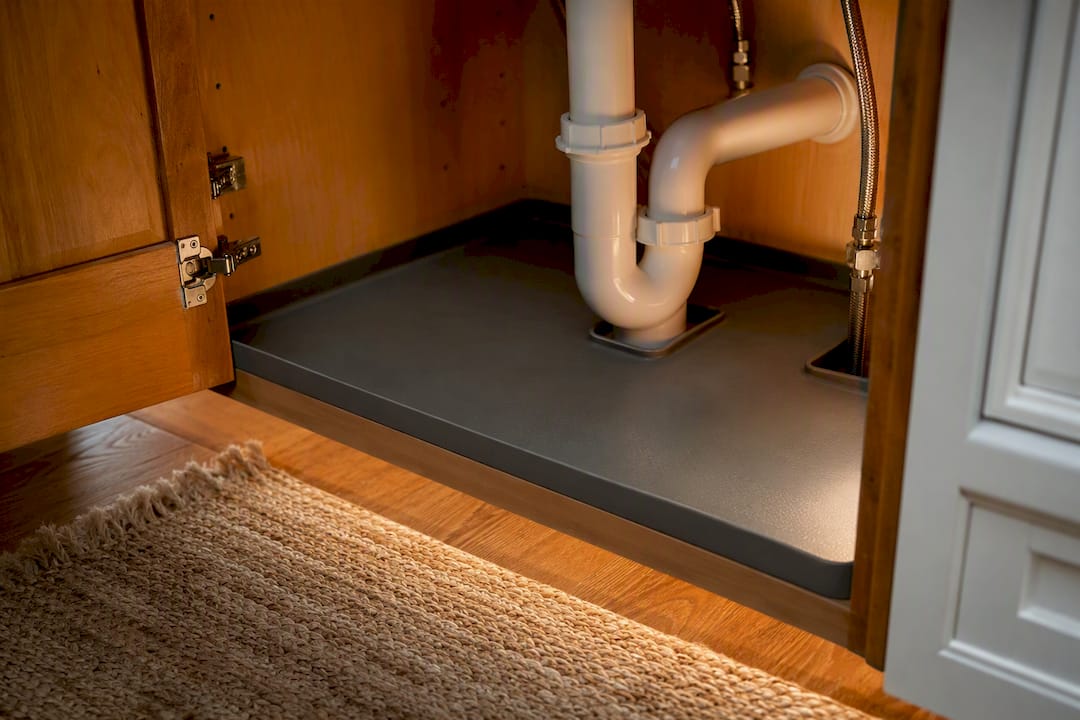
Bathroom vanities usually have a simpler footprint, often just a single P-trap and supply lines, which makes a smaller pre-cut mat a workable option without any trimming.
Kitchens with a garbage disposal need extra clearance on one side, since the disposal housing extends lower and further back than a standard drain assembly. A trimmable mat solves this better than a fixed cutout pattern, since you control exactly where the notch sits. Cabinets with a water filtration system, an instant hot water tank, or a soap dispenser pump add even more obstructions, and in those cases a full sheet you trim yourself outperforms any pre-cut design built for a generic layout.
Some households pair a mat with a battery-powered water sensor placed at the lowest point of the cabinet floor, adding early detection to the containment the mat already provides, an approach some manufacturers now build into their under-sink product lines. A mat catches the water; a sensor tells you it happened before the cabinet smells musty three weeks later.
How Do Popular Under-Sink Mat Styles Compare?
Shopping for a lipped mat means sorting through a handful of common design approaches, each with real trade-offs worth knowing before you commit.
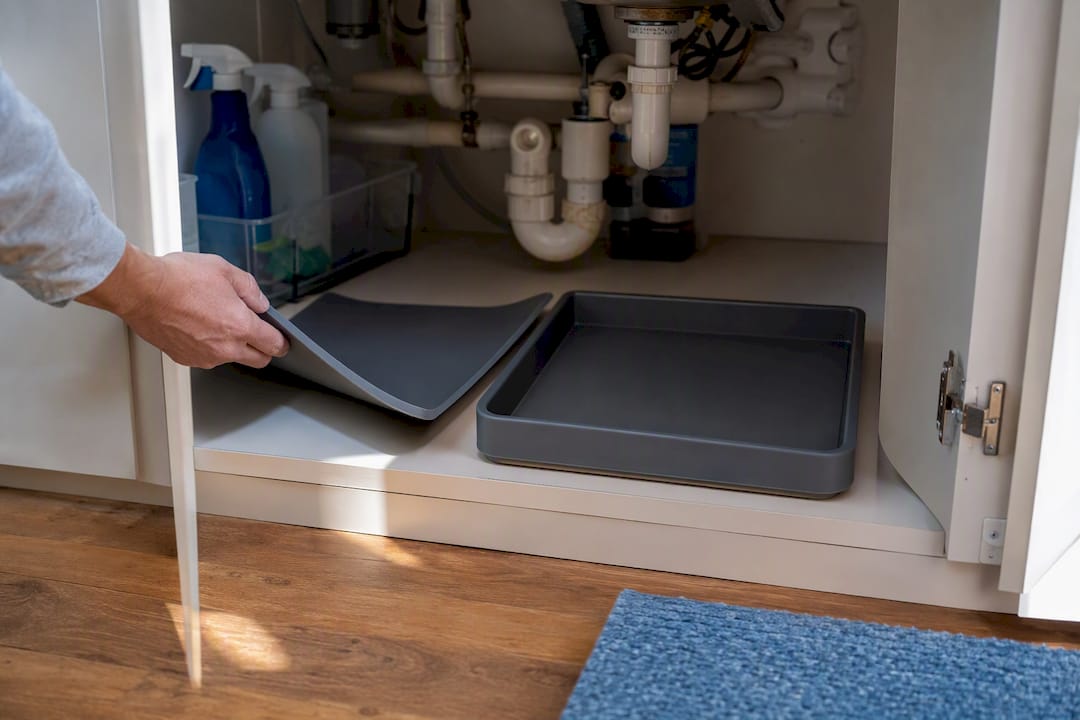
Flexible silicone sheets dominate the budget end of the category. They fold flat for storage, resist odors well, and clean up in a dishwasher, but their lips tend to be the shortest and softest of any style, which limits containment during an active leak rather than a light drip.
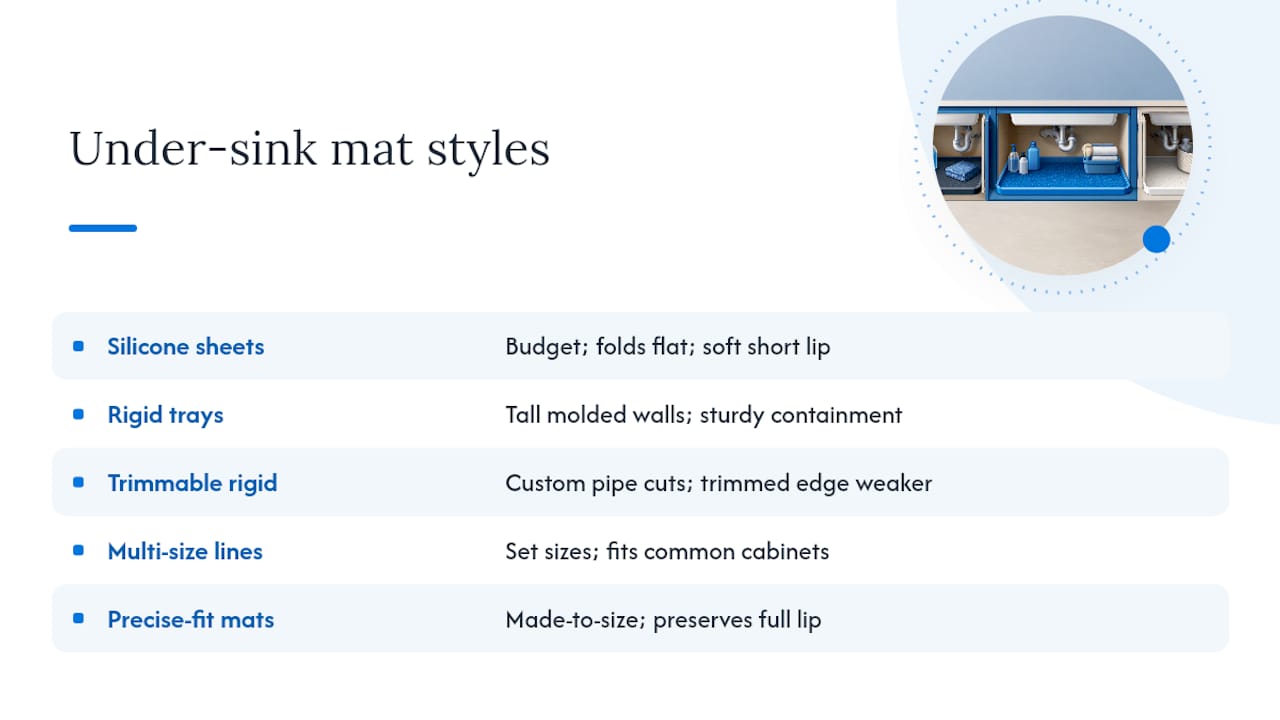
Rigid tray designs with taller molded walls sit at the other end. They carry a filled tray without buckling and hold their shape for years, though they cost more upfront and take up a fixed amount of cabinet floor space regardless of your actual layout. Trimmable rigid options split the difference, letting you customize pipe cutouts while keeping a reinforced lip around the perimeter, though the trimmed edge itself is usually less rigid than the factory-molded sides.
Multi-size product lines, where a brand sells the same design in several standard dimensions, work well if your cabinet matches a common width. Precise-fit approaches solve the layout problem differently: instead of trimming a generic sheet, you select dimensions that match your cabinet from the start, which preserves full lip integrity on all four sides since nothing gets cut. That trade-off, standard sizing convenience versus a fit built to your exact cabinet, is worth weighing against how unusual your plumbing layout actually is.
What Happens to These Mats After You’re Done With Them?
Material choice determines what happens to your mat once it wears out, and that’s worth factoring in alongside durability. PVC and standard vinyl mats generally resist recycling through curbside programs and tend to end up in landfill once cracked or discolored, since most municipal recycling streams aren’t set up to process flexible PVC.
Silicone breaks down slowly in landfill conditions and isn’t accepted by most curbside recycling either, though it doesn’t off-gas the way some PVC formulations can as they age. Rigid plastics stamped with a recyclable resin code fare better, provided your local program actually processes that specific plastic type, which varies significantly by municipality.
Recyclable materials matter beyond the mat’s eventual disposal. A mat built from a single recyclable material, rather than bonded layers of mixed plastics and adhesives, is genuinely easier to process at end of life and avoids the mixed-material problem that keeps so many household products out of recycling streams entirely. That’s a meaningful factor if you replace an under-sink mat every few years as households commonly do, since the cumulative material footprint adds up faster than a single purchase suggests.
Why Precise Fit and a Reinforced Lip Are Worth Paying For
Every failure mode I’ve studied in this category traces back to the same root cause: a gap between the mat and the cabinet wall where water sneaks past. A generic sheet trimmed by hand almost always leaves that gap somewhere.
That’s the case for precise-fit design over generic trimming. A mat built to your cabinet’s actual dimensions, with a lip that stays reinforced because nothing got cut near it, closes the gap that causes most of the damage homeowners eventually discover. Recyclable materials solve a second problem: durability without the landfill guilt of replacing a flimsy mat every year.
— Marty
Smartliner’s Under-Sink Mats Solve the Fit Problem Directly
Everything covered in this guide, lip height, material durability, flush-fit edges, points toward one conclusion: fit quality determines whether a mat protects your cabinet or just decorates it. Smartliner’s under-sink cabinet mats are offered in multiple pre-cut sizes rather than a one-size-fits-most sheet, so you get a reinforced lip that sits flush on all four sides without trimming through the containment wall yourself. The materials are built for repeat wipe-downs and long-term durability, the same recyclable-material approach Smartliner applies across its floor liner and cargo protection lines for vehicles.
If your cabinet has an unusual pipe layout or you’re not sure which size covers your dimensions, reach out to Smartliner-usa’s support team for measuring guidance before you order, or browse the under-sink cabinet mat listing directly to match your interior measurements to an available size today.
Sources
- Waterproof mat placement under kitchen sink — Sink Savvy Hub
- Home Depot product listing — under-sink cabinet mat with listed capacity
Recommended
- SMARTLINER Floor Liners for 2018-2021 Mitsubishi Eclipse Cross | Smartliner USA
- Smart Trim™ Floor Liners For 2007-2014 Tahoe / Yukon | Smartliner USA
- Smart Trim™ Floor Liners For 2007-2014 Suburban / Yukon XL | Smartliner USA
- Smart Trim™ Floor Liners for 2007-2014 Suburban / Yukon XL | Smartliner USA