

The safest approach is a single-material, injection-molded, low-VOC TPE mat or an equivalent custom-fit liner built without adhesive layers. Multi-layer bonded mats and low-grade PVC or rubber are the most common sources of formaldehyde and other off-gassing chemicals in a vehicle cabin. Some custom-fit liner manufacturers build their products around this construction principle. The materials review and buying checklist below explain why it matters and how to verify a seller’s claims before you buy.
TL;DR:
- Choose single-material, injection-molded TPE mats or custom-fit liners built without adhesive layers to minimize emissions and off-gassing.
- Verify manufacturer testing results, such as VDA 270 or ISO fogging tests, before purchasing, instead of relying on vague “non-toxic” labels.
- A hot dashboard can significantly increase VOC emissions from mats, especially surface temperatures above 140°F, amplifying potential health risks.
- Bonded multi-layer mats release more formaldehyde and VOCs compared to one-piece molded liners, which almost completely eliminate off-gassing sources.
- After purchasing, airing out new mats outdoors and avoiding long sun exposure can reduce VOC buildup and odor during the initial break-in period.
Table of Contents
- What Makes Car Mats Non Toxic: A Material Breakdown
- Do Rubber Car Mats Smell, and Should That Worry You?
- Why Construction Matters More Than the Material Label
- How to Choose a Truly Low-Emission Mat
- How Smartliner-usa’s Liners Fit the Non-Toxic Checklist
- How to Reduce VOC Exposure After You Buy
- The Real Gap Between “Non-Toxic” Marketing and Non-Toxic Materials
- Where to Find Custom-Fit, Low-Emission Liners
- Sources
- FAQ
What Makes Car Mats Non Toxic: A Material Breakdown
Not all “rubber” or “eco friendly” labels mean the same thing once you look at chemistry. The mat material determines emissions, odor, durability, and what happens to it when you eventually replace it, so it’s worth understanding what you’re actually stepping on every day.
- Thermoplastic elastomer (TPE). Properly formulated TPE runs low on VOCs and stays essentially odorless, but that outcome depends entirely on raw-material selection and processing control. Manufacturer testing on optimized low-emission TPE grades shows they can pass strict VDA and ISO fogging and odor standards, while a cheap or poorly processed TPE batch can still off-gas noticeably.
- Natural rubber. Durable and generally low in synthetic additives, but quality swings depending on how much recycled content or filler is blended in. Some recycled-rubber mats carry a strong initial odor that fades over weeks, not days.
- PVC. The material most associated with plasticizers and phthalates. Low-quality PVC mats are also the most heat-reactive of the common options, meaning a hot dashboard day can trigger a noticeable spike in that “new mat” smell, which is really off-gassing, not a scent.
- EVA and XPE foam. Reasonably safe on their own, but check the backing. Many EVA mats are laminated to a fabric or rubber base with adhesive, and that bonding layer is where emissions risk creeps back in.
- Carpet and textile mats. Comfortable underfoot but often glued rather than molded, and some backings raise flammability concerns alongside VOC questions.
- Natural fiber mats (coir, bamboo). Biodegradable and genuinely eco-friendly car mats in the end-of-life sense, but they trade off durability and can hold moisture, dust, and odor in ways molded synthetics don’t.
The pattern across every category is the same: the base polymer only tells half the story. Additives, colorants, and stabilizers shape the real-world result, which is why two mats labeled the same material can perform completely differently in a cabin.
Do Rubber Car Mats Smell, and Should That Worry You?
Yes, and the smell is often a signal worth paying attention to, not just an annoyance. In-cabin air can carry formaldehyde, benzene, and other aldehydes, compounds tied to headaches, dizziness, and respiratory irritation in acute exposure and to longer-term health concerns with repeated exposure. Research on vehicle interior air quality has found formaldehyde and acetaldehyde levels exceeding suggested air quality limits by 30 to 60% in some new vehicles, and mats are one of the largest surface-area contributors sharing that closed space with you.
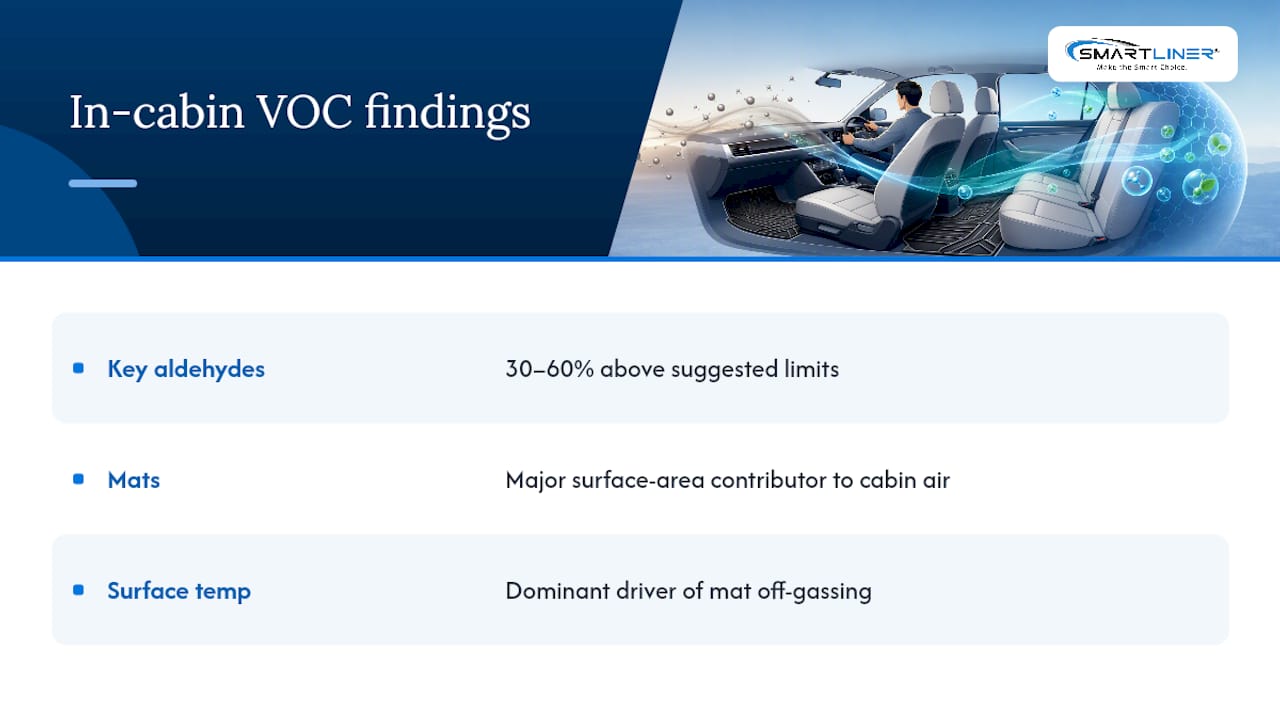
A car cabin is a small, sealed box that gets hot. That combination amplifies whatever your mats are emitting.
Material surface temperature, not just ambient cabin temperature, is the dominant driver of how much a mat off-gasses on a given day. A dashboard that reaches 140°F on a summer afternoon pushes mat-surface temperatures well past what most people imagine, and emission research shows surface heat drives VOC release more than general cabin warmth does. A separate long-term health risk assessment flagged formaldehyde and acrylonitrile among the compounds that can contribute to chronic exposure risk in sampled vehicles, which is exactly why minimizing the emission source matters more than masking the smell.
Why Construction Matters More Than the Material Label
Two mats can list the same base polymer and still perform completely differently, because how a mat is built often outweighs what it’s built from. Adhesives and laminate layers used to bond carpet backing, foam padding, and rubber soles are a direct source of formaldehyde and other VOCs. Environmental chamber testing found formaldehyde release rates for car mats ranging from roughly 0.02 to 0.13 mg per square meter per hour, with multi-layer adhesive-bonded constructions releasing more on average than single-material molded parts. Bonded carpet and coil-style mats followed that same higher-emission pattern in the same testing.
Single-material, injection-molded liners sidestep that problem almost entirely because there’s no glue layer to off-gas in the first place. When you’re comparing listings, look for language that signals this construction:
- “One-piece injection-molded” or “single-material construction”
- Explicit VDA 270 or VDA 278 odor and fogging test references
- No mention of “bonded,” “laminated,” or “multi-layer” backing
Pro Tip: Ask the seller directly for their VDA or ISO fogging test results rather than trusting a “non-toxic” label on its own. A seller with real test data will hand it over without hesitation; one relying on marketing language usually can’t.
How to Choose a Truly Low-Emission Mat
Run through this checklist before you buy, whether you’re shopping in a store or reading a product page online.
- Confirm the material declaration. The listing should name the exact polymer, not just say “eco friendly” or “premium rubber.”
- Check the construction type. Favor single-material or injection-molded over multi-layer bonded designs.
- Ask for VOC or fogging test results. VDA 270, VDA 278, or ISO 12219 references indicate the manufacturer actually tested emissions.
- Look for REACH SVHC compliance. This confirms the mat is free of substances of very high concern under EU chemical regulation, a useful proxy even for US buyers.
- Understand any Proposition 65 warning in context. It signals the presence of a listed substance above a threshold, not necessarily a dangerous product, but it’s worth asking what triggered it.
- Review the warranty and return policy. A seller confident in their materials usually backs the product with a real warranty.
Better materials and tighter manufacturing controls cost more to produce, and that cost typically shows up in the price. A liner that’s a few dollars cheaper but skips fogging tests and uses bonded layers is rarely the better long-term buy once you factor in odor, durability, and what you’re breathing.
How Smartliner-usa’s Liners Fit the Non-Toxic Checklist
Custom-fit construction checks several boxes on that list at once, and it is a recommended approach for building liners. Precise, laser-measured fit means less exposed cabin floor and tighter coverage around pedals, which reduces both material waste and the surface area available to off-gas or trap moisture and grime, compared to generic mats.
- Recyclable materials align with the push toward mats that don’t become landfill problems at replacement time.
- Precise-fit technology means less overlap, movement, or pedal interference compared to universal mats cut to a generic shape.
- Easy-clean, all-weather surfaces reduce the buildup of trapped debris that can hold odor over time.
If you’re comparing options, the SMARTLINER Custom Fit Floor Liners line and the custom liners built for the 2015 to 2021 Honda Fit both illustrate how model-specific fit reduces the gaps and overlap that generic mats leave behind.
How to Reduce VOC Exposure After You Buy
Even a well-made mat benefits from a few smart habits in the first weeks of use.
- Air new mats outdoors for a day or two before installing them, ideally in shade rather than direct sun.
- Crack the windows for the first several drives, especially on warm days, since heat is what pushes emissions higher, not just time.
- Avoid parking in direct sun for long stretches during the break-in period.
- Clean with mild soap and water, not solvent-based cleaners, which can degrade surface coatings and release more compounds than they remove.
- Replace mats that show cracking, stiffening, or a returning odor after cleaning. That’s usually a sign of material breakdown, not dirt.
Pro Tip: If odor persists after a full week of airing out and ventilation, that’s a signal worth taking seriously rather than waiting out. It’s the mat, not your imagination.
The Real Gap Between “Non-Toxic” Marketing and Non-Toxic Materials
Most “non-toxic” labels on car mats are marketing shorthand, not test results. The material and construction do the real work: single-material, low-VOC TPE or an equivalent injection-molded, custom-fit liner minimizes both adhesive exposure and off-gassing surface area. Expect to pay more for a mat backed by real fogging test data, and treat vague eco claims with more skepticism than a seller’s confidence in their own labeling.
Fit matters just as much as the polymer chemistry. A liner that hugs the footwell precisely traps less debris and moisture than a universal mat cut to a generic shape, which matters for odor over the life of the product, not just on day one.
— Marty
Where to Find Custom-Fit, Low-Emission Liners
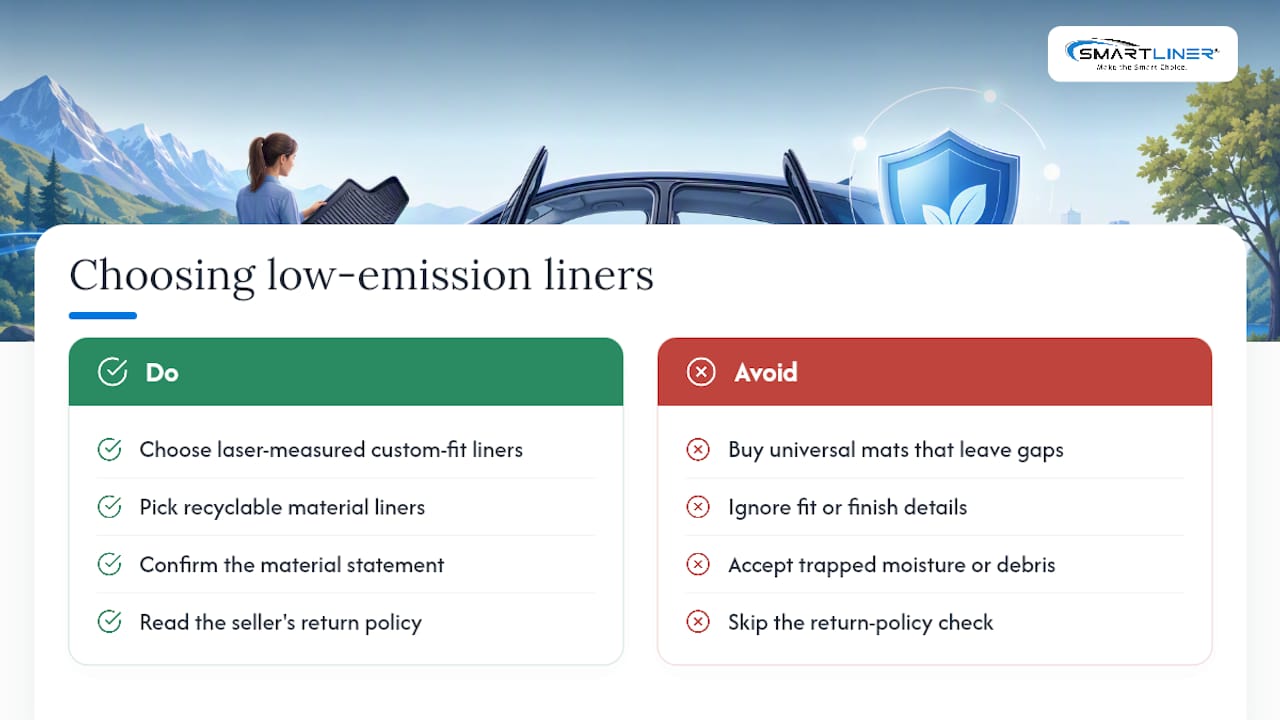
Universal mats leave gaps around pedals and edges that trap moisture and debris, exactly the conditions that shorten a mat’s life and invite odor back in. Some manufacturers offer laser-measured, custom-fit liners made from recyclable materials, designed so there’s less exposed floor and less room for grime to collect in the first place.
The SMARTLINER Custom Fit Floor Liners landing page covers the full lineup by vehicle, and specific fits like the Floor Liners for 2015-2021 Honda Fit show what model-specific coverage looks like in practice. Before you check out on any mat, from any seller, confirm the material statement and read the return policy so you’re covered if the fit or finish doesn’t match the listing.
Sources
The findings referenced throughout this guide come from peer-reviewed and industry testing:
- Cabin air dynamics: Unraveling the patterns and drivers of volatile organic compound distribution in vehicles
- Research on formaldehyde release rate of car mats
- Acute and chronic health risk assessment for automobile users due to inhalation exposure to volatile organic compounds and carbonyl compounds
This article is general information, not a substitute for advice from a qualified doctor. Consult a qualified healthcare professional about your own circumstances before acting on anything here.
FAQ
Are WeatherTech mats non-toxic?
WeatherTech mats use TPE, a material category that can be low-VOC and odorless when properly formulated and tested. Whether a specific mat qualifies depends on the manufacturer’s own fogging and emissions test data, so check for VDA 270 or VDA 278 results rather than assuming the material alone guarantees it.
What material is best for car floor mats?
Single-material, injection-molded TPE built without adhesive backing generally offers the best balance of low emissions, durability, and easy cleaning. Multi-layer bonded mats using carpet, foam, or laminated backing tend to release more formaldehyde in chamber testing than single-material designs.
Are TPE floor mats safe?
High-quality TPE formulated and processed for low emissions can achieve strong results on VDA and ISO fogging and odor tests. Cheap or poorly processed TPE can still off-gas, so the safety claim depends on formulation and manufacturing quality, not the material name alone.
Which material is better for car mats, TPE or PVC?
TPE generally outperforms PVC on emissions because PVC often relies on plasticizers and phthalates that off-gas more readily, especially under heat. TPE also tends to hold up better against temperature swings without becoming brittle or releasing odor over time.
Are car mats recyclable?
Many TPE and rubber mats are recyclable, though recyclability depends on the specific polymer blend and whether the manufacturer supports take-back or recycling programs. Some manufacturers detail their use of recyclable materials as part of their product approach on product pages like the Custom Fit Floor Liners page.