

The fastest way to keep floor mats from sliding is to engage your factory anchors if your vehicle has them, or place a non-slip pad underneath the mat right now. For a permanent solution, custom-fit all-weather liners eliminate the problem at the source by matching your floor’s exact geometry.
Immediate actions you can take today:
-
Re-seat the mat flat, making sure no edge is folded under or caught on the seat rail.
-
Clean the floor carpet with a dry brush or vacuum to remove debris that reduces grip.
-
Slide a shelf-liner or non-slip rug pad between the mat and carpet as a temporary gripper.
Safety warning: A mat that contacts the accelerator, brake, or clutch pedal is a serious hazard. Before driving, confirm at least one inch of clearance between the mat’s leading edge and the base of every pedal. Check this clearance in every seat position you use, including fully forward. Practical guides consistently flag pedal interference as the primary risk when mats shift.
Table of Contents
-
4. Why custom-fit all-weather liners are the best long-term solution
-
5. Why material and backing matter: TPE vs. rubber vs. carpet
-
6. Safety checklist: what to avoid and how to verify pedal clearance
-
Smartliner-usa custom-fit liners: precision that prevents sliding
1. Does your car already have factory mat anchors?
Always check for OEM retention points before buying any aftermarket fix. Most vehicles built after 2010 include factory floor hooks or anchor posts, and using them costs nothing.
-
Lift the driver’s mat and look for a round post or hook protruding from the carpet, usually positioned near the center or front of the driver’s footwell.
-
Check the mat itself for a pre-punched eyelet or grommet that aligns with that post.
-
Press the mat down so the eyelet seats fully over the post. You should hear or feel a click on vehicles with locking clips.
-
Tug the mat firmly toward the pedals. If it moves more than half an inch, the clip may be worn or broken.
-
For vehicles with dual front hooks, such as the Equinox and Terrain platform, align both eyelets before pressing down.
If the factory clip is broken, OEM replacements are available through your dealership’s parts counter or through compatible aftermarket clips sold by auto parts retailers. Replacing a single clip typically costs under $10 and takes minutes.
Pro Tip: After clipping the mat in place, sit in the driver’s seat, adjust it to your normal position, and press each pedal fully. The mat should not move, bunch, or contact any pedal at full depression.
3. How to install a universal floor-mat anchor kit
Anchor kits are a durable retrofit when factory clips are missing and your mats lack pre-punched eyelets. They work best on carpeted floors with padding underneath, which is standard in most passenger vehicles.
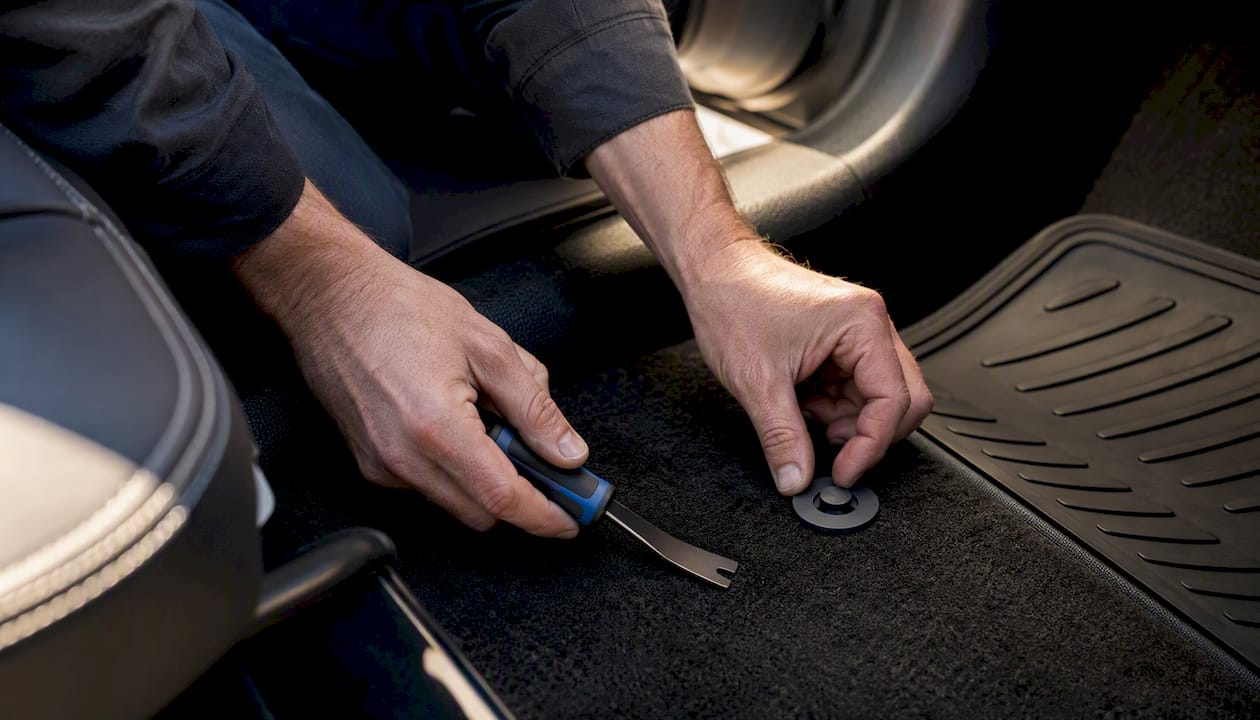
Tools you will need: anchor kit (cap, spiked base, washer, hole-punch tool), a rubber mallet, and a flashlight.
Safety check first: Knock lightly on the floor under the carpet with your knuckle. A hollow sound indicates padding beneath. A hard metallic ring means you are over a floor pan with no padding, and driving a spike there can damage wiring or coolant lines routed under the carpet. Avoid those spots.
-
Position the mat where it sits naturally, with the rear edge tucked under the seat and the front edge well clear of the pedals.
-
Mark the anchor location through the mat’s eyelet (or choose a spot near the rear center if the mat has no eyelet). Mark it with a piece of tape.
-
Remove the mat. Use the hole-punch tool included in the kit to cut a clean hole at the mark.
-
Push the spiked base through the hole from the underside of the mat, then press the cap onto the top to lock it.
-
Set the mat back in position and press the anchor spike firmly into the carpet padding using the mallet. One firm strike is enough.
-
Tug the mat in every direction. It should resist movement without pulling the anchor free.
Pro Tip: To remove the mat for cleaning, pull the anchor cap straight up. The spike releases cleanly from carpet padding. Repeated removal and re-insertion in the same spot will eventually loosen the hold, so rotate the anchor position slightly each time if you clean frequently.
Anchor kit installation is well-documented and effective, but it does leave small puncture marks in the carpet if you later remove the system entirely.
4. Why custom-fit all-weather liners are the best long-term solution
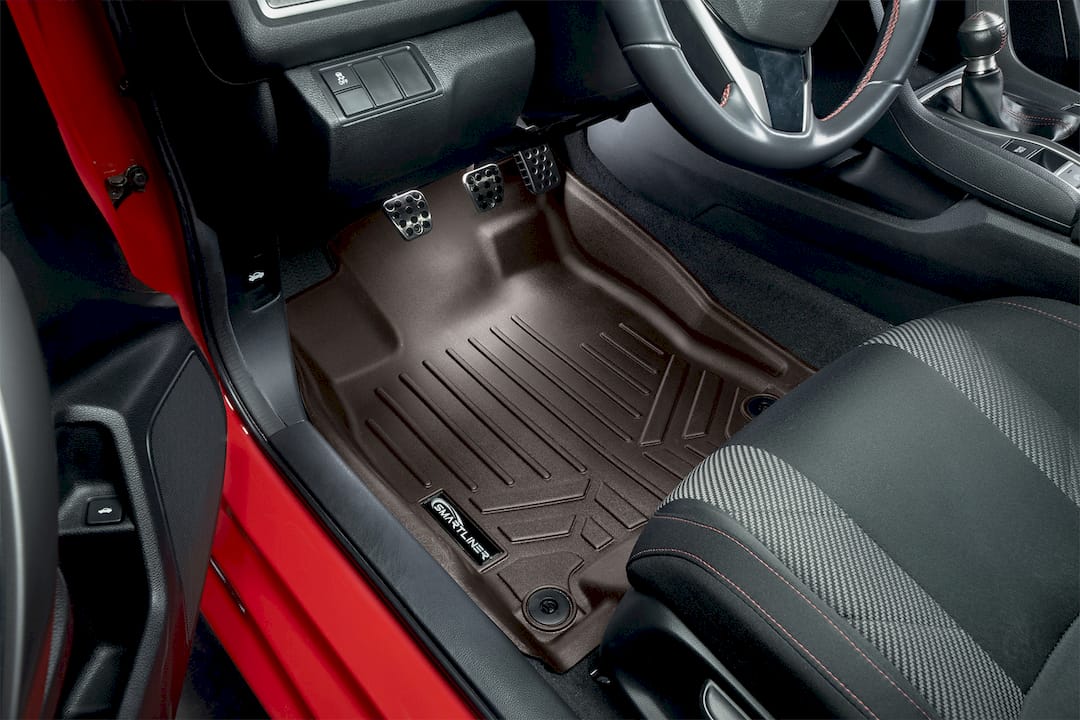
Custom-fit liners solve the car mats sliding problem at the design level, not with adhesives or hardware. Because they are shaped to the exact contours of your vehicle’s floor, they sit flush against every wall and channel, leaving no room to shift. Smartliner-usa’s custom-fit liners include non-slip textured backing and built-in anchor compatibility, which means you can engage your OEM hooks without drilling or cutting anything.
Key features to look for in any custom-fit liner:
-
Precise vehicle-specific fit that fills the footwell edge to edge
-
Non-slip textured or nibbed backing that grips carpet without adhesives
-
Raised edges for spill containment (keeps moisture away from carpet)
-
Pre-punched eyelets compatible with OEM anchor posts
-
TPE or similar modern material that stays flexible in cold and resists heat deformation
Installation steps:
-
Enter your vehicle’s year, make, and model on the product page to confirm fit.
-
Remove the old mat and vacuum the carpet.
-
Set the liner in place and press it flat. The raised edges should contact the floor walls on all sides.
-
If your vehicle has factory anchor posts, align the liner’s eyelets and press down to engage.
-
Sit in the driver’s seat, adjust to your normal position, and verify pedal clearance before driving.
Pro Tip: A liner that fits correctly will not require force to lay flat. If you are pressing down corners or the liner rocks, you have the wrong vehicle profile. Double-check your trim level, as some models have different floor configurations between base and higher trims.
For trucks and heavier-duty applications, model-specific liners for the Silverado and Sierra demonstrate how precise-fit technology scales to larger footwells.
5. Why material and backing matter: TPE vs. rubber vs. carpet
Modern thermoplastic elastomer (TPE) mats outperform older porous rubber and thin carpet mats for grip, durability, and ease of cleaning. MotorTrend’s testing found TPE mats required approximately 0.6 pounds of pulling force before the test sled broke loose, a result that reflects how well TPE backing grips carpet fibers compared to older formulations.
Why backing texture matters more than most drivers realize:
-
Rubber nibs or raised dots on the underside of a mat create dozens of small contact points with carpet fibers, distributing grip across the whole mat rather than relying on weight alone.
-
Older porous rubber loses its surface texture over time, becoming smooth and slick. Once the nibs wear flat, no amount of repositioning restores grip.
-
Thin carpet mats have no meaningful backing at all. They rely entirely on friction between two fabric surfaces, which fails quickly on wet or dusty floors.
TPE also resists heat deformation better than older rubber, so it does not curl at the edges in summer, a common cause of mat movement. For wet climates or heavy daily use, TPE is the clear material choice. For light daily driving in dry conditions, a quality rubber mat with intact nibs still performs adequately, provided the backing is not worn.
6. Safety checklist: what to avoid and how to verify pedal clearance
Safety checks are mandatory after any fix. A mat that passes a tug test while the car is parked can still shift under braking or hard cornering. Independent automotive resources consistently place pedal clearance verification at the top of any post-installation checklist.
After every fix, confirm all of the following:
-
The mat’s leading edge sits at least one inch from the base of the brake pedal with the seat in your normal driving position.
-
The mat does not lift off the floor when you press the accelerator to the floor.
-
No corner of the mat is folded under or resting on a seat rail.
-
The mat lies flat with no bubbling or raised sections near the pedal cluster.
What not to do:
-
Never stack two mats on top of each other. The combined thickness reduces pedal travel and the top mat will always slide.
-
Do not use adhesives that can fail in heat without a backup retention method.
-
Avoid overly thick aftermarket mats near the accelerator pedal, particularly in vehicles with a close pedal-to-floor relationship.
Pro Tip: If a mat shifts under your foot while driving, do not reach down to fix it. Pull over safely, stop the vehicle, and re-seat the mat before continuing. A mat caught under the brake pedal at highway speed is a genuine emergency.
7. When to stop patching and replace the mat or liner
Replace mats when the backing nibs are worn flat, anchor holes are torn or deformed, or the same fix fails within a few weeks of application. Repeated repositioning is a signal that the mat has lost the structural integrity needed to stay put.
Decision checklist:
-
Backing surface is smooth with no visible texture or nibs remaining.
-
Anchor eyelets are cracked, stretched, or missing.
-
Mat curls at the edges even after being pressed flat.
-
You have applied two or more fixes and the mat still shifts during normal driving.
-
The mat is more than three to four years old and shows visible wear.
The cost comparison is straightforward. DIY fixes, including shelf liner, Velcro, and anchor kits, typically run $5–$25 total. A quality set of custom-fit all-weather liners costs more upfront but eliminates recurring fix costs, protects the carpet underneath, and does not require replacement for years under normal use. When a mat has reached the point where fixes cost time and money every few months, replacement is the more economical choice.
Key Takeaways
The most reliable way to stop car mats from sliding is to use factory anchors first, then layer in temporary grippers or anchor kits, and replace worn mats with custom-fit all-weather liners for a permanent fix.
| Point | Details |
|---|---|
| Use factory anchors first | Check for OEM hooks before buying any aftermarket solution — they are free and the most secure option. |
| Temporary fixes have limits | Shelf liner and Velcro work short-term, but cabin heat degrades adhesive bonds; treat them as bridges only. |
| TPE backing outperforms rubber | MotorTrend testing recorded approximately 0.6 lbs of pull force before TPE mats broke loose, outperforming older rubber. |
| Replace when nibs wear flat | Smooth backing, torn eyelets, or repeated fix failures are clear signals that the mat needs replacement, not another patch. |
| Smartliner-usa custom-fit liners | Precise-fit, non-slip backed, TPE liners with OEM anchor compatibility address sliding at the design level. |
The fix that actually holds
Most drivers reach for tape or Velcro because it feels like the practical choice. The problem is that those fixes address the symptom, not the cause. A universal mat slides because it was never shaped to fit your specific floor. No amount of adhesive fully compensates for a mat that rocks on a contoured footwell or gaps at the edges.
The approach worth trusting is the one that starts with fit. When a liner matches the exact geometry of your vehicle’s floor, it has nowhere to go. Add a non-slip backing and OEM anchor engagement, and the sliding problem disappears without any ongoing maintenance. The materials matter too: TPE holds its shape in heat, cleans without damage, and maintains grip over years of use in ways that older rubber simply does not.
For drivers who have been re-seating the same mat every few weeks, the honest answer is that the mat has already told you what it needs. Replace it with something built for your vehicle, and the problem stops.
Smartliner-usa custom-fit liners: precision that prevents sliding
Worn-out universal mats and repeated DIY fixes cost more time than they save. Smartliner-usa builds custom-fit all-weather floor liners shaped to your vehicle’s exact floor profile, so they stay put without adhesives, screws, or weekly adjustments.
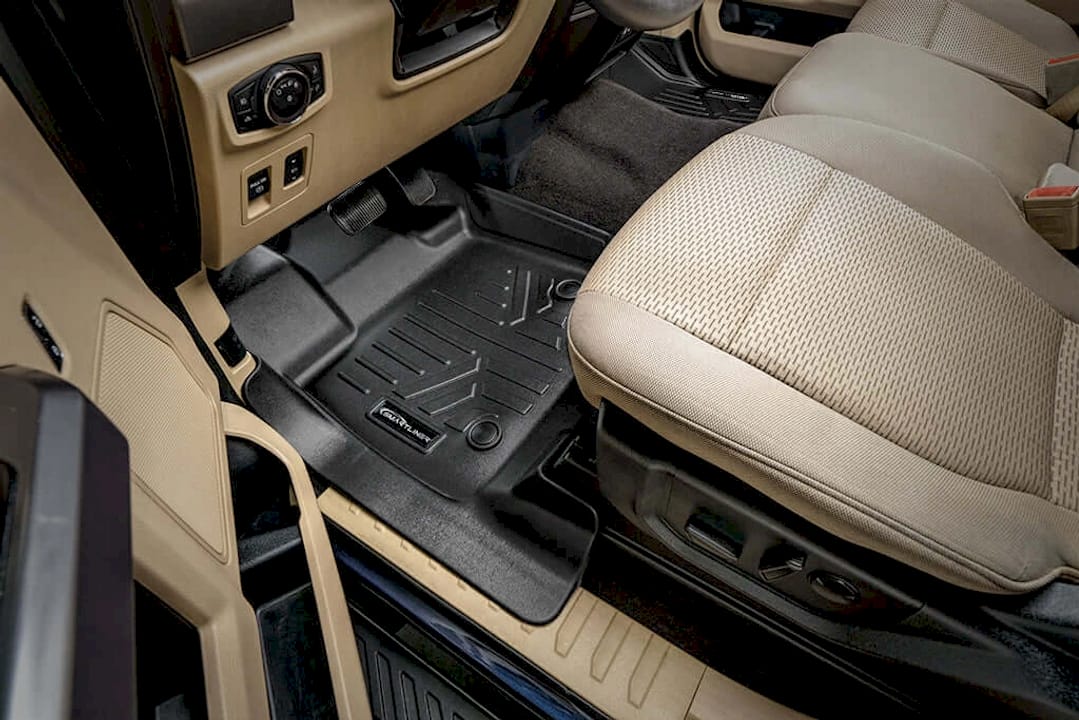
Every Smartliner-usa liner includes a non-slip textured backing, raised spill-containment edges, and pre-punched eyelets that engage your factory anchor posts directly. The material is 100% recyclable TPE, which resists heat deformation and cleans with a wipe. Whether you drive a compact, an SUV, or a full-size truck, there is a model-specific fit available. Enter your vehicle’s year, make, and model at smartliner-usa.com to confirm fit and place your order.
Useful sources
-
Custom Fit Vehicle Floor Mats & Liners | Smartliner USA
-
Best Floormats for 2026 Tested: The Best Mats, Ranked
-
3 Easy Ways to Keep Car Mats in Place - wikiHow
-
How to Keep Car Floor Mats From Sliding (4 Easy Fixes That Actually Work)
-
How To Keep Car Floor Mats From Sliding (Anchors & Grip Fixes)
-
Keeping floor mats from moving - no hook on car floor
-
SMARTLINER Custom Fit Floor Liners For 2010-2011 Equinox / Terrain (Dual Front Floor Hooks) | Smartliner USA