

For custom-fit, all-weather protection that won’t shift, crack, or leave your carpet exposed, Smartliner-usa custom-fit heavy-duty liners are the recommendation. Use the vehicle selector at checkout to confirm your year, make, model, and trim before ordering.
Pro Tip: Order using Smartliner-usa’s fit selector and double-check your trim level before adding to cart. Many vehicles share a model name but have different floor anchor configurations between trim levels.
Key Takeaways
Custom-fit thermoplastic liners from a brand with a verified fitment database deliver the best combination of protection, longevity, and ease of cleaning for most vehicle owners.
| Point | Details |
|---|---|
| Fit comes first | Confirm year, make, model, and trim level before ordering to avoid anchor and pedal clearance issues. |
| TPE outlasts rubber | Premium TPE liners with UV stabilizers can last 7–10 years in heavy-use conditions versus 3–6 years for rubber. |
| Raised lips contain spills | Look for liners with 1–2 inch containment lips and channeling that directs liquid away from the pedal area. |
| Clean often, dry fully | Rinse with mild soap and let liners air-dry completely before reinstalling to prevent mold under the mat. |
| Smartliner-usa recommendation | Smartliner-usa’s custom-fit liners use recyclable thermoplastic materials and model-specific CAD data for precise fit. |
Table of Contents
- What do “heavy duty” and “all-weather” actually mean in a floor mat?
- Smartliner-usa heavy-duty liners: what you get
- How to choose the right heavy-duty floor mat for your vehicle
- Custom-fit vs universal: how to verify fit and install correctly
- How to clean and care for heavy-duty mats so they last
- Warranties, lifespan, and when to replace your mats
- What independent testing reveals about heavy-duty liners
- Why trim level and year matter more than model name alone
- How brand reputation and customer service affect your purchase
- Environmental and safety standards: what to look for
- Return policies and satisfaction guarantees: what to confirm before you buy
- Order Smartliner-usa liners: fit selector, shipping, and guarantee
- Sources
What do “heavy duty” and “all-weather” actually mean in a floor mat?
These terms describe a specific category of durable floor liners built to contain liquid, resist cracking in cold, and survive years of heavy foot traffic. They’re not the same as standard carpet mats, which absorb spills rather than contain them.
Material families:
- TPE (thermoplastic elastomer): Flexible, lightweight, and recyclable. TPE mats offer better temperature stability, easier cleaning, and lower VOC off-gassing compared with many rubber mats, making them a strong long-term choice.
- TPO / HDTE (thermoplastic olefin / high-density thermoplastic elastomer): Stiffer formulations used in molded liners. Excellent shape retention and abrasion resistance.
- Rubber: Heavy, durable, and naturally anti-slip due to weight. Rubber mats resist abrasion well but can soften in high heat and stiffen in extreme cold compared with modern thermoplastics.
Coverage types:
- Custom-fit full liners: Molded front and rear sets that cover the entire cabin floor, including the hump between rows.
- Trim-to-fit universal mats: Cut to approximate size; less precise coverage, lower cost.
- Cargo trays: Rear cargo area protection, often sold separately or as part of a full-cabin set.
- Seatback protectors: Vertical coverage behind front seats, useful for pet owners and families.
Design features that matter:
- Raised lip depth (typically 1–2 inches for serious containment)
- Channeling that directs liquid away from the pedal area
- Reinforced heel pad where wear concentrates
- Anti-slip backing or retention nubs
- Anchor/retention system compatibility with factory floor hooks
| Feature | TPE / TPO | Rubber |
|---|---|---|
| Temperature stability | Excellent across a wide range | Moderate; softens in heat, stiffens in cold |
| VOC / odor | Low off-gassing | Can off-gas, especially when new |
| Weight | Lighter | Heavier |
| Recyclability | Often 100% recyclable | Rarely recyclable |
| Expected lifespan | Up to 7–10 years with UV stabilizers | 3–6 years in heavy-use conditions |
| Cleanability | Quick-dry, chemical-resistant | Absorbent edges; slower to dry |
Smartliner-usa heavy-duty liners: what you get
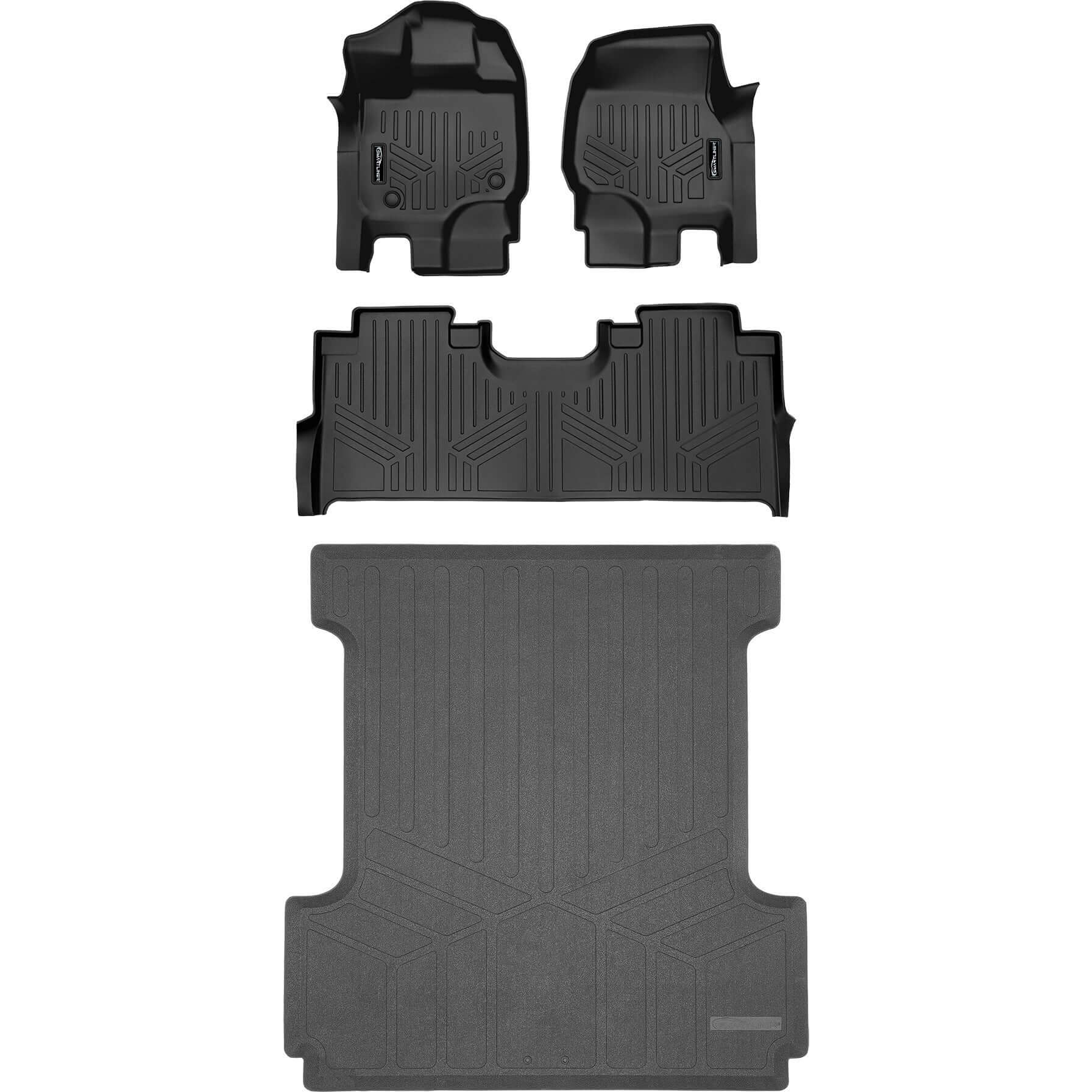
Smartliner-usa produces custom-fit floor liners and cargo liners built from 100% recyclable thermoplastic materials. Every liner is shaped to match a specific vehicle’s floor geometry, not approximated from a generic mold.
Core protective features:
- Raised containment lips that prevent liquid from reaching carpet
- Non-slip backing that grips the factory floor without adhesive
- High-wear heel pad reinforcement at the driver’s footwell
- Full-coverage design that extends into door sill areas on most models
Fit and specs:
Smartliner-usa uses vehicle-specific CAD data to produce contours that align with factory floor anchor points. The material profile varies by model but consistently delivers a rigid-enough structure to hold its shape under load while remaining flexible enough to remove for cleaning. The fit selector on the product page walks you through year, make, model, and trim, then returns the exact liner set for your configuration.
Installation:
Drop-in installation. Liners seat onto factory retention hooks or anchor posts without tools. No trimming required on custom-fit sets. The non-slip backing adds a second layer of security on vehicles without floor hooks.
Warranty:
Smartliner-usa backs its liners with a product warranty covering defects in materials and workmanship. Check the product page for the specific terms on your model.
Pro Tip: If your vehicle has an unusual floor post configuration (common on older Nissan Armada and Titan models), look for the product note specifying “dual driver’s side floor posts” to confirm the liner matches your anchor layout. Smartliner-usa lists these variations explicitly on model-specific pages like the 2008–2010 QX56 / Armada / Titan liner.
How to choose the right heavy-duty floor mat for your vehicle
Fit and safety come first. A mat that slides under the brake pedal is a hazard, not a protection product. After that, material, coverage, and price follow in that order.
Priority checklist:
- Confirm anchor system compatibility with your vehicle’s factory floor hooks before ordering.
- Verify pedal clearance: the mat must not contact or restrict the accelerator or brake pedal.
- Choose custom-fit over universal whenever your vehicle is supported. The coverage difference is significant.
- Match the material to your climate: TPE/TPO for cold climates where rubber stiffens; either works in moderate conditions.
- Check return policy and fit guarantee before purchasing from any source.
Material trade-offs:
TPE and TPO liners are lighter, easier to clean, and offer better chemical resistance and quicker drying than older rubber formulas. Rubber mats carry more weight, which can help them stay put on slick vinyl floors, but that advantage disappears when the vehicle has factory anchor hooks.
Red flags to avoid:
- No mention of retention anchors or anti-slip system
- Fitment listed only as “universal” with no vehicle-specific option available
- No VOC or odor information on the product page
- Stacking a new mat on top of an existing mat (doubles the slip risk)
- Vague fitment descriptions with no year/trim breakdown
Price ranges:
Universal trim-to-fit mats typically run $20–$60 for a front pair. Custom-fit full-cabin liner sets from quality thermoplastic brands generally fall in the $80–$180 range, depending on vehicle size and coverage area. Cargo liners add $40–$80 on top of a cabin set.
Custom-fit vs universal: how to verify fit and install correctly
Custom-fit liners are shaped from vehicle-specific data. Universal mats are cut to a general shape and require the buyer to trim them to fit. The practical difference is coverage: a custom liner reaches the door sill edges and wraps the transmission tunnel; a universal mat leaves gaps.
When to choose custom-fit:
Choose custom-fit whenever your vehicle is listed in the brand’s fitment database. The contour match prevents bunching, covers more floor area, and aligns with factory anchor points.
When universal makes sense:
Universal mats work for older or rare vehicles not covered by custom-fit databases, or as a short-term solution while waiting for a custom set.
Fit verification steps:
- Use the brand’s vehicle selector: enter year, make, model, and trim level exactly.
- Cross-reference the product page’s anchor diagram with your vehicle’s floor hook positions.
- If no selector is available, measure the driver’s footwell length and width at the widest point, the rear footwell at its deepest point, and the cargo area floor length and width.
- Check whether your trim level includes a center console floor post, which changes the liner’s cutout pattern.
Installation steps:
- Remove existing mats and vacuum the floor.
- Locate factory anchor posts or retention clips.
- Align the liner’s anchor grommets with the floor posts and press down firmly.
- Confirm the liner lies flat with no bunching near the pedals.
- Sit in the driver’s seat and press each pedal through its full range of motion to confirm clearance.
Fit complications to check:
- EV and hybrid floors: Some EVs have flat, featureless floors with no anchor posts. Look for liners with anti-slip backing rated for smooth surfaces.
- Vinyl or rubber factory floors: Heavier liners with textured backing grip better than lightweight TPE on slick surfaces.
- Trim-level variations: Sport trims, AWD models, and packages with under-seat storage often have different floor hook positions than base trims.
For compact cars, Smartliner-usa covers models like the 2015–2021 Honda Fit with full-cabin liner sets, confirming that small vehicles aren’t an afterthought in the fitment database.
How to clean and care for heavy-duty mats so they last
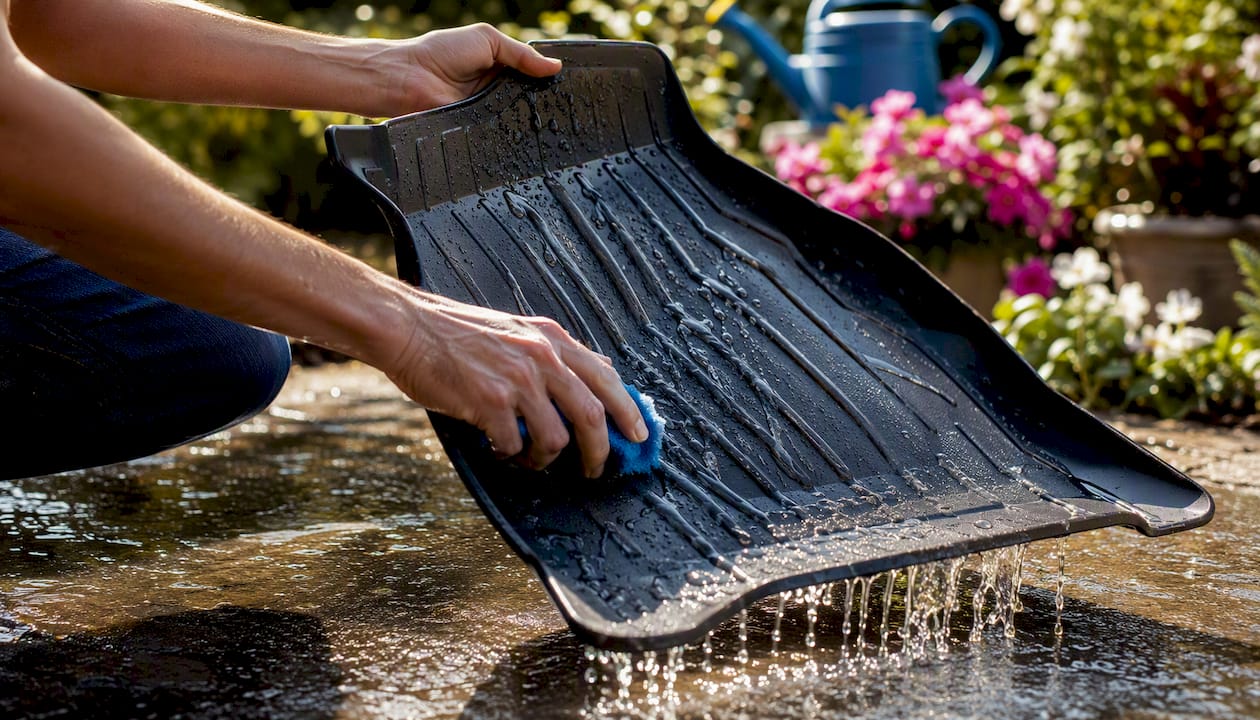
The cleaning process for thermoplastic liners is straightforward: remove, rinse, dry, reinstall. The containment features that make these liners effective also make cleaning faster than dealing with soaked carpet mats.
Cleaning steps:
- Remove the liner from the vehicle and shake out loose debris.
- Rinse with a garden hose or pressure washer on a low setting.
- Scrub with mild soap and a stiff brush if mud or grime has dried in the channels.
- Rinse thoroughly and stand the liner upright to air-dry completely before reinstalling.
Dos and don’ts:
- Do clean liners every 4–6 weeks during winter or after off-road use.
- Do use mild dish soap or an automotive interior cleaner.
- Don’t use harsh solvents (acetone, bleach) that can degrade the thermoplastic surface.
- Don’t dry liners in a clothes dryer or with a heat gun; sustained heat can warp the molded contours.
- Don’t reinstall a wet liner. Trapped moisture under the liner promotes mold on the carpet beneath.
Pro Tip: Stand wet liners against a wall or fence in the sun for 20–30 minutes. Thermoplastic materials dry quickly in open air, and sunlight won’t damage a quality TPE liner the way it would a rubber mat with a fabric backing.
Seasonal care:
In winter, clean liners weekly if you’re driving on salted roads. Salt residue left in the channels can accelerate wear on the liner’s surface texture over time. In summer, a monthly rinse is usually sufficient. If you want to preserve a pristine set for summer driving, a second set of liners for winter use is a practical approach.
Warranties, lifespan, and when to replace your mats
Premium thermoplastic liners built with UV stabilizers and anti-aging compounds can last roughly 7–10 years under heavy-use conditions. Budget rubber mats typically show significant wear within a few years, particularly in climates with wide temperature swings.
What a strong warranty covers:
- Defects in materials (cracking, delamination, warping under normal use)
- Manufacturing defects in the anchor grommet or retention system
- A clear replacement process with no excessive documentation burden
Replacement signs:
- Cracked or split edges that no longer contain liquid
- Backing has worn smooth and the liner slides on the floor
- Raised lips have compressed or deformed and no longer hold spills
- The liner has shifted and contacts the pedal area
- Visible mold or permanent odor that cleaning doesn’t resolve
Preserving warranty validity:
Follow the manufacturer’s cleaning instructions. Stacking a second mat on top of a liner voids most warranties and creates a slip hazard. Using harsh chemicals that degrade the surface can also affect warranty claims. Keep the original packaging or order confirmation as proof of purchase.
What independent testing reveals about heavy-duty liners
Car and Driver’s hands-on testing of top floor mats identifies construction and material choice as the primary drivers of real-world liner performance. Specifically, variable thickness across the liner (thicker at the heel pad, thinner at the edges for flexibility), reinforced sidewalls, and taller containment lips consistently separate high-performing liners from average ones.
Material performance in extreme conditions:
| Material | Cold performance | Heat performance | Chemical resistance | Lifespan (heavy use) |
|---|---|---|---|---|
| TPE | Remains flexible in cold weather | Stable up to high temperatures | High | 7–10 years |
| TPO / HDTE | Slightly stiffer in cold | Excellent shape retention | High | 6–10 years |
| Rubber | Stiffens significantly in cold | Softens in high heat | Moderate | 3–6 years |
What test results mean for your climate:
- Snow and ice regions: TPE’s cold-weather flexibility is a clear advantage. Stiff rubber liners crack at the edges when bent during removal in freezing temperatures.
- Desert and high-heat climates: TPO’s heat stability keeps the liner from softening and losing its molded shape on a hot dashboard or in a parked vehicle.
- Coastal and muddy conditions: Chemical resistance matters here. Salt spray and organic debris accelerate degradation in rubber; TPE and TPO resist both.
When a product page uses marketing language without test data, look for these specifics: stated material type (not just “heavy-duty rubber”), wall height in inches or millimeters, heel pad thickness, and anchor system type. A product page that lists none of these is describing a commodity mat, not a precision liner.
Truck owners pairing floor protection with other practical upgrades can find complementary resources at Wheel Light Express’s truck upgrade guide for additional aftermarket considerations.
Why trim level and year matter more than model name alone
Two vehicles with the same model name and year can require completely different liner shapes. This is one of the most common fitment errors buyers make.
Common sources of variation:
- AWD vs FWD: All-wheel-drive models often have a different transmission tunnel profile and sometimes an additional floor anchor point.
- Trim packages: Sport, Limited, and Platinum trims frequently include under-seat storage drawers, different console configurations, or additional floor hooks not present on base trims.
- Mid-cycle refreshes: A model sold across a five-year span may have had a floor redesign in year three. The liner for a 2017 model may not fit a 2019 of the same name.
- 3rd-row configurations: SUVs with optional third-row seating have different cargo floor dimensions than the same model without it.
Smartliner-usa addresses this directly by listing trim-specific and configuration-specific product variants. The 2017–2018 Armada / 2011–2013 Infiniti QX56 / 2014–2018 QX80 liner page is a clear example: the product covers three related nameplates across multiple model years, with explicit notes on which configurations are supported.
Always confirm trim level, drivetrain, and any factory-installed packages before finalizing an order.
How brand reputation and customer service affect your purchase
Material specs matter, but so does what happens after you order. A liner that arrives with the wrong fitment, or a warranty claim that goes unanswered, erases the value of the product itself.
What to look for in a brand’s service record:
- Transparent fitment databases with trim-level detail, not just model-year ranges
- Responsive customer support that can confirm fit before you order
- Clear return and exchange policies that don’t require you to prove a manufacturing defect
- Consistent customer reviews that specifically mention fit accuracy and ease of cleaning
Smartliner-usa’s customer feedback consistently highlights fit accuracy and ease of cleaning as the two strongest points. The brand’s direct-to-consumer model means support questions go to the source, not a third-party retailer who may not know the product’s fitment nuances.
Environmental and safety standards: what to look for
VOC (volatile organic compound) emissions are the primary environmental and safety concern with interior vehicle products. New mats that off-gas strongly in a closed cabin are a comfort issue and, at high concentrations, a health concern.
What the standards address:
- VOC emissions: TPE and TPO liners generally off-gas at lower levels than some rubber compounds, particularly in the first weeks after installation. Look for products that note low-VOC or odor-free formulations.
- Non-toxicity: Liners marketed as non-toxic and free of heavy metals (lead, cadmium) are the safer choice for families and pet owners.
- Recyclability: Smartliner-usa’s 100% recyclable material claim addresses end-of-life disposal, which matters for buyers who replace liners every few years.
- REACH and RoHS compliance: These European standards for chemical safety are increasingly referenced by quality thermoplastic manufacturers as a benchmark, even for products sold in the U.S. market.
No universal federal standard mandates VOC testing for automotive floor mats in the U.S., so the burden falls on the buyer to ask. If a product page lists no material composition or environmental information, that’s a gap worth questioning before purchase.
Return policies and satisfaction guarantees: what to confirm before you buy
A return policy is part of the product’s value. Custom-fit liners that don’t fit correctly due to a fitment database error should be returnable at no cost to the buyer.
Questions to ask before ordering:
- What is the return window (30 days is standard; 60 days is better for seasonal purchases)?
- Does the brand cover return shipping if the fitment was incorrect on their end?
- Is there an exchange option, or only a refund?
- Does the warranty require registration, or is it automatic with purchase?
Smartliner-usa’s direct-to-consumer model gives buyers a single point of contact for returns, exchanges, and warranty questions. Purchasing through a third-party marketplace can add a layer of complexity to returns that purchasing directly avoids.
Why I trust custom-fit thermoplastic liners for serious use
The case for custom-fit thermoplastic liners isn’t complicated once you’ve cleaned a set after a muddy trail run. The liquid stays in the channels, the liner lifts out in one piece, and the carpet underneath is dry. That’s the whole argument.
What I’ve come to trust specifically is the combination of a precise contour fit and a retention system that actually engages the factory floor hooks. A liner that slides even slightly toward the pedals is a problem waiting to happen. The recyclable TPE construction is a practical bonus: it doesn’t stiffen in January or warp in a hot parking lot in August, and it cleans in minutes rather than hours.
For anyone who drives in real conditions, whether that’s winter commutes, weekend off-roading, or just hauling kids and dogs, a quality custom-fit liner is the one interior upgrade that pays for itself the first time it saves your carpet.
Order Smartliner-usa liners: fit selector, shipping, and guarantee
Smartliner-usa’s custom-fit floor mats and cargo liners cover thousands of vehicle configurations, from compact cars to full-size SUVs and trucks. Ordering takes three steps: select your year, make, model, and trim using the fit selector; confirm the anchor configuration matches your vehicle; and check out directly on the Smartliner-usa site.
For cargo protection, the Smartliner cargo liner category covers rear cargo areas for SUVs, crossovers, and trucks with model-specific contours. Truck owners looking to pair floor protection with other practical upgrades can also explore F-150 and Super Duty puddle lights as a complementary accessory.
Smartliner-usa ships directly to your door, and the brand’s warranty and return support is handled through the same direct channel. If you have a fitment question before ordering, contact support through the website before placing the order.
Sources
- Best Car and Truck Floor Mats for 2026, Tested
- The Ultimate Guide to Car Floor Mats: How to Choose the Best for Your Vehicle in 2026 - Automotive Tools Guide
- Difference Between Rubber And Tpe Car Floor Mats - Jeep Car Info
Recommended
- SMARTLINER Custom Fit Floor Liners For 17-18 Armada / 11-13 Infiniti QX56 / 2014-2018 QX80 | Smartliner USA
- Smart Trim™ Floor Liners For 2010-2011 Equinox / Terrain (Dual Front Floor Hooks) | Smartliner USA
- Omnichannel Live Chat Widget
- Smart Trim™ Floor Liners For 2007-2014 Tahoe / Suburban / Yukon / Yukon XL / Denali (No Hybrid Models) | Smartliner USA