

Floor mat retention clips are the small fasteners, knobs, hooks, or spike anchors that lock a floor mat to the vehicle’s carpet so it can’t slide into the pedals. The main styles are knob/twist, hook, spike/universal anchor, and two-piece snap. If you’re missing one, your first move is to check your existing grommet or anchor style and buy a matching OEM retainer or a universal anchor kit built for that fit.
TL;DR:
- Matching OEM grommets or hooks are essential for secure mat retention, with universal spike anchors only suitable when factory fittings are absent.
- Proper identification of the retainer type involves checking for factory grommets, hooks, and measuring diameter before purchasing.
- Installing knob or twist retainers requires alignment, pressing down, and a quarter turn to lock, while hook and spike methods involve pressing and probing for wiring underneath.
- Confirm pedal clearance and proper locking at every mat installation or swap to prevent pedal interference and ensure safety.
- Smartliner offers custom-fit liners designed around specific vehicle retention hardware, reducing the need for aftermarket clips and ensuring proper compatibility.
Table of Contents
- Which Floor Mat Retention Clips Should You Buy?
- How Do You Identify the Retainer Type Your Vehicle Needs?
- How Do You Install Knob, Hook, and Spike-Style Retainers?
- Why Pedal Clearance and OEM Fit Guidance Matter
- Smartliner Best Practices for Long-Lasting Mat Retention
- Smartliner Liners Built Around Your Retention System
- A Safety-First Note From the Author
- Sources
- FAQ
Which Floor Mat Retention Clips Should You Buy?
Buying the wrong clip is the most common mistake DIYers make, and it usually comes down to skipping one step: identifying what your vehicle already uses before shopping for a replacement.
Knob/twist retainers are the standard on many factory floor mats. A plastic or metal knob rises from the carpet, and the mat’s grommet has a matching triangle cutout that locks with a quarter turn. If yours is broken, order the OEM replacement rather than a generic substitute, since the twist mechanism and grommet size are often model-specific.
Hook-style retainers anchor to the floor pan and grip a die-cut hole or eyelet in the mat. They’re common in trucks and SUVs and tend to be more forgiving of mat thickness than knob systems.
Spike or universal anchors work on almost any mat because you cut the hole yourself, which makes them the go-to fix when your mat has no factory grommet at all.
Two-piece snap assemblies use a lower collar mounted to the floor and an upper cover that clamps the mat between them, a mechanical lock rather than a twist or hook.
Before you buy, run through this checklist:
- Measure the grommet’s inside diameter, not just the mat thickness.
- Match material and thickness limits (rubber liners often need longer anchors than thin carpet mats).
- Confirm compatibility with your mat brand, since not every retainer fits every grommet shape.
- Check for an OEM part number before defaulting to universal kits.
How Do You Identify the Retainer Type Your Vehicle Needs?
A five-minute inspection saves you from ordering the wrong part twice. Work through it in order:
- Check for pre-cut grommets. Flip the mat over and look for a factory hole with a triangle-shaped notch. That notch is the signature of a knob/twist system.
- Lift the carpet edge near the pedals. Feel for a metal hook or eyelet mounted to the floor pan. If you find one, you’re working with a hook-style retainer.
- Measure the grommet’s inside diameter with a tape measure or calipers, and jot down the number before you shop.
- Look up your OEM part number using your vehicle’s year, make, and model if the retainer is factory-installed and cracked or missing.
- Default to a universal anchor kit only if there’s no factory grommet, hook, or part number available.
Pro Tip: Snap a photo of the grommet or hook before removing the old mat. Retailers and parts counters can often confirm the right clip faster from a picture than from a verbal description.
OEM part numbers are worth the extra step when your vehicle has a known fit issue. Toyota’s own installation guidance stresses using mats designed for your specific model and year, precisely because grommet spacing and knob height vary between trims.
How Do You Install Knob, Hook, and Spike-Style Retainers?
Installation differs by clip type, but each one follows a short, repeatable sequence. Set aside some time per mat, and gather a Phillips screwdriver, an awl or scratch tool, and the anchor kit’s included hole cutter if you’re going the universal route.
Knob/twist installation:
- Align the mat’s grommet directly over the floor-mounted knob.
- Press the mat down flat over the knob.
- Twist the knob a quarter turn to lock it in place.
- Verify the triangle alignment marks on the knob and grommet match up, confirming a secure lock.
This quarter-turn method is the standard OEM procedure used across many vehicle lines for exactly this reason: it’s fast, and the triangle marks give you a visual confirmation the mat is actually locked, not just resting on top of the knob.
Hook-style installation:
- Seat the floor-mounted hook clip under the carpet edge if it isn’t already anchored.
- Position the mat’s hole directly over the hook.
- Press the mat down firmly without bending or forcing the hook, which weakens its grip over time.
Spike or universal anchor installation:
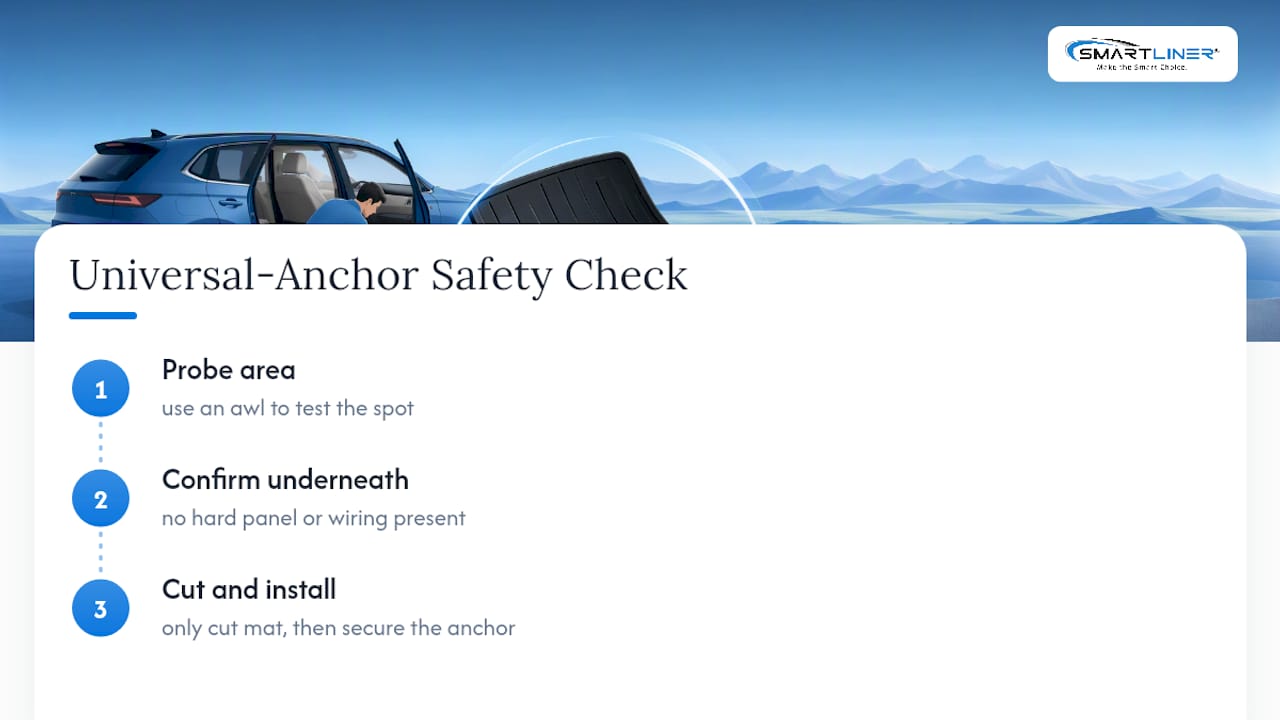
- Probe under the carpet with an awl to confirm there’s no wiring, sensor, or hard panel beneath your intended anchor point.
- Use the kit’s hole cutter to punch a clean hole through the mat at the marked spot.
- Pre-engage the spike through the carpet and floor pan.
- Stomp or press firmly to seat the spike fully, then tighten the cap or washer on top.
Two-piece snap assemblies install in reverse order from the others: seat the lower annular collar against the floor first, then lay the mat over it and clamp the upper cover down until it clicks. Once any of these are installed, press each corner of the mat and confirm it lies flat with no lift near the pedals; that flatness check matters as much as the lock itself.
Why Pedal Clearance and OEM Fit Guidance Matter
Loose or improperly retained mats are a documented pedal interference risk, which is exactly why manufacturers and safety regulators keep repeating the same warnings in service bulletins. A service bulletin on floor mat retainers ties proper retention directly to safe pedal operation, not just tidy carpets.
Use mats designed for your vehicle’s specific model and year, secure them with retainers at every attachment point, and never install more than one mat stacked in the driver’s position.
That guidance comes straight from Toyota’s own support documentation, and it applies well beyond one brand. Before you drive off:
- Press the accelerator and brake pedal through their full range of motion with the mat installed.
- Confirm the mat edge doesn’t curl or bunch near the pedal box.
- Check that all four corners are locked, not just the front two.
OEM replacements matter most on vehicles where grommet spacing is tight or non-standard; universal anchors are perfectly acceptable everywhere else, as long as you’ve probed for wiring and structural panels first. Installing anchors without checking underneath the carpet risks puncturing wiring harnesses or sensor lines, and cutting into bonded hardboard flooring can crack the substrate.
Smartliner Best Practices for Long-Lasting Mat Retention
A fit test beats a guess every time. Before committing to any spike or universal anchor, probe the target area with an awl, confirm there’s no hard panel or wiring directly beneath it, and only then cut the mat. Smartliner’s own installation guidance treats this probing step as non-negotiable, since drilling blind into a hardboard floor or a sensor line turns a five-minute fix into a repair bill.
Most retention complaints trace back to one of a few fixable causes. A clip that’s popped loose usually just needs re-seating rather than replacing. A cracked knob cap is a cheap swap once you know the OEM part number. If a mat keeps bunching despite a solid lock, the shape of the mat itself, not the clip, is often the real problem, and a custom-fit liner solves that where a universal mat can’t.
Maintenance is just as simple: whenever you pull mats for cleaning, inspect each clip for cracking or looseness, and re-tighten or replace worn anchors before they fail on the road. For general interior upkeep, pairing that habit with proper door jamb cleaning keeps grime from working its way back onto a freshly secured mat.
Pro Tip: Keep a spare knob cap or two in your glovebox. They’re small, cheap, and the part most likely to crack from repeated foot traffic.
Smartliner Liners Built Around Your Retention System
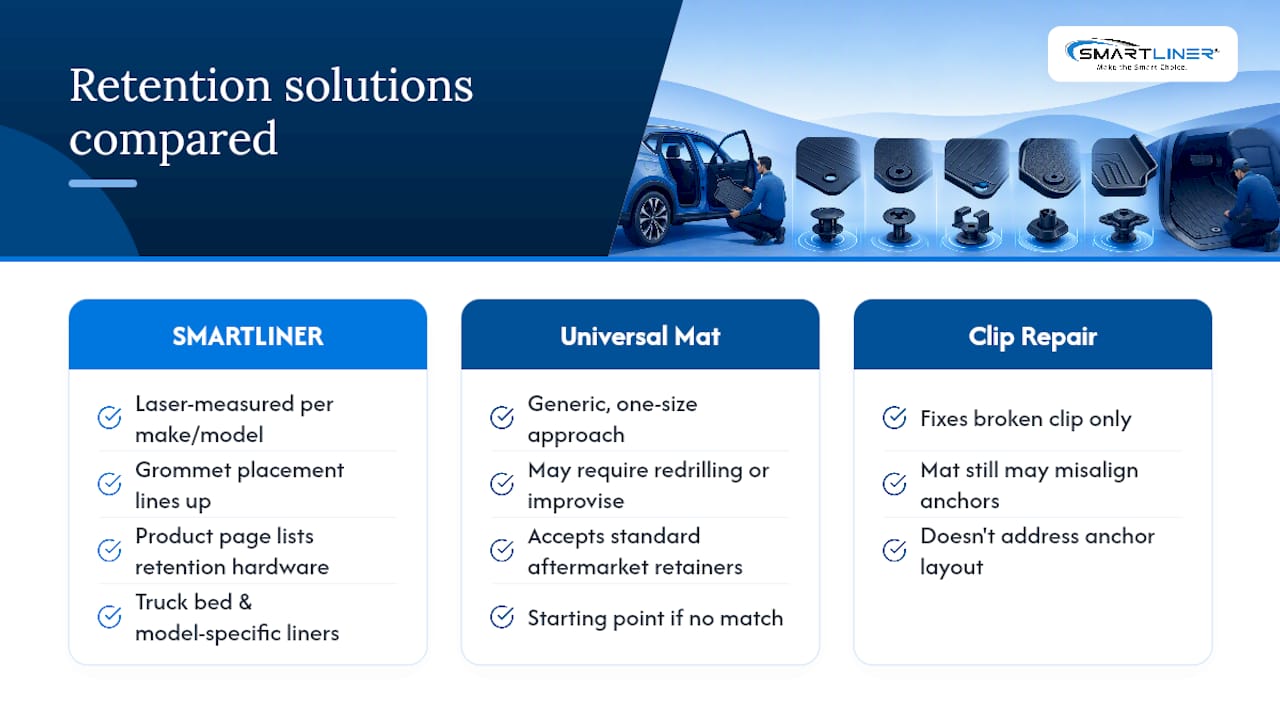
Fixing a broken clip only solves half the problem if the mat itself doesn’t match your vehicle’s anchor layout. SMARTLINER Floor Liners are laser-measured for specific makes and models, so grommet placement lines up with your factory knobs, hooks, or anchors instead of forcing you to redrill or improvise.
The lineup covers more than passenger cabins. SMARTLINER Truck Bed Mat Liners are built for the punishment of daily hauling, and the Smart Trim™ Floor Liners For 2010-2011 Equinox / Terrain are engineered specifically around that model’s dual front floor hooks, so the retention points line up without any guesswork.
Each custom-fit floor liner product page lists the retention hardware it’s designed to work with, right alongside the vehicle-specific fitment details, so you can confirm compatibility before you order. If your current mat has no matching anchor style at all, browsing the universal fit floor mat options gives you a starting point that still accepts standard aftermarket retainers. Check your vehicle’s fitment on the product page, and order the liner built for your exact retention layout instead of forcing a universal mat to work around it.
A Safety-First Note From the Author
Most mat retention failures I see aren’t caused by cheap clips. They’re caused by skipping the inspection step and guessing at a fit. Take the extra five minutes to identify your grommet or anchor type before you order anything, and always confirm pedal clearance after installation, not just once but every time you swap mats.
If you’re unsure which retention style your vehicle uses, Smartliner’s fit resources and support team can help you match a liner to your exact anchor layout. When in doubt, ask before you cut.
— Marty
Sources
The installation steps and safety warnings in this guide draw on documented OEM and vendor procedures rather than guesswork. NHTSA and OEM service bulletins outline the knob-and-hook retention procedures used across many vehicle lines, Toyota’s support documentation covers OEM cautions in plain language, and Eagle Klaw’s vendor install guide walks through universal spike-anchor installation step by step. Smartliner’s own maintenance and installation posts round out the practical, hands-on side of the process.
- Floor mat installation during PDS (OEM/NHTSA service bulletin)
- How do I install the floor mats in my vehicle? (Toyota support)
FAQ
What Can I Use to Keep Floor Mats in Place?
Match your mat’s existing grommet or anchor style, a knob, hook, or spike, with a compatible retainer rather than swapping types. If your factory hardware is broken or missing, a custom-fit liner built for your vehicle’s dual hooks or knobs solves the fit problem at the source.
How Do I Install Floor Mat Retainer Clips?
For knob/twist retainers, align the grommet over the knob, press down, and twist a quarter turn until the triangle alignment marks line up. For hook-style retainers, seat the floor hook first, then press the mat’s hole down over it without bending the hook.
What Is a Floor Mat Retainer?
A floor mat retainer is the clip, knob, hook, or anchor that locks a mat to the vehicle’s floor pan so it can’t shift toward the pedals while driving. Common types include knob/twist, hook, spike/universal anchor, and two-piece snap assemblies, each suited to a different grommet or mounting style.
How Do I Get Aftermarket Mats to Stay in Place?
Check whether your mat has a factory grommet or hole that matches an existing knob or hook; if it does, use the matching OEM-style retainer instead of a generic clip. If there’s no factory grommet, a universal spike anchor kit works, but only after you’ve probed under the carpet for wiring or hard panels, as Eagle Klaw’s install guide recommends.
Does Smartliner Sell Replacement Retention Clips?
Smartliner’s custom-fit floor liners are designed to align with various vehicle retention hardware instead of offering standalone clips for sale. Current pricing and fitment details can be found on the product pages on the company’s website.