

A model-specific, all-weather floor liner is the best choice for most Jeep Wrangler owners, and Smartliner-usa builds that exact product for nearly every generation on the road. Universal rubber mats and carpeted inserts have their place, but neither matches the containment depth or precision fit that a Wrangler’s mud, snow, and river-crossing lifestyle demands.
Here’s how to sort yourself into the right category before you spend a dollar:
- Daily drivers who off-road on weekends should buy custom all-weather liners with raised edges and deep tread channels.
- Owners who tow, camp, or haul gear need liners paired with a matching cargo liner for full cabin protection.
- Budget-first buyers replacing worn factory mats can start with universal rubber mats, understanding they’ll need trimming and won’t seal every gap.
- Show-truck or garage-queen owners who rarely see rain or trail mud can get away with carpeted mats for looks alone.
Before buying anything, confirm the seller states a specific year range, door count, and subwoofer configuration for your Wrangler, and check whether the warranty covers cracking or fading, not just shipping damage.
Key Takeaways
Model-specific all-weather liners built from thermoplastic elastomer outperform universal or carpeted mats on containment, fit, and long-term durability for Wrangler owners.
| Point | Details |
|---|---|
| Fit precision beats price | Confirm your exact year, door count, and subwoofer configuration before buying any liner. |
| Material matters for climate | Thermoplastic elastomer resists cracking in cold and stays flexible through winter salt exposure. |
| Retention hardware prevents hazards | A liner without factory snap stud anchors can slide and interfere with pedal travel. |
| Custom fit protects resale value | Clean factory carpet under a proper liner makes a measurable difference at trade-in inspection. |
| Smartliner-usa covers multiple generations | Model-specific listings span JK, JL, and Wrangler Unlimited configurations with recyclable material construction. |
Table of Contents
- What Are the Best Wrangler Floor Mats for Different Driving Styles?
- How Do You Check Fit Before Buying Wrangler Floor Mats?
- How Do You Choose the Right Wrangler Floor Mats for Your Budget?
- How Do You Clean and Maintain Wrangler Floor Mats?
- Why Smartliner-usa Fits the Recommendation for Wrangler Owners
- What Do Wrangler Owners Actually Recommend in Forums?
- How Do Leading Wrangler Floor Mat Brands Compare?
- What Should You Expect to Pay for Wrangler Floor Mats?
- Do Wrangler Floor Mats Work With Seat Covers and Pedal Upgrades?
- Should You Buy From a Jeep Dealer or a Third-Party Manufacturer?
- Are Custom Floor Mats Worth It Over Universal Options?
- What Owners Get Wrong About Floor Mat Shopping
- Get Model-Specific Wrangler Protection From Smartliner-usa
- Frequently Asked Questions
- Sources
What Are the Best Wrangler Floor Mats for Different Driving Styles?
Three categories dominate the Wrangler floor mat market, and each one trades price against protection in a different way.
Custom all-weather liners are molded from thermoplastic elastomer, a flexible rubber-like polymer that resists cracking in cold weather and softening in heat. They’re built from a laser-scanned model of your Wrangler’s specific floor pan, which means the raised edges follow the actual contours of the footwell instead of sitting flat like a generic tray. That raised lip, often an inch or more in the deepest channels, is what keeps a spilled coffee or a boot full of trail mud from sliding onto the carpet underneath. Expect to pay more than a basic rubber mat, but the coverage and cleaning convenience (a quick hose rinse and shake) make them the standard pick for anyone who takes a Wrangler off pavement, through snow, or near salted winter roads. Owners in forum threads consistently point to containment depth and edge height, not decorative patterns, as the real differentiator in messy conditions.
Universal rubber mats cost less upfront and show up in nearly every auto parts store. The catch is fit. A Wrangler’s footwell shape changes by generation and trim, so a universal mat usually needs trimming with scissors or a utility knife to avoid bunching near the pedals. Even after trimming, gaps along the transmission tunnel or door sill remain common, which defeats the purpose of buying a mat in the first place. They’re a reasonable stopgap, not a long-term solution.
Carpeted mats matter when you care more about matching your interior’s look than stopping a spill. They trap moisture instead of channeling it away, and a wet carpeted mat left in a closed cabin can start smelling within a day or two. Reserve these for a Wrangler that mostly lives in a garage.
Cargo areas need the same logic applied in reverse: a dedicated cargo liner protects the rear cabin the way a floor liner protects the front, and skipping it leaves your trunk space exposed to the same mud and gear scuffs you just solved up front.
How Do You Check Fit Before Buying Wrangler Floor Mats?
Wrangler generations differ enough under the seats that a mat built for one won’t sit right in another, and getting this wrong is the single most common buying mistake.
The JK (2007 to 2018), JL (2018 to 2026), and older TJ (1997 to 2006) each have distinct floor pan shapes, transmission tunnel widths, and seat mounting points. Within the JL generation alone, Wranglers built with a subwoofer under the front passenger seat have a different footwell profile than those without one, which is why one insight from Smartliner’s own JL-specific product listings calls out subwoofer presence as a separate fit variable, not a footnote. Miss that detail and an otherwise correct “JL” liner won’t seat flush.
Verify fit in this order before you buy:
- Pull your exact model year and trim from your VIN or owner’s manual, since visual similarity between years can be misleading.
- Confirm whether you own a 2-door or 4-door Wrangler, since floor pan length and rear footwell shape differ significantly between the two.
- Check for a factory subwoofer under the front passenger seat, a common JL variable that changes the liner’s underside contour.
- Locate your factory snap studs or floor anchor points, since retention hardware needs to match your Wrangler’s built-in mounting locations.
Older under-floor storage compartments, common in earlier generations, are typically deeper than the console-access compartments in newer JL models, so always check your owner’s manual before assuming a cargo liner will clear built-in storage.
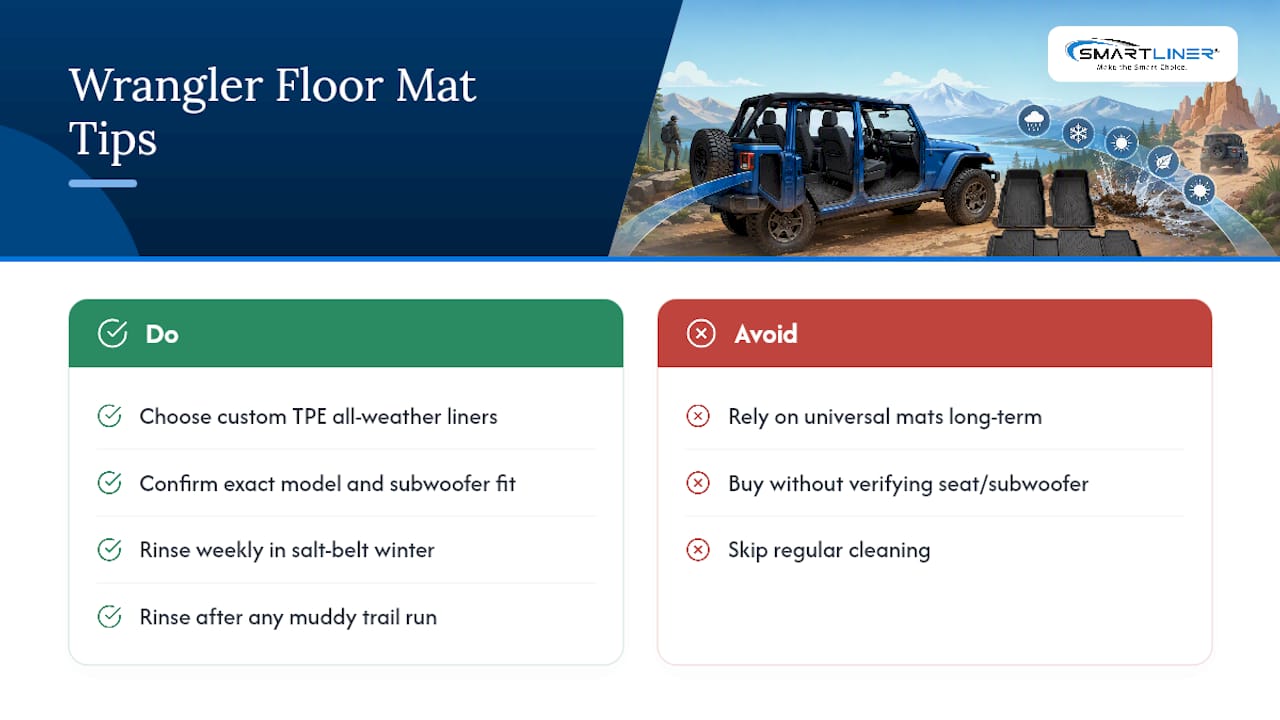
Pro Tip: A mat that isn’t anchored to factory snap studs can slide forward under braking and jam against the accelerator pedal. That’s not a comfort issue, it’s a safety issue, so never settle for a liner that relies on friction alone to stay in place.
How Do You Choose the Right Wrangler Floor Mats for Your Budget?
Matching the mat to how you actually use your Wrangler prevents both overspending and under-protecting.
A daily driver that sees light rain and the occasional grocery run doesn’t need the same containment depth as a rig that fords creek crossings every weekend. Pet owners should weight cleaning ease heavily, since a liner that lifts out and hoses off in five minutes beats one that requires a shop vac and an hour of scrubbing. Anyone in a salt-belt winter climate should prioritize raised edges over price, because road salt left sitting against factory carpet accelerates corrosion on the metal floor pan underneath.
Run through this checklist before you commit to a purchase:
- Confirm the listing states your exact year range, door count, and subwoofer configuration, not a broad “fits most Wranglers” claim.
- Check the material spec directly. Thermoplastic elastomer resists cracking in cold better than basic PVC or generic rubber blends.
- Measure containment depth in inches if the seller lists it. Anything under half an inch offers little real spill protection.
- Read the warranty terms before checking out. A limited lifetime warranty against cracking and fading is a meaningful signal of confidence in the material.
- Scan recent customer reviews for fit complaints specific to your exact model year.
Watch for red flags: sellers who won’t provide a part number, vague “universal fit” language on a page selling model-specific liners, no returns policy, or product photos that don’t show retention hardware at all. If a seller can’t answer a direct fit question about your specific trim, that’s a signal to keep looking rather than gamble on a mat that might not seat correctly.
How Do You Clean and Maintain Wrangler Floor Mats?
Keeping a liner performing like new takes about five minutes a week and almost no special equipment.
For thermoplastic elastomer or rubber liners, follow this routine:
- Pull the mats out and shake off loose dirt and debris before it grinds into the texture underfoot.
- Rinse with a garden hose or in a utility sink, using mild dish soap for caked-on mud or grease.
- Avoid harsh solvents or petroleum-based cleaners, since they can degrade the material’s flexibility and finish over time.
- Air-dry fully before reinstalling to prevent trapped moisture from reaching the carpet below.
Carpeted mats need a gentler touch: vacuum first, spot-clean stains with a mild detergent, and let them dry completely in open air rather than a closed cabin.
Salt is the biggest threat in winter climates. Rinse liners weekly during salt-belt months, since dried salt residue left in the channels can eventually pit the material’s surface over repeated freeze-thaw cycles.
Pro Tip: Store a spare set of liners flat, not rolled, if you swap between a work setup and a weekend trail setup. Rolling thermoplastic liners for weeks at a time can leave a memory curve that keeps them from sitting flush.
Inspect your mats every few months for thinning, cracking near the edges, or retention nibs that have worn smooth. Once the underside loses its grip texture, it’s time to replace rather than keep pushing a mat that can now shift underfoot.
Why Smartliner-usa Fits the Recommendation for Wrangler Owners
Smartliner-usa builds its Wrangler liners around the same principle owners raise in forum threads over and over: precise fit and deep containment matter more than anything else. The brand’s product line covers multiple Wrangler generations with distinct listings, including options built specifically around subwoofer presence and door count, rather than a single “one size fits all” JL liner.
The gap between a mat that “should fit” and one verified against your exact floor pan is the difference between a liner that stays anchored on a rocky trail and one that slides the first time you brake hard. Model-specific tooling closes that gap.
Smartliner’s liners are made from eco-friendly, recyclable materials, which matters if you want performance without adding another discarded rubber mat to a landfill every few years. That material choice pairs with the same thermoplastic elastomer durability that makes custom liners the preferred category for off-road and winter use.
Readers ready to move from research to purchase can go directly to model-matched listings:
- 2015-2018 JK 2-Door Wrangler liners
- 2011-2013 Wrangler Unlimited 4-Door liners
- Smart Trim liners for 2015-2018 Wrangler Unlimited
For readers building or maintaining their own rig, deeper technical background on why chassis-specific tooling matters is worth a read in this fitment best practices guide.
What Do Wrangler Owners Actually Recommend in Forums?
Ask a group of Wrangler owners what mat they’d buy again, and the answers cluster around a handful of consistent priorities rather than brand loyalty alone.
Containment depth comes up first almost every time. Owners on Reddit, WranglerForum, and JLWranglerForums repeatedly describe wanting a liner with a WeatherTech-style raised lip, deep enough to hold a full water bottle spill without it reaching the carpet edge. Fit is the second recurring theme, particularly for JL owners who’ve learned the hard way that subwoofer and non-subwoofer configurations need different tooling.
Material durability rounds out the top three. Owners who’ve run the same liner through multiple winters talk about whether the material stayed flexible in cold weather or turned brittle and started cracking at the edges. Ease of cleaning matters just as much to anyone who takes their Wrangler off-road regularly. A liner that lifts out clean with one rinse beats one that traps mud in textured grooves.
What’s notably absent from most owner recommendations is any strong preference for decorative patterns, brand logos, or color-matching. Practical performance wins over appearance nearly every time a real owner weighs in, which tracks with why raised edges and tall lips consistently rank above cosmetic detail in the conversations that actually influence buying decisions.
How Do Leading Wrangler Floor Mat Brands Compare?
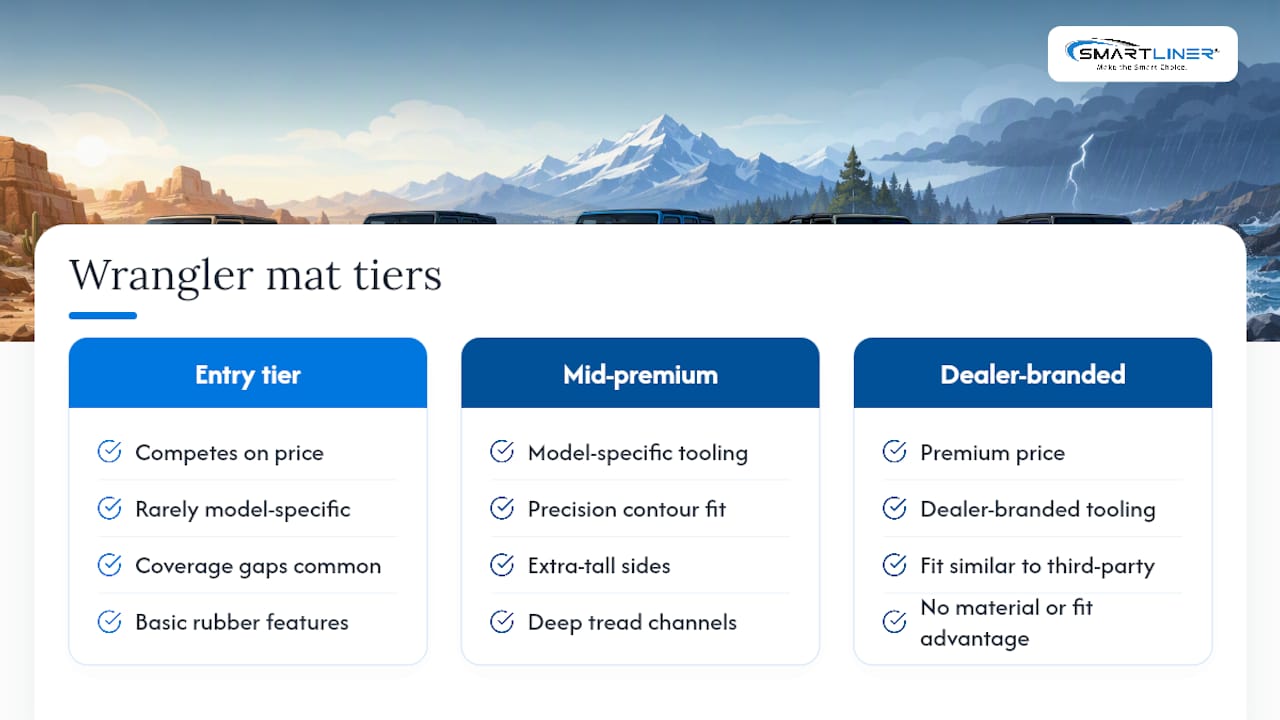
The Wrangler floor mat market splits roughly into three tiers, and understanding where a product sits tells you what you’re actually paying for.
At the entry tier, generic rubber mat brands sold through big-box auto stores compete almost entirely on price. They rarely offer model-specific tooling, and coverage gaps around the transmission tunnel are common across the tier regardless of brand name.
The mid-to-premium tier is where model-specific liners live, and this is where the meaningful differences show up. Feature sets in this tier typically include a precision contour fit, extra-tall sides, and deep tread channels for liquid containment, the same combination Quadratec highlights on its own JL-specific liner listing. Warranty coverage in this tier tends to run longer, often framed as limited lifetime protection against cracking and fading.
Smartliner-usa competes directly in this tier, differentiated by its combination of model-specific tooling across a wider span of Wrangler generations and its use of recyclable thermoplastic material. Where some competitors focus tooling investment on the newest JL body style, Smartliner-usa maintains active listings for JK and older Wrangler Unlimited configurations as well, which matters if you’re protecting a Wrangler that’s more than a decade old.
The dealer-branded tier, sold through Jeep’s own accessories catalog, often carries a premium tied to the Jeep name itself rather than a material or fit advantage over third-party model-specific liners.
What Should You Expect to Pay for Wrangler Floor Mats?
Price tracks almost directly with fit precision and material quality, and understanding the tiers helps you avoid overpaying or under-protecting.
Universal rubber mats sit at the bottom of the price range, and they’re the cheapest way to cover bare carpet. The tradeoff is trimming work and the coverage gaps that come from a mat built for no vehicle in particular.
Carpeted mats occupy a similar low price band, sometimes slightly higher for licensed Jeep branding or plush materials, but they deliver the least actual protection of any category.
Custom all-weather liners cost more, reflecting the laser-scanned tooling and thermoplastic material behind each model-specific set. Within this tier, price varies by whether you’re buying a front-row set alone or a full front-and-rear package, and whether a matching cargo liner is bundled in. Dealer-branded accessory liners frequently sit at the top of this range, charging a premium tied to the Jeep name without necessarily improving on the containment or fit you’d get from a dedicated third-party liner maker.
The value calculation is straightforward once you frame it against replacement cost. A $30 universal mat that needs replacing every year or two after cracking in cold weather costs more over five years than a single custom liner built to survive a decade of winters. Buyers focused purely on the sticker price often end up spending more in the long run, not less.
Do Wrangler Floor Mats Work With Seat Covers and Pedal Upgrades?
Floor liners and other interior accessories generally coexist without conflict, but a couple of installation order details are worth knowing before you stack upgrades.
Seat covers have no meaningful interaction with floor liners since they occupy entirely separate surfaces. Install them in either order without concern. Aftermarket pedal covers are a different story: if you’re adding a wider brake or accelerator pedal cover, install the pedals first, then check that your floor liner’s front edge doesn’t creep up far enough to interfere with full pedal travel. This matters more on 2-door Wranglers, where footwell space runs tighter than on the 4-door Unlimited.
Center console accessories, cup holder inserts, and door sill guards typically layer fine with a properly fitted floor liner since none of them share contact points with the floor pan. The one accessory combination worth double-checking is aftermarket subwoofer boxes installed after the fact. If you add a subwoofer to a Wrangler that didn’t originally have one, your existing “no subwoofer” liner may no longer seat correctly and you’ll need the subwoofer-specific version instead.
The general rule holds across nearly every combination: confirm the floor liner clears any accessory that alters pedal position or under-seat clearance, and install rigid accessories before laying down the mat rather than after.
Should You Buy From a Jeep Dealer or a Third-Party Manufacturer?
Jeep’s own dealer accessory catalog sells branded floor mats, and third-party manufacturers like Smartliner-usa sell model-specific alternatives, but the two paths aren’t offering equivalent value for equivalent price.
Dealer-branded mats carry the advantage of guaranteed brand association and, in some cases, bundling into a new-vehicle purchase package. The tradeoff is usually price. Dealer accessory pricing tends to run higher than comparable third-party liners without a corresponding jump in material quality or fit precision, since many dealer-branded mats are manufactured by the same third-party suppliers under a licensing arrangement.
Third-party manufacturers who specialize in model-specific liners compete on fit precision, material innovation, and warranty terms rather than badge recognition. That specialization is exactly why the mid-to-premium tier discussed earlier is dominated by dedicated floor liner brands rather than the vehicle manufacturers themselves.
The practical test that matters more than the source is whether the listing names your exact year, door count, and configuration. A third-party liner with a verified part number for your specific Wrangler beats a dealer-branded mat with vague “universal Wrangler fit” language, regardless of which logo is stamped on the heel pad. Buyers chasing brand prestige over fit precision are the ones most likely to end up with a mat that doesn’t sit flush.
Are Custom Floor Mats Worth It Over Universal Options?
Availability has shifted heavily toward custom fit over the past several years, and that shift reflects what actually protects a Wrangler’s interior rather than just marketing trends.
Universal mats remain widely available and cheap, and they still make sense as a stopgap for a Wrangler you’re planning to sell soon or a temporary fix while you shop for the right custom liner. Their impact on protection, though, is limited by design. A mat cut to fit “most” vehicles inevitably leaves gaps in a Wrangler’s specific footwell shape, and those gaps are exactly where spills and mud find their way to the carpet.
Custom-fit availability has expanded significantly as manufacturers like Smartliner-usa build out model-specific tooling across more Wrangler years, closing what used to be a real gap for owners of older JK and TJ generations who once had fewer precise-fit options than newer JL owners. That expansion matters because a Wrangler’s resale value benefits directly from a clean, unstained interior, and custom liners are the more reliable way to keep it that way across years of ownership.
The real-world impact shows up at trade-in time more than anywhere else. A Wrangler with factory carpet intact under a properly fitted liner commands a noticeably better impression during inspection than one with salt stains and mud ground into the fibers, even when both trucks have identical mileage.
What Owners Get Wrong About Floor Mat Shopping
The conventional advice on this topic treats floor mats like a commodity purchase: grab whatever fits your budget, trim it if needed, done. That’s backward. The research on this consistently points the other way, that fit precision and containment depth are the two variables that actually determine whether a mat protects your Wrangler or just decorates the floor.
What’s overrated is brand prestige, particularly dealer badging. A mat manufactured by the same third-party supplier under a Jeep-branded label doesn’t perform any differently than the identical product sold direct. What’s underrated is checking your subwoofer configuration and door count against the exact listing before buying, since that single step prevents most of the fit complaints that show up in owner reviews.
If you take one thing from this, prioritize model-specific verification over price comparison shopping. A liner that’s five dollars cheaper but doesn’t seat flush costs you more in mud tracked onto carpet than it ever saved at checkout.
Get Model-Specific Wrangler Protection From Smartliner-usa
Buying a mat that trims to “roughly fit” or hoping a dealer-branded liner justifies its markup both leave you guessing. Smartliner-usa builds its liners around your Wrangler’s exact year, door count, and subwoofer configuration from the start, so you skip the trial-and-error that comes with universal mats and the price premium that comes with dealer badging. The recyclable thermoplastic construction holds up through winters and trail seasons without the cracking that shortens a cheaper mat’s lifespan.
If you’re covering more than just the front seats, pair your liner with a cargo liner for full-cabin protection, or check the floor liners catalog directly for your Wrangler’s exact model year and configuration to start your order today.
Frequently Asked Questions
What is the best type of floor mat for a Jeep Wrangler? Custom all-weather liners made from thermoplastic elastomer are the best wrangler floor mats for most owners, since they combine model-specific fit with raised edges deep enough to contain spills, mud, and melted snow that a universal mat can’t fully seal against.
Do Wrangler floor mats differ between JK, JL, and TJ models? Yes. Each generation has a distinct floor pan shape, and JL models add a further variable depending on whether your Wrangler has a factory subwoofer under the front passenger seat, so always confirm your exact configuration before buying.
Are universal rubber mats worth buying for a Wrangler? They work as a low-cost stopgap but typically require trimming and still leave coverage gaps near the transmission tunnel, making them a weaker long-term choice than model-specific liners.
How often should I clean my Wrangler’s all-weather floor liners? Rinse them weekly during salt-belt winter months and after any muddy trail run; a quick hose-off with mild soap keeps thermoplastic material from holding grit that can wear down its texture over time.
Should I worry about model year when buying a used Wrangler and its mats? Reliability varies by production year more than by mat fit, and ForCar’s data shows some years, like 2018, carry higher complaint rates, so prioritize the vehicle’s condition and maintenance history over year alone when shopping used.
Sources
- Jeep Wrangler Reliability — Best and Worst Years by the Data | ForCar
- Quadratec Ultimate All Weather Floor Liners for 18-24 Jeep Wrangler JL 2-Door | Quadratec
Recommended
- SMARTLINER Floor Liners for 2015-2018 Jeep Wrangler 2 Door Model Only (JK Old Body Style Only) | Smartliner USA
- SMARTLINER Custom Fit Floor Liners For 2011 - 2014 Jeep Wrangler Unlimited (4-Door Only) | Smartliner USA
- SMARTLINER Custom Fit Floor Liners For 2011-2013 Jeep Wrangler Unlimited (4-Door) | Smartliner USA
- Smart Trim™ Floor Liners For 2007-2010 Jeep Wrangler Unlimited (4-Door) | Smartliner USA