

The best under sink mats are flexible, food-grade silicone with a raised lip around the perimeter, thick enough to resist punctures but still trimmable to fit around pipes and center posts. That combination catches spills, resists mold, and adapts to almost any cabinet shape. A rigid tray becomes the better pick only when the cabinet floor is a clean, unobstructed rectangle and you need maximum containment against a large-volume leak, like a water heater closet or a laundry sink that goes unchecked for days.
For most kitchen and bathroom cabinets, SMARTLINER HOME Under Sink Cabinet Mats hit that sweet spot. They combine:
- Flexible, cuttable silicone that molds around plumbing and center posts
- A raised lip built to hold spills instead of letting them run to the cabinet floor
- Food-grade, recyclable material that wipes clean or goes in the dishwasher
Pro Tip: Measure your cabinet interior before you shop, not after. A mat that’s a half-inch too wide will curl at the edges and stop containing anything.
Key Takeaways
The best under sink mats combine food-grade silicone, a raised containment lip, and a trim-to-fit design suited to your cabinet’s actual plumbing layout.
| Point | Details |
|---|---|
| Prioritize lip height | Look for a rim of at least 0.2 to 0.6 inches; taller lips hold significantly more spilled liquid. |
| Match material to layout | Choose flexible silicone for cabinets with center posts or pipes, and rigid trays only for clean, unobstructed floors. |
| Trim carefully, cut once | Mark pipe and post locations before cutting silicone, since it won’t spring back if you trim too much. |
| Dry mats fully after leaks | Pull the mat and let it air-dry completely to prevent mold, rather than just wiping the surface. |
| Choose Smartliner HOME mats | SMARTLINER HOME Under Sink Cabinet Mats offer precise-fit silicone with raised lips in two standard bathroom sizes. |
Table of Contents
- What Makes the Best Under Sink Mat for Your Cabinet?
- Silicone vs. Plastic vs. Rubber vs. Rigid Liners
- How Do You Measure and Fit an Under Sink Mat?
- How Do You Keep an Under Sink Mat Clean and Mold Free?
- Why Smartliner HOME Mats Fit the Buying Checklist
- How Do You Buy the Right Smartliner Under Sink Mat?
- Why I’d Skip the Cheapest Mat Every Time
- Frequently Asked Questions
- Sources
What Makes the Best Under Sink Mat for Your Cabinet?
Not every mat marketed for under-sink use actually protects against a real leak. The material, the lip height, and the drainage design all determine whether a mat is decoration or defense.
Material decides how the mat handles both water and time. Silicone resists mold growth better than porous foam or thin vinyl, and it doesn’t pick up the sour smell that cheaper rubber mats develop after repeated wet cycles. Independent testing across a dozen kitchen sink mats found that silicone options with raised lips and roughly 3mm of thickness consistently outperformed thinner alternatives for containment and cleaning ease.
Lip height is the number that actually matters for leak protection, and it’s the one most shoppers skip. Buyer guides generally recommend a minimum rim of about 0.2 to 0.6 inches, and containment testing shows that a taller, reinforced rim holds noticeably more liquid before it spills over the edge. A quarter-inch lip stops a slow drip. It won’t stop a burst supply line.
Drain holes versus full containment is a design choice, not a defect either way. A mat with a drain hole lets you route water to a bucket or a floor drain, which matters in a laundry closet. A fully sealed lip holds everything in place until you notice it, which matters more under a kitchen sink you don’t check daily.
Here’s what to weigh before you buy:
- Thickness: aim for at least 2 to 3mm to resist punctures from can edges, tool corners, or pet claws
- Surface texture: a textured underside grips uneven cabinet floors better than a smooth one
- Certifications: look for food-grade, BPA-free labeling, especially if you store pet food or dishware nearby
- Price versus lifespan: budget rubber mats often run $10 to $15 but degrade within a year or two, while a well-made silicone mat costs more upfront and typically lasts several years without cracking
The gap between a $12 mat and a $30 mat usually shows up in month eight, not day one.
Silicone vs. Plastic vs. Rubber vs. Rigid Liners
Material choice shapes everything from mold resistance to how well the mat handles your cabinet’s plumbing.
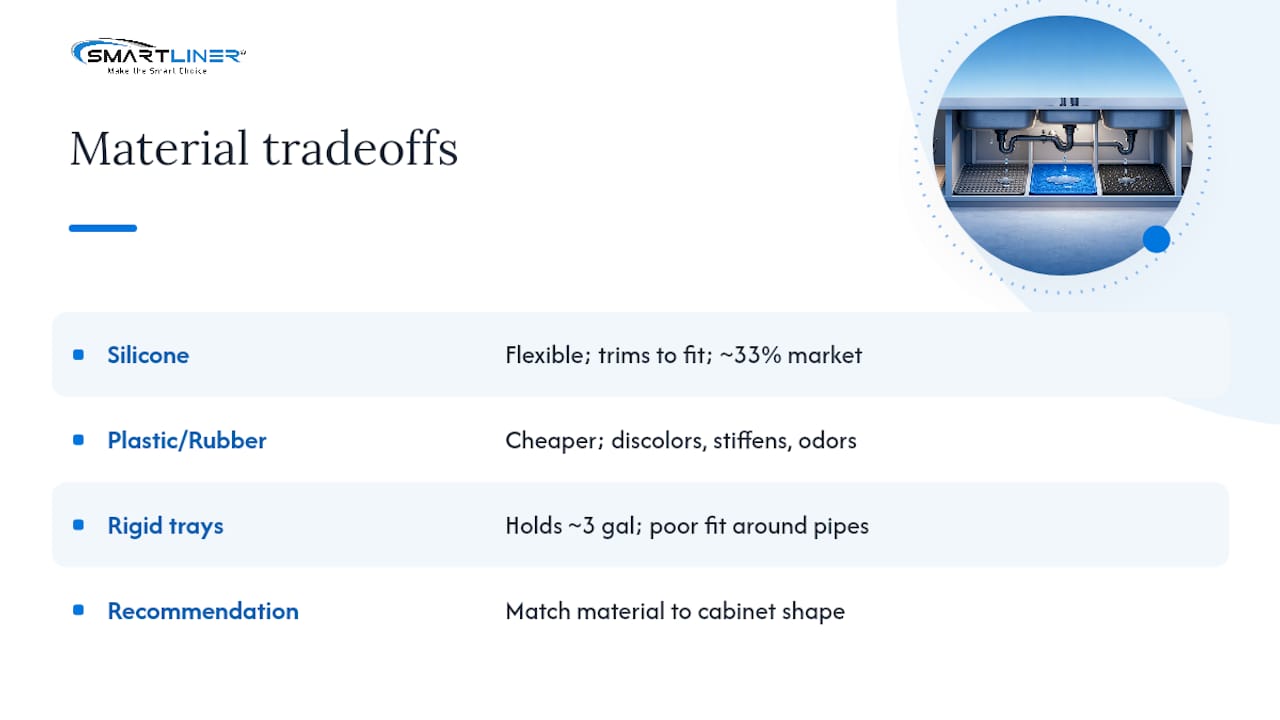
Silicone stays the default recommendation for a reason. It flexes around pipes, trims with household scissors, and shrugs off mold better than porous materials. Market data shows silicone holding close to a third of overall material share among sink mat purchases, with cut-to-fit versions gaining ground specifically because they adapt to irregular cabinets instead of forcing the cabinet to adapt to the mat.
Plastic and rubber mats are cheaper at checkout but often discolor, stiffen, or develop odor after repeated wet and dry cycles. They also flex less, so fitting one around a center post or floor-mounted drain pipe can leave gaps exactly where you need coverage most.
Rigid trays offer the highest containment ceiling. Comparative reviews note that a properly sized rigid tray can hold up to roughly three gallons before overflowing, which makes sense for a laundry room sink or a rarely checked utility closet. The tradeoff is fit: rigid trays perform poorly in cabinets with center posts, uneven plumbing, or multiple obstacles, since they can’t bend to work around anything.
Match the material to your cabinet, not the other way around. Clean rectangular floor, no obstacles, high leak risk: rigid tray. Anything with pipes, a center post, or an irregular shape: silicone.
How Do You Measure and Fit an Under Sink Mat?
Getting the fit right takes ten minutes and prevents the curling, buckling, or gapping that turns a good mat into a false sense of security.
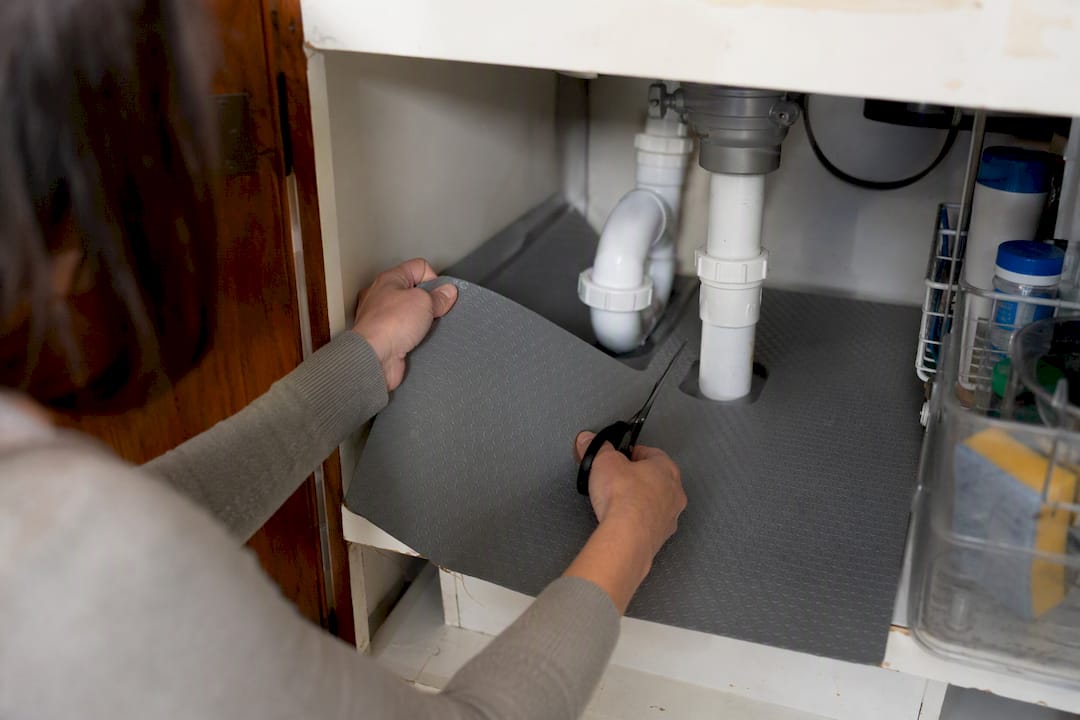
- Measure interior width and depth at the widest usable points, then note where pipes, center posts, or the garbage disposal drop down into the cabinet space.
- Mark obstacles on paper first if you’re trimming a silicone mat, so you cut once instead of guessing twice.
- Trim silicone with sharp household scissors, cutting slightly inside your marked line since silicone doesn’t spring back if you take off too much. Rigid liners generally can’t be modified, so exact SKU sizing matters more.
- Test the fit dry before loading anything back into the cabinet, checking that the lip sits flush against the cabinet walls with no lifted corners.
- Choose two smaller mats over one large one when your cabinet has a center divider, multiple drawers, or plumbing that splits the floor space into awkward sections.
Pro Tip: If a single large mat won’t lie flat because of a center post, don’t force it. Two properly trimmed mats seal better than one mat with a permanent wrinkle running through it.
How Do You Keep an Under Sink Mat Clean and Mold Free?
A mat only works if it stays clean enough to actually catch what falls on it, and mold prevention comes down to drying time more than cleaning frequency.
Wipe silicone mats weekly with warm water and a mild dish soap, and run them through the dishwasher occasionally if the manufacturer allows it. Cleaning guidance from sink mat reviewers consistently points to one habit above all others: pull the mat out and let it air-dry completely after any spill, rather than sliding items back on top of trapped moisture.
- Wipe down weekly, even without a visible spill
- Pull the mat and dry it fully after any leak, not just a visible mold spot
- Prop cabinet doors open occasionally to let airflow reduce trapped humidity
- Check the cabinet subfloor for soft spots or discoloration each season, and call a plumber if you find either
A textured silicone underside does double duty here. Beyond gripping an uneven cabinet floor, that texture lets air move underneath the mat when you lift a corner, which speeds up drying and cuts down the humidity that mold needs to take hold.
Why Smartliner HOME Mats Fit the Buying Checklist
Every criterion in this guide, lip height, flexible fit, food-grade material, easy cleaning, points toward the same kind of product Smartliner-usa builds for vehicle interiors and now for home cabinets. SMARTLINER HOME Under Sink Cabinet Mats use precise-fit technology drawn directly from Smartliner’s automotive liners, where custom dimensions matter down to the pipe cutout.
That durability matters under a sink, where a mat gets stepped on, splashed, and forgotten for months at a time.
For a standard bathroom vanity, the 19.5" x 28.5" size fits most narrow cabinets without trimming. Larger vanities or kitchen cabinets typically call for the 19.5" x 34.5" size. Smartliner-usa’s customer support team can help confirm sizing before you order, which matters more than it sounds since a half-inch miscalculation is the most common reason a mat underperforms.
How Do You Buy the Right Smartliner Under Sink Mat?
Start by measuring your cabinet interior the same way outlined above, then match those numbers to a SKU rather than guessing. The SMARTLINER HOME Under Sink Cabinet Bathroom Mats, 19.5" x 34.5" covers standard and larger bathroom cabinets, while the 19.5" x 28.5" version fits narrower vanities without a trim. If you’re unsure which size your cabinet needs, the SMARTLINER HOME Under Sink Cabinet Mats landing page lays out both dimensions side by side.
Every order ships with Smartliner-usa’s standard return window, and the customer support team answers fit questions directly, which matters if your cabinet has an unusual center post or a disposal unit that eats into your usable floor space. If a mat doesn’t sit flat once trimmed, reach out before you assume the size was wrong.
Once your cabinets are covered, the same precise-fit approach extends to your vehicle. Smartliner-usa’s Floor Liners and Cargo Liners apply the identical containment logic, raised lips, recyclable material, custom dimensions, to protect against mud, spills, and daily wear in your car or truck.
Why I’d Skip the Cheapest Mat Every Time
The instinct to grab whatever mat is cheapest at checkout makes sense until you calculate what a single undetected leak actually costs. A warped subfloor, moldy particleboard, or a cabinet base that has to be torn out and rebuilt runs into hundreds of dollars, sometimes more depending on how long the leak went unnoticed. A $30 silicone mat that lasts five years is not the expensive option here. The $10 rubber mat that curls at the edges after eight months is.
What gets underestimated most is lip height. Shoppers fixate on thickness and material, both reasonable things to check, but the rim is what actually stops water from reaching the cabinet floor in the first place. A thick mat with no lip is still just a thick surface for water to run off of. I’d also push back on the idea that one mat style fits every cabinet. The plumbing under a kitchen sink and the plumbing under a bathroom vanity rarely look the same, and buying based on price alone ignores that mismatch entirely.
Frequently Asked Questions
What is the best material for an under sink mat? Flexible, food-grade silicone is the best choice for most cabinets because it resists mold, trims easily around pipes, and holds up under repeated wet and dry cycles better than plastic or rubber.
How high should the lip be on an under sink mat? Look for a rim of at least 0.2 to 0.6 inches. Taller, reinforced lips hold considerably more liquid before overflowing, which matters most in cabinets you don’t check daily.
Can I cut a silicone under sink mat to fit my cabinet? Yes. Silicone trims easily with household scissors, which makes it the practical choice for cabinets with center posts, uneven plumbing, or tight corners that a rigid tray can’t accommodate.
Do under sink mats prevent mold? A quality silicone mat resists mold better than porous materials, but prevention still depends on drying the mat fully after every spill and allowing occasional airflow inside the cabinet.
Should I use one large mat or several smaller mats? Use multiple smaller mats when your cabinet has a center divider, drawers, or plumbing obstacles that prevent a single large mat from lying flat across the entire floor.
Sources
Readers who want to dig deeper into how these recommendations were sourced can check the independent testing and market data behind this guide. Hands-on comparisons across a dozen kitchen sink mats are covered in this multi-product testing roundup, while material share trends and mold-prevention cleaning advice appear in this sink mat buying guide. For a closer look at the flexible-versus-rigid tradeoff discussed above, see this comparison of containment capacity and fit. Full specifications for Smartliner-usa’s own under-sink lineup are available on the SMARTLINER HOME Under Sink Cabinet Mats product page.
- 12 Best Kitchen Sink Mats (August 2026) Tested
- Sink Mat : Amazing Ways to Prevent Water Damage . - Kitchen Tools Reviews
- Gorilla Grip vs Xtreme Mats: Best Under Sink Mat (2026)