

A tray-style, waterproof liner with a raised lip is the best under sink liner for real leak protection. It contains water instead of just soaking it up, unlike flat felt mats that only handle light condensation. Before buying one, measure your cabinet’s interior base and note where the P-trap sits, since that measurement determines whether a stock size fits or you need a custom tray.
TL;DR:
- Waterproof tray-style liners with raised lips provide the best leak containment, especially if they sit flush against cabinet walls without gaps.
- Measuring the interior cabinet base and locating the P-trap are crucial steps to ensure a proper fit and avoid water bypassing the liner.
- Durable materials like PVC, vinyl, rubber, or LDPE blends offer better long-term protection than absorbent felt or foam liners that trap moisture and promote mold.
- Proper installation includes dry, clean surfaces, careful trimming around pipes, and sealing seams to prevent water from escaping behind the liner.
- Choosing a precise-fit, recyclable liner offers better protection, longevity, and environmental benefit compared to universal or cheaply priced options.
Table of Contents
- What Makes the Best Under Sink Liner Material?
- How Do You Choose and Size an Under-Sink Liner?
- How Do You Install and Maintain a Sink Cabinet Liner?
- What Do Under-Sink Liners Cost, and Which Material Gives You the Best Value?
- Which Under-Sink Liner Brands and Products Should You Consider?
- How Long Does an Under-Sink Liner Actually Last?
- Are Under-Sink Liners Bad for the Environment?
- Why Custom-Fit, Recyclable Tray Liners Solve the Problems Cheaper Options Don’t
- Ready to Protect Your Cabinet? Here’s Where to Start
- Sources
What Makes the Best Under Sink Liner Material?
The material decides whether a liner actually stops water or just delays the mess. Waterproof materials like PVC, vinyl, rubber, and high-quality LDPE blends resist saturation and wipe clean in seconds, which is why they hold up best against active leaks. Absorbent materials like PET felt or foam soak water in instead of containing it, and once saturated, they trap moisture against the cabinet floor and become a mold risk rather than a solution.
Design matters just as much as material. A tray-style liner with raised, rigid edges is the design practitioners recommend for genuine leak protection, since it physically holds standing water instead of letting it run to the cabinet corners. A flat liner, by contrast, only protects against light moisture or surface scratches. It won’t help you if a supply line fails overnight.
- PVC/vinyl: Fully waterproof, wipes clean, holds shape well under weight from cleaning supplies.
- Rubber: Waterproof and grippy underfoot for storage bins, though heavier and pricier than vinyl.
- LDPE blends: Lightweight, waterproof, and often the material behind flexible tray-style liners.
- Silicone: Waterproof and heat-tolerant, useful near garbage disposals or hot-water lines.
- PET felt/foam: Absorbent, best for minor condensation only. Skip it if you’ve had a leak before.
Pro Tip: A liner does not stop a leak at the source. It makes the leak visible by collecting water on top instead of letting it soak into the cabinet wood, which is exactly why the tray design matters more than the material alone.
Skip soft or felt-topped liners if you’ve ever dealt with an active supply-line leak or a slow drain seep. They’re built for humidity, not standing water, and a saturated felt mat left in place for weeks can do more hidden damage than no liner at all.
How Do You Choose and Size an Under-Sink Liner?
Getting the right fit takes more effort than grabbing the first liner in the size that looks close. Follow this order and you’ll avoid the two most common mistakes: buying too small and leaving gaps, or trimming the lip so aggressively that it stops containing anything.
- Measure the interior base, not the outer cabinet dimensions. Width, depth, and height of the lip all matter, and the cabinet’s inside footprint is usually a few inches smaller than what you’d guess from the doors.
- Locate the P-trap and any shutoff valves before you buy, so you know where cutouts will need to go.
- Choose a waterproof material over an absorbent one if the cabinet has ever seen a leak, condensation, or a garbage disposal drip.
- Pick a lip height tall enough for realistic spill volume. A quarter inch of lip stops nothing; two to three inches gives you a real buffer.
- Trim carefully around pipes, cutting only as much as needed to clear the P-trap while keeping the lip’s edge intact and upright.
- Consider custom-fit if your cabinet has an irregular shape, angled walls, or built-in shelving that a universal tray won’t clear.
- Check for a non-slip base and chemical resistance if you’re storing cleaning products, and arrange items so pipes stay visible for quick inspection.
The lip detail is where most buyers get tripped up. A high lip only works if it sits flush against the cabinet walls on all sides; if it folds inward or leaves a gap, spilled water bypasses the tray entirely and escapes behind the mat where you won’t see it until the cabinet floor is already damaged. That’s the single most overlooked failure point in DIY liner installs.
How Do You Install and Maintain a Sink Cabinet Liner?
Installation is straightforward, but skipping the prep steps is how liners end up shifting or trapping moisture underneath instead of preventing it.
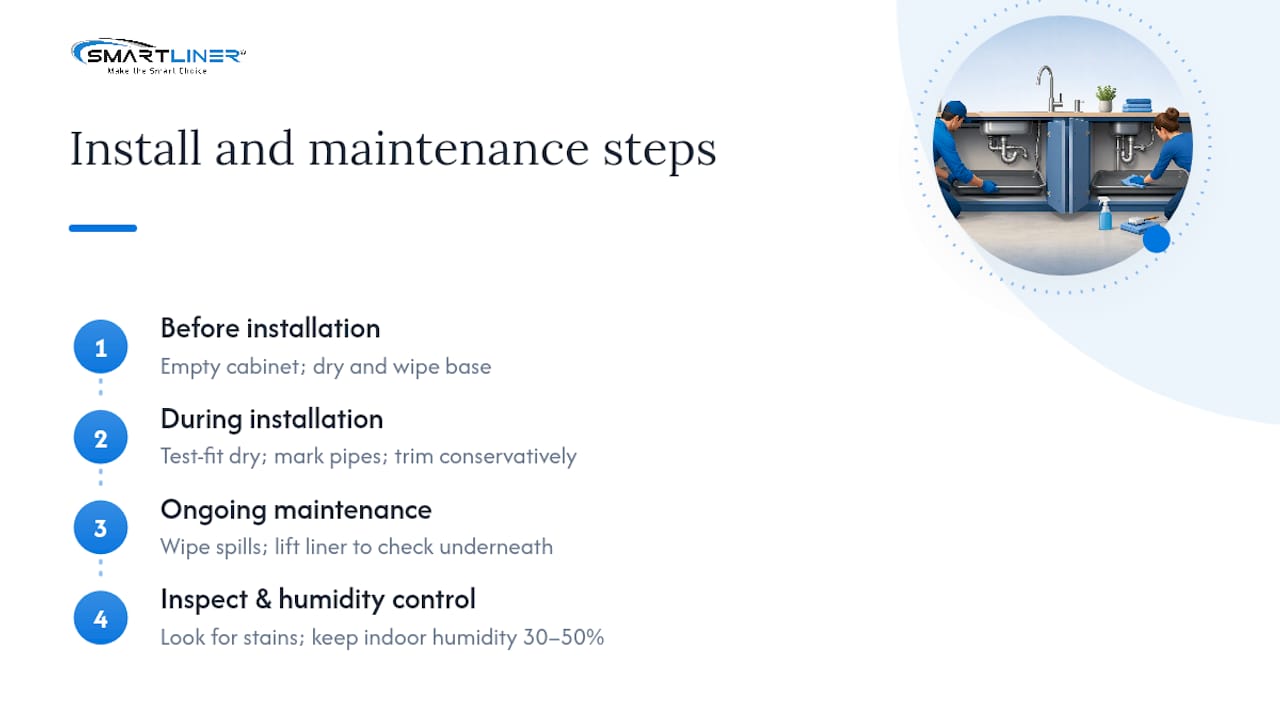
Before you install: Empty the cabinet completely and let it dry fully, especially if you’re replacing a liner because of a past leak. Wipe down the base so the new liner sits on a clean, dry surface rather than trapping old grime or moisture underneath.
During installation: Test-fit the liner dry before committing to any cuts. Mark where the P-trap and shutoff valves need clearance, trim conservatively, and press the lip flat against every wall so there are no gaps for water to slip behind. Some homeowners add a thin bead of silicone around the perimeter for extra insurance. Sealants like GE Advanced Silicone Kitchen & Bath create a flexible waterproof barrier at pipe penetrations and seams, and they hold up better than standard acrylic caulk in a damp environment.
Ongoing maintenance: Wipe the liner down when you notice spills, and lift it every so often to check whether moisture is collecting underneath rather than staying on top where you can see it.
Inspect the liner and the cabinet floor beneath it regularly, checking for yellow stains or dark streaks that signal a slow leak you missed. The EPA recommends keeping indoor humidity between roughly 30% and 50% to cut down on condensation forming on pipes in the first place, which matters most in humid climates or bathrooms with poor ventilation. A mold prevention checklist built around humidity control pairs well with this inspection habit.
What Do Under-Sink Liners Cost, and Which Material Gives You the Best Value?
Price tracks pretty closely with material and design, and the cheapest option usually isn’t the best value once you factor in how often you’ll replace it. Thin felt or foam mats sit at the low end of the market, but they’re the ones most likely to need replacing after a single real leak, since saturated absorbent material rarely dries out clean.
Flat vinyl or rubber sheets cost more than felt but less than a molded tray, and they split the difference: waterproof, but without raised edges to actually contain a spill beyond a thin film of water. Molded tray-style liners in PVC, rubber, or LDPE blends sit at the higher end of the price range, and that premium buys you the raised lip that separates real containment from surface protection.
Custom-fit tray liners, sized to a specific cabinet’s interior dimensions rather than a generic rectangle, typically cost the most upfront. The value case here is straightforward: a universal liner that gaps at the corners or requires aggressive trimming to fit isn’t actually cheaper if it lets water bypass the tray anyway. For an irregular cabinet shape, paying more for a liner that fits flush the first time usually beats buying two or three universal ones trying to get it right.
The most expensive option on the shelf isn’t always tray-style, either. Some flat mats made from premium rubber cost more than basic molded PVC trays despite offering less containment, so lip height and material matter more to your decision than sticker price alone.
Which Under-Sink Liner Brands and Products Should You Consider?
Retail shelves carry three broad categories of under-sink liner, and each comes with real trade-offs worth knowing before you buy.
Generic flat rubber or vinyl sheets, sold at most hardware stores, are inexpensive and easy to trim to a rough size. The downside is obvious once you look closely: no raised lip means no real containment, just a slightly better wipe-down surface than bare cabinet wood.
Universal tray-style liners with molded lips solve the containment problem and cost more than flat sheets, but they’re built to fit an average cabinet size, not yours specifically. If your cabinet is a standard rectangle, this works fine. If it has an angled back wall, a center support post, or shelving, you’ll be trimming and hoping the lip still seals.
Custom-fit tray liners, built to a specific cabinet’s interior dimensions, solve the fit problem directly. Smartliner-usa’s approach to vehicle floor liners applies the same precise-fit thinking to cabinet protection: a liner engineered to match the actual footprint rather than a generic size, so the lip sits flush without you needing to guess at trim lines. The trade-off is a longer lead time and higher price than a shelf-bought universal tray, which makes sense for an oddly shaped cabinet but is overkill for a plain rectangular one.
How Long Does an Under-Sink Liner Actually Last?
Lifespan depends almost entirely on material and how much water it’s actually asked to handle. Felt and foam liners have the shortest realistic lifespan under wet conditions. Once saturated by even one real leak, the material rarely dries out clean, and most homeowners end up replacing it within a year of a significant spill.
Flat vinyl or rubber sheets hold up longer since they don’t absorb water, but repeated folding, trimming, and shifting inside the cabinet gradually cracks or curls the edges. Expect a few years of solid performance before the material starts losing its shape.
Rigid tray-style liners in PVC, rubber, or LDPE blends last the longest of the common options, since the molded shape resists the curling and cracking that shortens a flat sheet’s life. A well-fitted tray that never sees standing water beyond routine spills can realistically last five years or more before it needs replacing, and even after a real leak, a rigid tray usually just needs wiping and drying rather than full replacement.
The variable that shortens any liner’s life fastest isn’t the material. It’s trapped moisture underneath, from a lip that doesn’t sit flush or from skipping the periodic lift-and-check habit. A liner that traps water against the cabinet floor defeats its own purpose regardless of how durable the material is rated.
Are Under-Sink Liners Bad for the Environment?
Material choice affects your cabinet and your environmental footprint at the same time, which is worth weighing alongside price and durability. Standard PVC liners are effective at containment but aren’t always recyclable at end of life, and some contain plasticizers that raise questions for households trying to minimize chemical exposure near food storage or cookware kept under the sink.
Rubber liners tend to be more durable and lower in off-gassing than PVC, though virgin rubber production carries its own environmental cost. LDPE blends fall in a middle ground: recyclable in many municipal programs and generally low in the additives that make some PVC formulations less appealing for indoor use.
That combination used to force a trade-off, either you got containment with a less recyclable material, or an eco-friendly liner with weaker waterproofing. Liners built specifically to be fully recyclable while keeping a rigid, waterproof tray shape close that gap, giving budget-conscious and environmentally minded homeowners the same protection without the same footprint.
Why Custom-Fit, Recyclable Tray Liners Solve the Problems Cheaper Options Don’t
Most under-sink liner failures trace back to one thing: a gap between the lip and the cabinet wall that lets water sneak behind the tray. Universal liners are especially prone to this because they’re sized to fit an average cabinet, not your cabinet. Precise-fit technology, the kind Smartliner-usa applies across its floor liner and cargo liner product lines, addresses that gap directly by matching the tray to the actual footprint instead of a generic template, so the lip presses flush without the folding or bypassing that undermines cheaper liners.
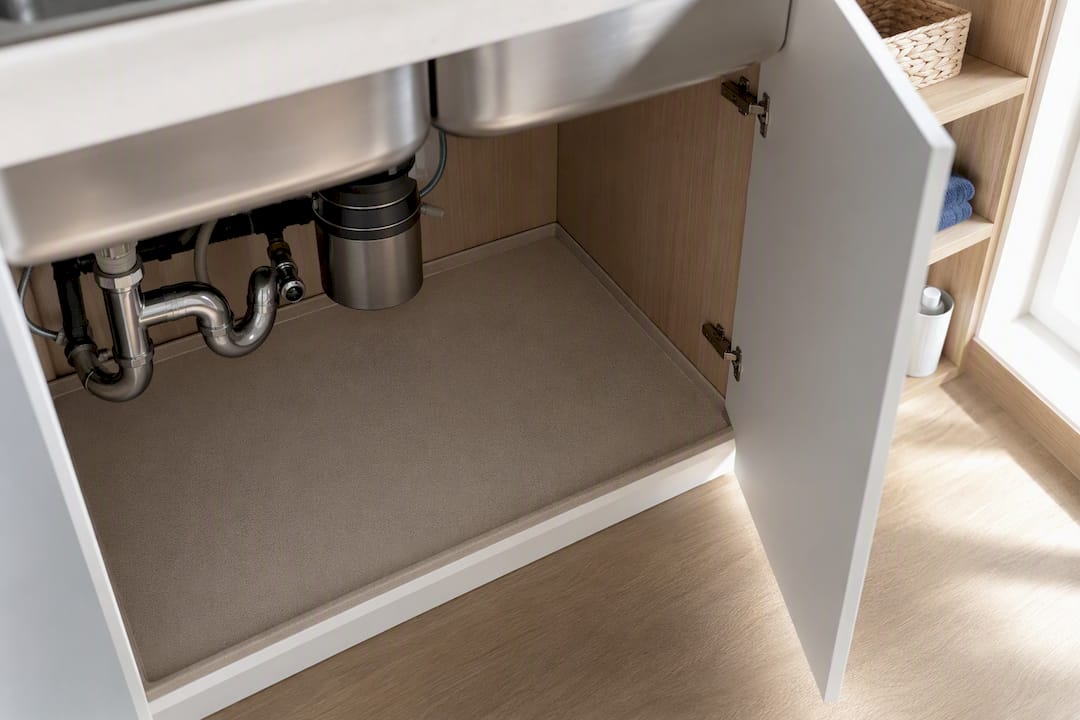
The materials question doesn’t have to be a trade-off either. A liner built from 100% recyclable material can still deliver full waterproof containment, which means you’re not choosing between eco-conscious and effective. That matters more under a sink than almost anywhere else in the home, since it’s a space that stays hidden for weeks between checks.
Installation and support are where a lot of buying guides go quiet, but they shouldn’t. A liner that requires guesswork to trim or fit defeats its own purpose, and homeowners dealing with an irregular cabinet or an unusual pipe layout benefit from being able to ask a real question before committing to a cut. Seamless installation paired with responsive support, including live chat for fit-specific questions, turns a potentially frustrating DIY project into a fifteen-minute job done right the first time.
— Marty
Ready to Protect Your Cabinet? Here’s Where to Start
Everything in this guide points to the same conclusion: containment beats absorption, and fit beats guesswork. Smartliner-usa built its reputation on precise-fit technology for vehicle interiors, and that same engineering discipline, matching a liner to the actual dimensions of the space rather than a generic size, is what makes its cargo liner and floor liner lines hold up where flat mats and loose-fit trays fall short.
If you’re outfitting a UTV, truck bed, or SUV cargo area alongside your home protection project, the same tray-style, waterproof logic applies. Browse UTV floor mats or truck bed mat liners built from durable, 100% recyclable materials with the same raised-lip containment this guide recommends for under-sink protection.
Not sure which size or configuration fits your setup? Smartliner-usa’s live chat support can walk you through fit questions before you buy, so you’re not left trimming and hoping. Visit the Smartliner-usa product catalog to compare options and get a liner sized right the first time.