

Custom-fit TPE all-weather liners are the best Tundra floor mats for most owners, because they combine flexible, non-toxic material with a mold that matches your cab’s exact contours instead of a generic universal shape. CrewMax owners should prioritize single-piece rear coverage that reaches under the second-row seat and across the transmission tunnel, while Double Cab owners have a slightly simpler footprint to protect.
TL;DR:
- Custom-fit TPE liners designed for specific Tundra model years and cab styles ensure proper coverage, especially under the second-row seat for CrewMax owners.
- Verified anchor point compatibility and a snug, factory-matched fit prevent mats from sliding or bunching, reducing safety risks like pedal jamming.
- TPE is the optimal material for durability in extreme temperatures, resisting cracking better than rubber and maintaining flexibility in cold weather.
- Coverage quality, particularly full rear liners and seamless designs, significantly decreases dirt and moisture bypass into the carpet.
- Proper installation and periodic cleaning with hose and soap, along with choosing durable materials, extend the liner’s lifespan and environmental benefits.
Table of Contents
- What To Look For In The Best Floor Mats For A Tundra
- How Smartliner Liners Match Every Item On That Checklist
- Which Mat Setup Fits Your Actual Tundra Use
- How Do You Confirm The Right Fit For Your Tundra?
- TPE vs. Rubber vs. Hybrid: What Actually Lasts?
- Cleaning, Warranty, And What Your Mats Really Cost Over Time
- Can You Customize The Look Of Your Tundra’s Floor Mats?
- Are Tundra Floor Mats Bad For The Environment?
- An Honest Take On What Actually Matters Here
- Where To Buy Custom-Fit Liners For Your Tundra
- Sources
What To Look For In The Best Floor Mats For A Tundra
Fit is the single biggest variable in whether a mat actually protects your truck. Toyota changed the Tundra’s cab geometry, pedal box, and seat-track spacing across generations, and even trims within the same model year sometimes shift the floor pan slightly. A mat built for the wrong year or cab configuration leaves gaps near the door sills or bunches up against the transmission tunnel, and a loose mat that slides forward can jam a pedal. The National Highway Traffic Safety Administration has documented crashes tied to unsecured floor mats, which is why anchor compatibility is not a minor feature. It is a safety requirement.
Material choice comes second, but it decides how the mat performs once it is actually in the truck. Thermoplastic elastomer (TPE) stays flexible in extreme cold and heat, resists cracking better than rigid PVC, and has no rubbery odor. Vulcanized rubber can outlast TPE against pure abrasion, but it stiffens and can crack in a cold garage after a few winters. Hybrid composites split the difference, trading some of TPE’s flexibility for extra noise dampening underfoot.
Coverage geometry matters more for CrewMax trucks than most buyers expect. The center transmission hump and the space under the second-row seat are where cheap universal mats fail first, letting mud and road salt slide past the edges and into the carpet.
When you compare options, run through this checklist:
- Confirm the mat lists your exact year, cab style, and trim, not just “Tundra.”
- Check sidewall height. Anything under an inch and a half struggles to hold a spilled coffee or a melted snow load.
- Verify the mat uses factory-matched anchor points, not adhesive tabs or loose grommets.
- Ask whether the rear liner is one piece or split, since seams are where debris gets in.
- Divide the price by the expected years of use rather than judging sticker price alone.
Pro Tip: Measure your factory anchor post locations before you buy if you have ever swapped seats or had aftermarket flooring work done. A shifted anchor post is the most common reason a “correct” fitment still sits slightly crooked.
How Smartliner Liners Match Every Item On That Checklist
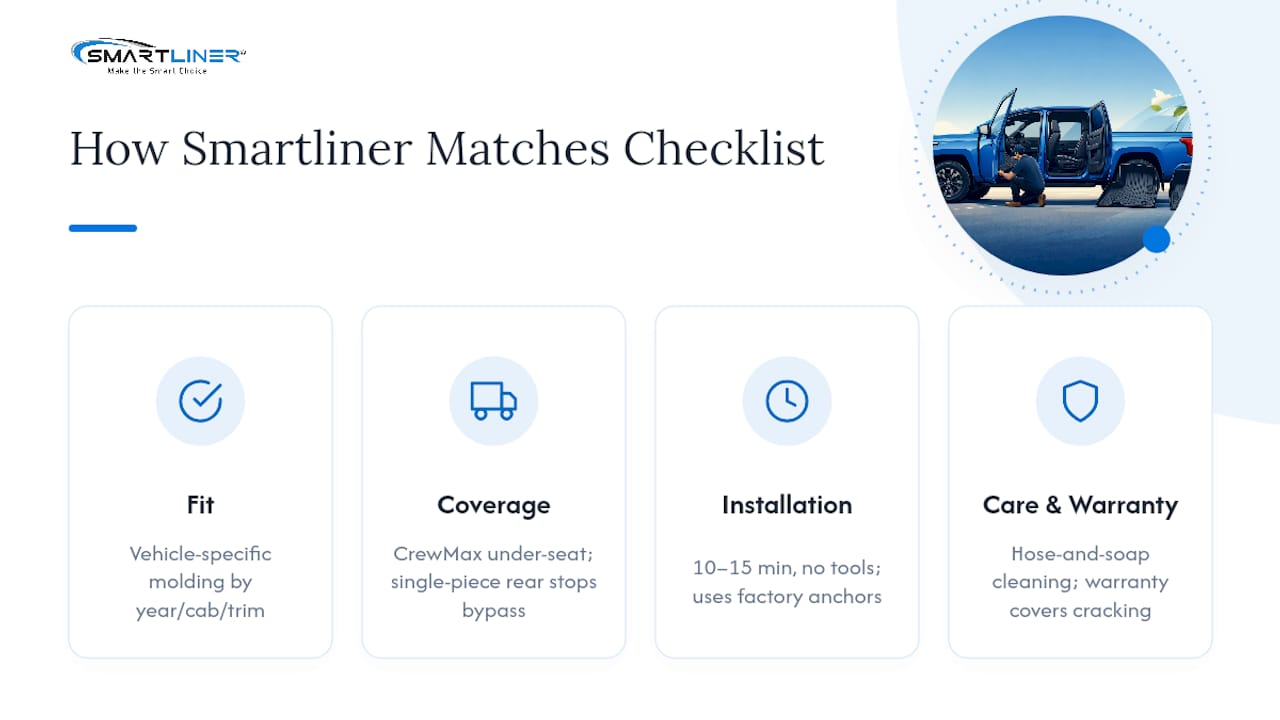
Smartliner builds its Tundra liners around the same fit-first logic the checklist above demands. Each SMARTLINER Floor Liner is molded to a specific year, cab type, and trim rather than stretched across a generic truck-bed shape, which is why the fitment guidance on comparable Tundra liner tests consistently flags vehicle-specific molding as the difference between a liner that disappears into the floor pan and one that visibly floats above it.
Material is where Smartliner leans hardest into its brand identity.
Coverage is built around the trouble spots owners actually complain about. For CrewMax cabs, Smartliner offers a rear liner with coverage under the second-row seat, closing off the gap where loose gravel and dog hair usually collect. Owners of earlier trucks aren’t left out either. The 2012-2013 CrewMax fitment and the 2007-2011 Tundra liner set cover older trucks that still see daily work.
Real-world owner reports on comparable Tundra liners point to single-piece rear coverage as the feature that most reduces dirt bypassing the mat, since a seamed liner always leaves an entry point at the joint.
Installation typically takes ten to fifteen minutes with no tools, since the liners drop onto the factory anchor points rather than requiring drilling or adhesive. Cleaning is a hose-and-soap job. Warranty terms cover manufacturing defects like premature cracking or warping, which matters more than most buyers realize once a liner is a few winters old.
Which Mat Setup Fits Your Actual Tundra Use
Not every Tundra owner needs the same liner priorities. A contractor hauling tools through a job site five days a week has different failure points than a parent shuttling kids and a muddy dog on weekends.
- Daily work trucks need abrasion resistance up front, since dropped tools and gritty boots wear the driver’s side faster than anywhere else. A thicker-gauge TPE liner with reinforced heel pads holds up better than a lighter-duty mat here.
- Family haulers with kids and pets benefit most from high sidewalls and full rear coverage, since spilled juice boxes and muddy paws hit the second row as often as the front. Prioritize a one-piece rear liner over sidewall thickness in this case.
- Off-road and outdoor use calls for a liner that handles standing water and mud without staying stiff in cold weather. TPE’s flexibility down to subzero temperatures beats rubber here, since a brittle mat cracks at the folds exactly where debris accumulates.
- Seasonal swap strategy works well for owners in states with harsh winters. Keep a dedicated all-weather set for salt and snow season, then switch to a lighter set the rest of the year to reduce wear on any single set of liners.
The trade-off across all four scenarios is largely the same: more rigidity and thicker walls buy you abrasion resistance but add a small amount of stiffness in extreme cold, while a more flexible compound trades a bit of raw toughness for comfort and cold-weather performance.
How Do You Confirm The Right Fit For Your Tundra?
Getting the fit wrong is the most common and most avoidable mistake Tundra owners make when shopping for liners. Before you buy, confirm four fields on any product page: model year, cab style (CrewMax, Double Cab, or Regular Cab), trim level, and drivetrain, since some 4x4 models have a slightly different transmission tunnel shape than 2WD versions.
CrewMax owners need extra care here. The rear liner with second-row coverage is built specifically to wrap the transmission hump and reach under the seat track, so double-check that the listing explicitly mentions under-seat coverage rather than assuming any CrewMax-labeled mat includes it. Double Cab owners have their own dedicated fitments, including this Double Cab liner with second-row coverage and the 2012-2013 Double Cab option
Once the liner arrives, run through this quick installation check:
- Confirm all factory anchor posts line up with the liner’s grommets before pressing it flat.
- Sit in the driver’s seat and press the brake and gas pedals through full travel to confirm no edge interferes.
- Allow a short break-in period. TPE liners sometimes need a day or two to fully settle into the floor pan’s contours.
- If a liner edge overlaps a plastic trim piece by a fraction of an inch, light trimming with scissors is normal. If it’s off by more than that, contact support before you cut anything.
Pro Tip: Take a photo of your factory floor mats’ anchor grommets before removing them. It’s the fastest way to describe your exact setup if you ever need to call support about a fitment question.
TPE vs. Rubber vs. Hybrid: What Actually Lasts?
TPE is the material to beat for most American climates. It stays flexible from roughly negative 20°F to 140°F, which covers everything from a Minnesota February to a Phoenix summer dashboard, and modern formulations include UV stabilizers and anti-aging compounds that push cracking and fading out several years further than older rubber compounds managed.
Vulcanized rubber still has a place. It resists pure abrasion slightly better than TPE, which matters if you’re dragging tool bags or lawn equipment across the mat daily. Its weak point is cold brittleness. Independent testing shows rubber can lose flexibility through repeated freeze-thaw cycles, where TPE tends to hold its shape.
Hybrid composites blend a firmer core with a softer top layer, mainly to cut down road noise and add a bit of cushioning. They’re a reasonable middle ground if ride comfort matters more to you than raw toughness.
Quick comparison:
| Material | Cold weather performance | Abrasion resistance | Typical feel |
|---|---|---|---|
| TPE | Excellent, stays flexible in deep cold | Very good | Slightly cushioned, quiet |
| Vulcanized rubber | Can stiffen and crack over time | Excellent | Firm, dense |
| Hybrid composite | Good | Good | Softest underfoot |
Given UV-stabilized TPE’s documented lifespan advantage, it’s the safer long-term bet for anyone who parks outside year-round.
Cleaning, Warranty, And What Your Mats Really Cost Over Time
Cleaning a TPE liner is simple: hose it off, scrub with a pH-neutral soap and soft brush, and let it air dry. Avoid harsh solvents and forced heat-drying, since both can degrade the backing and, in some cases, void a manufacturer’s warranty.
When you compare warranties, look specifically for coverage against cracking and warping, not just a generic “manufacturing defect” clause that excludes normal wear. A three-year warranty on a $150 liner set works out to $50 per year of coverage, a useful number to compare directly against a cheaper mat with no warranty at all that might need replacing after one winter.
- Hose off loose debris before scrubbing to avoid grinding grit into the surface.
- Use a soft-bristle brush, never a wire brush, on textured grip patterns.
- Store off-season liners flat, not folded, to avoid permanent creases.
- Rotate a winter-specific set into use before the first salted road of the season.
Can You Customize The Look Of Your Tundra’s Floor Mats?
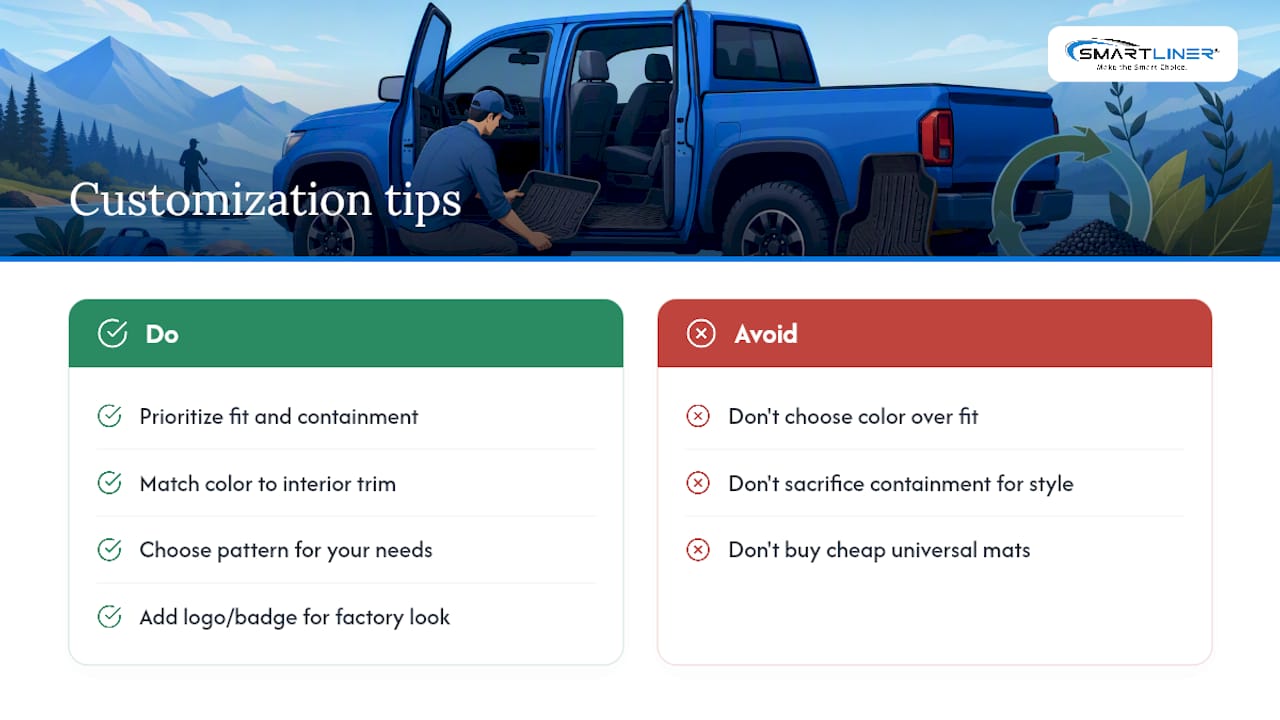
Protection doesn’t have to mean a plain black mat that disappears into your interior. Most custom-fit liner programs, including Smartliner’s, offer color options beyond basic black, letting owners match interior trim or simply pick a shade that hides dust and lint better than solid black does. Tan and gray tones are common requests from owners who want something closer to their factory interior color.
Pattern and texture also vary by product line. A deeper, more aggressive channel pattern moves liquid toward containment edges faster, while a shallower texture is easier to wipe clean but holds slightly less standing water before it needs draining.
Logo and badge options exist on some liner lines as a smaller functional detail, giving the mat a finished, factory-installed look rather than an obvious aftermarket add-on. It’s a minor point compared to fit and material, but it’s part of why custom liners read as a step up from a $30 universal mat picked up at a big-box store.
None of this customization should come at the expense of the containment and coverage features covered earlier. Color and pattern are the last decision in the buying process, not the first, and a great-looking mat that doesn’t fit your CrewMax’s transmission tunnel still leaves the same gaps a plain black universal mat would.
Are Tundra Floor Mats Bad For The Environment?
Rubber and PVC mats that crack after two winters usually end up in a landfill, and neither material breaks down quickly. TPE changes that equation somewhat, since it’s fully recyclable at the end of its service life rather than destined for permanent disposal.
Smartliner markets its liners around this exact point, positioning 100% recyclable materials as a core part of its product identity rather than an afterthought. That matters more than it might seem at first glance: a liner that lasts five or six years instead of two, and that can be recycled rather than landfilled when it’s finally retired, has a meaningfully smaller footprint than a cycle of cheap mats replaced every winter.
The manufacturing side matters too. TPE production generally requires less energy-intensive processing than vulcanized rubber, though the bigger environmental lever for any Tundra owner is simply buying a liner built to last rather than one you’ll replace every season. Fewer replacement cycles means less material extracted, processed, and shipped over the life of your truck, and a genuinely durable mat is the more sustainable choice even before recyclability enters the picture.
An Honest Take On What Actually Matters Here
Most buying guides treat floor mats like a commodity decision, where the cheapest option that technically fits your truck is good enough. That’s backwards. A Tundra’s floor pan sees more abuse over its lifetime than almost any other interior surface, and a mat that doesn’t fully seal the transmission tunnel or holds only a quarter inch of liquid before overflowing isn’t protecting anything. It’s just delaying the inevitable carpet replacement.
Smartliner’s approach, precise molded fit, recyclable TPE, and coverage that actually reaches under the CrewMax second row, addresses the real failure points rather than the ones that photograph well in a product listing… If you’re weighing fit against price against material, fit wins every time, and everything else in this guide exists to help you verify it before you buy.
— Marty
Where To Buy Custom-Fit Liners For Your Tundra
Smartliner’s advantage over a generic auto parts aisle is straightforward: every liner is built to a specific year, cab, and trim instead of a one-size-fits-most shape, so you’re not guessing whether the mat you’re ordering will actually clear your pedals or seal off the transmission tunnel. That precision is also why Smartliner backs its liners with a manufacturer’s warranty against cracking and warping, along with a standard return and exchange policy if a fitment ever comes up short.
Start by pulling up the SMARTLINER Floor Liners page and entering your Tundra’s exact year, cab style, and trim to confirm compatibility before you check out. If you haul gear regularly, pair your floor liners with the SMARTLINER Truck Bed Mat Liners for full interior-to-bed protection, or add SMARTLINER Cargo Liners if you’re outfitting a second vehicle in the household. Confirm your VIN details, order the fitment that matches your cab, and you’ll have a liner that actually does the job a mat is supposed to do.
Sources
- The Ultimate Guide to Car Floor Mats: How to Choose the Best for Your Vehicle in 2026 - Automotive Tools Guide
- LASFIT Tundra Floor Mats Review: Pros, Cons, Verdict - CarXplorer
- What makes a floor mat all-weather - CarBuzz
Recommended
- SMARTLINER Custom Fit Floor Liners For 2007-2011 Toyota Tundra
- SMARTLINER Custom Fit Floor Liners For 2012-2013 Toyota Tundra Double Cab
- SMARTLINER Floor Liners for 2014-2021 Toyota Tundra Double Cab (with Coverage Under 2nd Row Seat)
- SMARTLINER Custom Fit Floor Liners For 2012-2022 Toyota Tundra & Sequoia