

For most truck owners who want edge-to-edge protection against mud, snow, and job-site debris, custom-fit TPE liners outperform universal rubber mats on every practical measure. Some custom-fit floor liners deliver a strong combination of precise fit, raised-wall containment, and price relative to premium competitors. Budget-conscious buyers who need a short-term fix for a rental or a truck they plan to sell soon can still get by with a universal mat, but anyone keeping their truck more than a season should skip that compromise entirely.
TL;DR:
- Custom-fit TPE liners with raised edges offer superior containment, especially at entry points, compared to universal mats that leave gaps and allow debris to spread.
- Proper installation with factory anchor points and close-to-sill coverage prevents liner slippage and pedal interference, reducing safety risks during driving.
- TPE material resists heat buildup, odor, and staining, making it more durable and easier to maintain long-term than rubber or PVC options.
- For extended ownership and resale value, investing in laser-measured liners that preserve factory carpet is more cost-effective than short-term universal mats.
- Coverage should match your routine: full-row and cargo protection for work or outdoor use, and front-only for light, casual driving to avoid over- or under-protecting your truck.
Table of Contents
- Which Truck Floor Mats Are Worth Buying?
- Why Custom-Fit Liners Beat Universal Mats for Real Protection
- TPE vs Rubber vs PVC: Which Material Actually Holds Up?
- How to Choose the Right Liner for Your Truck
- How to Clean and Maintain Truck Floor Liners
- Smartliner’s Approach to Custom-Fit Protection
- Which Pick Should You Actually Buy?
- Liners vs. Mats: What Coverage Actually Means
- TPE, Rubber, and PVC: Behavior in Heat and Cold
- Getting the Anchors and Pedal Clearance Right
- The Hose-Off Routine That Keeps Liners Looking New
- What You’re Really Paying For
- Fitting Crew Cabs, Extended Cabs, and Multi-Row Trucks
- What a Real Warranty Should Cover
- Getting Liners In and Out Without a Struggle
- Matching Liners to How You Actually Use Your Truck
- How Truck Mat Brands Differ in Practice
- What Truck Owners Actually Say After Months of Use
- Return Policies and Getting Help When Fit Is Wrong
- What I’ve Learned From Living With Liners Day to Day
- Where to Find the Right Smartliner for Your Truck
- Sources
- FAQ
Which Truck Floor Mats Are Worth Buying?
Not every liner on the market deserves a spot in your truck. Some are laser-measured to your exact cab; others are cut to a generic template and hope for the best. Here is how the top categories stack up once you separate marketing language from what actually happens on a muddy job site or a snowy commute.
- Best overall for daily drivers: Custom-fit TPE floor liners with raised edges and a channeled surface. They trap water, mud, and road salt in a contained basin instead of letting it wick into carpet fibers.
- Best value custom option: Smartliner Floor Liners balance laser-scanned fitment against a price that undercuts many premium competitors, without giving up the raised-wall containment that makes custom liners worth buying in the first place.
- Best for contractors and mud season: Heavy-duty TPE liners with deep front-row wells and tall lips over the door sill, matched with a bed mat for the cargo area.
- Best for multi-row crew cabs: Full sets that cover front, second-row, and sometimes third-row footwells, since a mat that stops at the front seats leaves half the cab exposed.
- Best for off-road and utility use: UTV Floor Mats built for the same abuse trucks see, just scaled to smaller cabs.
Car and Driver’s long-term testing across multiple vehicles found that SmartLiner performed particularly well on fit, containment, and cleanability, with testers specifically calling out the lip over the door sill and tub-like water containment as standout features. That door-sill detail matters more than it sounds. Most spills and mud tracking happen right at the entry point, and a liner that stops the sill from acting as a dam for standing water keeps your rocker panels dry too.
MotorTrend’s testing separately rated premium TPE-based liners highly for slip resistance and easier removal for cleaning, which reinforces a pattern worth remembering: the material under your boots matters just as much as the shape of the mat.
If your truck doubles as a work vehicle, pair your cab liner with a dedicated cargo solution. Cargo areas take a different kind of punishment, hauling tools, dog crates, or grocery runs, and a liner built for that space holds up better than repurposing a cab mat. Smartliner’s cargo liner lineup shows how that fitment logic extends beyond the front seats.
Why Custom-Fit Liners Beat Universal Mats for Real Protection
A universal mat is a compromise dressed up as a product. It is cut to fit “most” trucks, which in practice means it fits none of them precisely. Custom-fit liners solve this with what amounts to a 3D tray: raised walls molded to trace the exact contour of your specific footwell, turning what used to be exposed carpet into a shallow basin that holds spills instead of spreading them.
Three things separate a genuinely protective liner from a mat that just sits on top of your carpet:
- The tray effect. Raised edges molded around your truck’s specific floor pan stop water, coffee, and mud from migrating toward the console or door panels.
- Retention hardware. Anchors or clips that lock the liner in place prevent it from sliding under the brake or accelerator pedal, a safety issue that generic mats create far more often than fitted liners.
- Edge coverage. A liner that runs close to the door sill and around pedal housings leaves no gap where debris can slip underneath and grind into the carpet.
Truck Gear Nation’s breakdown of containment mechanics confirms that raised walls and exact-fit design turn the footwell into a basin rather than a flat surface debris can slide off of, and it flags the pedal-entrapment risk that comes with mats that shift underfoot.
Pro Tip: Before buying any liner, press down on a flat universal mat sample near the accelerator pedal. If it slides more than half an inch without resistance, it lacks the retention grip your pedals need.
The cost difference is real. Custom liners typically run higher than a generic three-piece rubber set, but Topspeed’s analysis notes that custom-fit liners better preserve factory carpet and can help protect resale value, which usually outweighs the upfront gap over a multi-year ownership period. Universal mats still make sense for a short-term rental, a truck you’re flipping within months, or a loaner vehicle where long-term protection isn’t the point.
TPE vs Rubber vs PVC: Which Material Actually Holds Up?
TPE (thermoplastic elastomer) is the material most truck owners should default to, and the reasoning comes down to three practical factors: odor, heat behavior, and cleanup.
- TPE: Resists heat buildup in a sun-baked cab, stays odor-neutral over years of use, and wipes or hoses clean without retaining stains.
- Rubber: Durable and inexpensive, but heavier, stiffer in cold weather, and prone to a persistent rubbery smell that some owners find unpleasant in an enclosed cab.
- PVC/TPO: Often the cheapest option, but more prone to off-gassing in high heat and less flexible over time, which can lead to cracking at the folds.
GarageGist’s material comparison backs this pattern directly, finding that TPE offers superior heat resistance and odor neutrality compared with many PVC and rubber alternatives, a meaningful edge for a truck that sits in a parking lot all afternoon. Industry commentary on off-gassing also points to a consistent complaint with cheap PVC: heat exposure intensifies the plastic smell, while TPE stays largely neutral even after years in direct sun.
Marketing terms like “tri-extruded” or “HDTE” (high-density thermoplastic elastomer) describe manufacturing processes that layer material for added durability at the wear points, mainly the heel area and pedal zone. In practical terms, they signal a liner built to resist cracking at the fold lines where a flat rubber mat would eventually split.
Material choice shows up years later, not on day one. A TPE liner that started jet black usually still looks close to new after three winters of salt exposure. A PVC mat from the same era often shows chalky fading and a curl at the edges where it was folded during shipping.
How to Choose the Right Liner for Your Truck
Buying the right liner is a four-step process, and skipping any one of them is how people end up with a mat that looks right in photos but fails in the cab.
- Confirm year, make, and model fit. A liner listed for the wrong cab configuration, regular cab versus crew cab, for instance, will leave gaps no matter how good the material is.
- Check retention compatibility. Verify the liner includes anchor points or clips matched to your factory floor hooks, not a generic peg that may not align.
- Verify edge height and coverage. Higher front walls matter more for contractors and off-roaders; lower profiles suit owners who prioritize a cleaner look.
- Confirm the warranty. A liner backed by a real warranty tells you the manufacturer expects it to last, not just survive the return window.
Red flags to watch for on any product page: no mention of anchor points, a thin lip that barely rises above the mat surface, or vague material descriptions like “premium rubber blend” with no named polymer. If a listing can’t tell you whether it’s TPE, PVC, or rubber, assume it’s the cheapest of the three.
Pro Tip: Match coverage to your actual routine, not your ideal one. A contractor hauling tools daily needs deep-well front liners and a bed mat. A family hauling groceries and soccer gear needs full-row coverage more than extra depth. An outdoor enthusiast hauling dogs and gear after trail days needs both, plus a cargo liner.
CarMatLab’s buying guidance echoes this same sequence, noting that laser-measured fitment and lifetime warranties are the two clearest trust signals separating a serious liner brand from a generic import.
How to Clean and Maintain Truck Floor Liners
TPE and rubber liners both respond well to a simple routine: pull them out, hose them down, scrub stubborn spots with mild dish soap and a soft brush, then let them air dry flat before reinstalling. Avoid bleach and harsh solvents. They can degrade the surface texture that gives TPE its grip and, over time, dull the finish faster than plain soap and water ever would.
A few habits keep liners performing for years instead of degrading after one winter:
- Hose off liners every few weeks during salt season rather than waiting for visible buildup.
- Dry them fully before reinstalling; trapped moisture under a liner is exactly what causes hidden carpet mold.
- Flatten shipping creases by laying the liner flat in the sun for an hour or two before first use.
- Store a spare set flat, not rolled, if you swap between seasonal liners and all-weather mats.
- Check manufacturer warranty terms before attempting aggressive cleaning methods like pressure washing, since some coverage excludes damage from improper cleaning.
TPE’s cleaning advantage over rubber isn’t just anecdotal. Its surface resists staining because it doesn’t absorb oils and road grime the way porous rubber can over several seasons, which is part of why GarageGist’s material testing ranks it ahead on long-term appearance retention.
Smartliner’s Approach to Custom-Fit Protection
Some floor liners and cargo liners use laser-measured, custom-fit technology designed to match specific cabs down to the contour of the footwell, not a generic template stretched across multiple models.
The checklist that matters for real protection maps directly onto what some manufacturers ship:
- Precise fit: Liners are scanned to specific year, make, and model combinations rather than sized to a rough category.
- Raised-wall containment: Edges rise around the footwell to hold spills and mud rather than letting them spread to carpet.
- Durable material: Built from all-weather material designed to handle repeated exposure without degrading.
- Straightforward installation: Liners drop into place using factory anchor points, without special tools or trimming.
Long-term testing from Car and Driver found that SmartLiner’s fit and containment held up well across repeated use, particularly around the door sill lip. That kind of independent, hands-on evaluation is worth more than a spec sheet, since fit problems in liners usually only show up after months of real use, not on day one out of the box.
Which Pick Should You Actually Buy?
If you drive a crew cab and haul tools most weekdays, a full-coverage TPE liner set with a matching bed mat solves both the cab and cargo problem at once. If you’re outfitting a family truck, prioritize full second-row coverage over extra depth, since kids and groceries create more spread-out mess than concentrated mud. If your truck doubles as a trail vehicle on weekends, add a cargo liner to the mix so gear doesn’t scuff factory carpet in the back.
The consistent thread across every use case is the same: custom fit beats universal fit, and TPE beats PVC or rubber for anyone who wants the liner to still look good after three years. Smartliner’s floor liner lineup checks both boxes without pushing into premium-brand pricing.
Skip universal mats unless your ownership horizon is measured in months, not years. The math on a custom liner pays off almost every time once you factor in preserved carpet and resale condition.
Liners vs. Mats: What Coverage Actually Means
“Floor mat” and “floor liner” get used interchangeably, but the distinction matters. A flat mat sits on top of carpet with little or no raised edge. A liner is molded with walls that rise around the footwell, creating actual containment instead of just a barrier layer.
Universal mats are cut to a rough size range meant to fit “most” trucks in a category. That approximation leaves gaps along the transmission hump, around pedal housings, and at the door sill, exactly the spots where debris and moisture concentrate. Custom liners are scanned to a specific vehicle’s floor pan, so the raised wall traces the actual contour instead of an average.
CarMatLab’s comparison frames the tradeoff bluntly: custom-fit wins on containment and stability, while universal mats remain a budget-only tool for short-term use. That framing holds up in practice. A universal mat can look fine in a listing photo and still fail the moment a coffee spill hits the edge where coverage runs out.
TPE, Rubber, and PVC: Behavior in Heat and Cold
Temperature swings expose material weaknesses faster than anything else a truck floor liner faces. TPE holds its flexibility in cold weather and resists softening or off-gassing in summer heat, which is why it dominates premium liner lineups. Rubber survives extreme cold reasonably well but stiffens more than TPE and often carries a persistent odor that intensifies in a hot cab. PVC and TPO blends tend to be the most heat-sensitive of the three, with a higher risk of off-gassing when a truck sits in direct sun for hours.
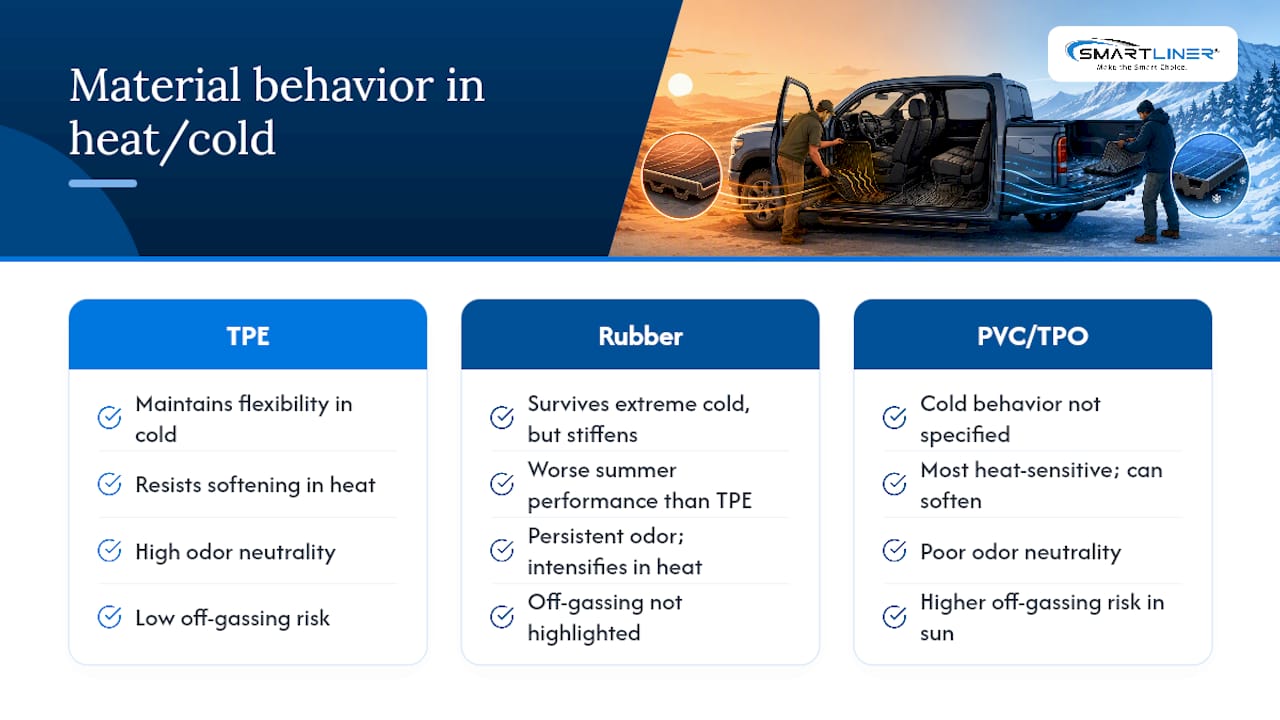
GarageGist’s comparison work isolates this exact pattern, finding TPE liners rated highest for summer performance and odor neutrality against both alternatives. For truck owners in hot climates especially, that heat behavior isn’t cosmetic. A liner that softens and traps odor in July is a liner you’ll want to replace within a year or two, erasing whatever you saved buying cheaper material upfront.
Getting the Anchors and Pedal Clearance Right
Retention hardware is the most overlooked part of any floor liner purchase, and it’s also the part with real safety stakes. A liner without a way to lock into your truck’s factory anchor points can slide forward under braking, and in the worst case, wedge under the accelerator or brake pedal.
Truck Gear Nation’s analysis of containment mechanics flags this directly, noting that poorly fitted mats create genuine pedal-entrapment risk when retention hardware is missing or mismatched. Buyers often treat anchor pegs as a minor spec, but a liner that clips into your factory floor hooks stays locked in place through hard stops and sharp turns, while an unanchored mat migrates with every drive.
Before buying, confirm the liner lists compatible retention points for your exact trim. Some trucks use two anchor points per side, others use a single center clip, and a mismatch means the liner sits loose no matter how well it was cut otherwise.
The Hose-Off Routine That Keeps Liners Looking New
Cleaning a TPE or rubber liner takes minutes, not a full detailing session. Pull the liner out of the cab, hose it down to knock loose dried mud and debris, then use mild soap and a soft brush on any remaining grime, particularly in the channeled grooves designed to trap water. Rinse thoroughly and let it air dry flat rather than propping it against a wall, which can warp the shape over time.
Winter driving adds a wrinkle: road salt. Left to dry on a liner’s surface, salt residue can eventually etch into rubber and leave a chalky film on TPE. Regular rinsing during salt season prevents that buildup from ever setting in, and it protects the carpet underneath from the corrosive effects road salt exposure causes over a winter of neglect. That same principle extends to the rest of the cab; a liner does no good if salt-laden slush pools around it rather than draining off.
Avoid pressure washers on close settings, since concentrated water pressure can push into seams and stress retention clips over time. A garden hose on a standard nozzle setting does the job without the risk.
What You’re Really Paying For
Universal rubber mats typically cost a fraction of a custom liner set, and that gap is real. But the comparison changes once you account for what each option actually protects. A universal mat protects the top layer of carpet from light foot traffic. A custom liner protects the entire footwell, including the parts of the cab a flat mat never covers.
Topspeed’s analysis on resale puts a number on the intangible side of this tradeoff, noting that custom liners better preserve factory carpet condition, which matters directly at trade-in or private sale. A truck with stained, worn factory carpet loses negotiating leverage fast, and re-carpeting a cab professionally costs far more than the price difference between a universal mat and a custom liner ever would.
The practical way to think about it: a custom liner is closer to insurance for your factory carpet than it is to a disposable accessory. Paid once, it protects an asset, factory carpet condition, that directly affects what your truck is worth years down the road.
Fitting Crew Cabs, Extended Cabs, and Multi-Row Trucks
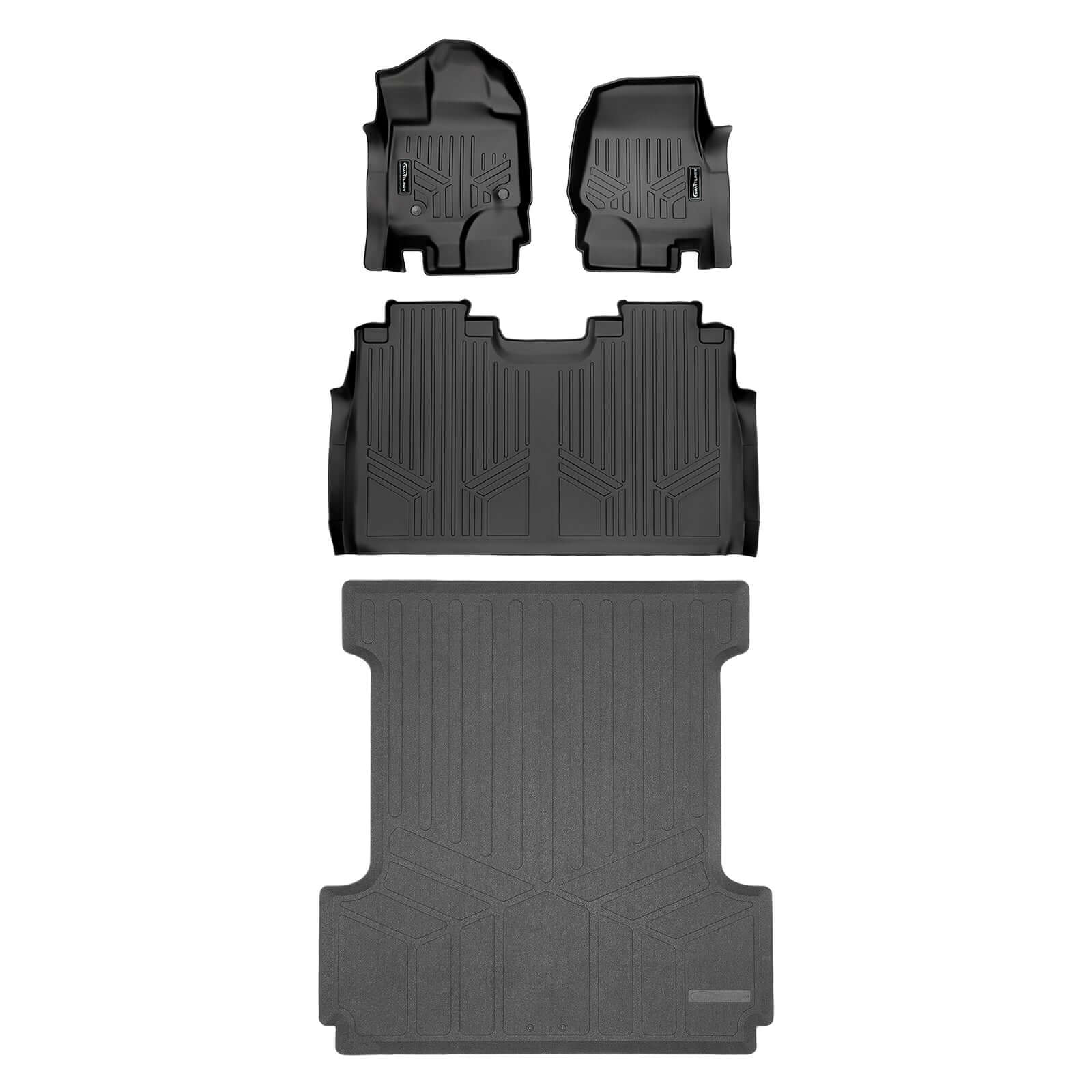
Coverage gets more complicated the more rows a truck has. A regular cab needs front-row protection only, but crew cabs and extended cabs need liners that extend into the second row, where kids, dogs, and cargo create just as much mess as the front seats.
The mistake many buyers make is assuming a “front and rear” set automatically covers every configuration. Second-row footwells vary significantly between trim levels, especially around transmission humps and underseat storage bins, so a liner designed for one trim can leave gaps in another. Always confirm the specific cab configuration, not just the model year, when selecting a set.
Smartliner’s fitment catalog breaks this down by exact configuration, including options built specifically for common crew cab and extended cab combinations rather than a one-size-fits-all approach across trims.
What a Real Warranty Should Cover
A warranty is one of the clearest signals of how confident a manufacturer is in its own material. Lifetime warranties on liners typically cover cracking, material degradation, and manufacturing defects, though most exclude damage from improper cleaning methods like bleach or aggressive pressure washing.
CarMatLab’s guidance identifies lifetime warranties and laser-measured fitment as the two strongest trust signals buyers should look for when comparing premium liner brands. A liner backed by a real warranty also tends to hold up better in practice, since manufacturers offering long-term coverage have a financial incentive to use materials that won’t crack or fade within a year or two.
Before buying, check exactly what a warranty claim requires. Some brands require proof of purchase and photos of the defect; others require the liner to have been cleaned only with approved methods. Reading that fine print before a problem happens saves a frustrating dispute later.
Getting Liners In and Out Without a Struggle
Installation for most custom-fit liners takes under ten minutes per row, with no tools required. The process usually involves aligning the liner’s molded shape with the footwell, then clipping it into the factory anchor points that hold your original mats in place.
The most common installation mistake is forcing a liner that doesn’t align correctly, usually a sign the wrong fitment was ordered. A liner scanned to your exact model should drop into place without pressing or trimming. If it doesn’t, that’s a fitment issue to resolve with the seller before continuing to use it.
Removing liners for cleaning is just as simple: unclip from the anchor points, lift out, hose off, and reinstall once dry. That ease of removal is part of why TPE liners rated well in MotorTrend’s testing for slip resistance and easier removal compared with heavier rubber alternatives that can feel like wrestling a tire out of a footwell.
Matching Liners to How You Actually Use Your Truck
A contractor’s truck and a weekend family hauler need different things from a liner, even if both are the same model year. Contractors should prioritize deep front-row wells, tall lips for wet boots, and a matching bed mat, since the cab takes daily abuse from work boots, tools, and job-site debris. Off-road and outdoor use calls for full-row coverage plus a cargo liner, since trail dust, wet gear, and dog hair spread further than typical daily commuting mess.
Daily drivers without heavy work or off-road demands can often get by with a standard-depth front and second-row set, prioritizing easy cleaning over maximum containment depth. The mistake to avoid is buying based on your truck’s capability rather than your actual routine. A liner built for extreme mud season is overkill for someone who mostly drives to an office, and a lightweight set won’t survive a contractor’s daily grind.
How Truck Mat Brands Differ in Practice
The floor mat market splits roughly into three tiers: premium custom-fit brands using laser-scanned technology and name-brand materials, mid-range brands that offer decent universal fit at a lower price, and budget imports that prioritize price over everything else.
Premium brands, including Smartliner, differentiate mainly through fitment precision and material quality, backed by warranties that signal confidence in long-term durability. Mid-range universal brands serve a real purpose for short-term ownership or budget-constrained buyers, but they consistently show gaps in coverage that testing from both Car and Driver and MotorTrend has documented across multiple vehicle categories. Budget imports vary wildly in quality, since “custom fit” claims on cheap listings aren’t always backed by actual laser-scanned measurements.
The clearest way to sort reputation from marketing is checking whether a brand publishes real fitment data, by year, make, model, and cab configuration, rather than vague category labels like “full-size truck.”
What Truck Owners Actually Say After Months of Use
Feedback that holds up over time tends to center on three things: whether the fit stayed tight after repeated use, whether the material held its color and shape, and how easy cleaning stayed after a full season of mud or snow. Complaints about universal mats consistently mention slippage and gaps at the edges, exactly the failure points custom-fit design solves.
Long-term testing corroborates what individual owners report anecdotally. Car and Driver’s extended evaluation found that SmartLiner fit and containment held up consistently across repeated use, rather than degrading noticeably after the first few months, which is often where cheaper mats start to show their limits.
Return Policies and Getting Help When Fit Is Wrong
Fitment mistakes happen even with laser-measured products, usually because a buyer selects the wrong trim or cab configuration rather than a manufacturing error. A reasonable return policy accounts for that reality, offering an exchange path rather than treating every return as a lost sale.
When comparing sellers, check whether returns require the liner to be unused and whether the company offers a way to confirm fitment before you buy, through VIN lookup or detailed trim selection. That upfront verification step prevents most fitment disputes before they start, which matters more than the return policy itself in most cases.
What I’ve Learned From Living With Liners Day to Day
Custom-fit TPE liners are the right call for nearly every truck owner, and the reasoning holds up under real use, not just spec comparisons. The scenario that convinces most skeptics is simple: a rainy job site, wet boots, and a five-minute drive home. A universal mat lets that water spread toward the console. A properly anchored custom liner holds it in a shallow basin until you can hose it out that evening.
If your daily habits involve mess, mud, kids, gear, work boots, choose coverage and containment first. Everything else about a liner is secondary to whether it actually holds what it’s supposed to hold.
— Marty
Where to Find the Right Smartliner for Your Truck
Every criterion covered here, precise fit, raised-wall containment, durable material, and fair pricing against premium competitors, is considered in some product lineups rather than treated as an upsell. For cab protection, Smartliner Floor Liners cover the front and second-row footwells with laser-measured accuracy specific to your truck’s year, make, and model. For hauling tools, gear, or muddy dogs, Smartliner Cargo Liners extend that same containment logic to the bed and trunk area. Owners who also run a UTV or side-by-side can outfit it with matching UTV Floor Mats built for identical abuse in a smaller footprint.
Start by checking fitment for your specific truck model on the Smartliner Floor Liners page, confirm your cab configuration, and place your order directly online. That single step, matching year, make, model, and trim, is what separates a liner that fits perfectly from one that almost does.
Sources
- Best Car and Truck Floor Mats for 2026, Tested
- Best Floormats for 2026 Tested: The Best Mats, Ranked
- Are custom-fit floor mats worth it?
FAQ
Is Anything Better Than WeatherTech Mats?
Several premium custom-fit brands compete closely with WeatherTech on fit and containment, and testing from Car and Driver found SmartLiner performed strongly on the same criteria, fit, containment, and cleanability, often at a more accessible price point.
Which Car Floor Mats Are the Best Quality?
Custom-fit TPE liners with raised walls and factory-anchor retention consistently rate highest in independent testing for containment and long-term durability, according to both Car and Driver and MotorTrend.
Are Husky or WeatherTech Mats Better?
Both are respected universal and semi-custom options, but neither is the only choice worth considering. Laser-measured custom liners from brands like Smartliner match or exceed their containment performance while typically costing less.
Are WeatherTech Mats Really Worth It?
WeatherTech mats perform well in independent testing, but “worth it” depends on price sensitivity. Buyers who want comparable fit and containment at a lower cost have solid alternatives in other laser-measured custom-fit brands.
How Often Should I Clean My Truck Floor Liners?
Hose off liners every few weeks during salt season and after any heavy mud or spill exposure, then let them dry fully before reinstalling to prevent trapped moisture underneath.