

Smartliner’s custom-fit TPE floor liners are the best overall pick for most vehicle owners, particularly families, pet owners, outdoor enthusiasts, and anyone hauling cargo, because the material resists cracking and staining while wiping clean in seconds. The precise-fit design closes the gaps universal mats leave open, so spills, mud, and road salt stay off the carpet instead of soaking through it.
TL;DR:
- Custom-fit TPE floor mats provide superior protection and precise coverage, especially for families, pet owners, and outdoor enthusiasts, by sealing gaps and preventing spills from reaching the carpet.
- TPE material maintains flexibility across temperature ranges, resists porosity, and is recyclable, making it more durable and odor-resistant than older foam or carpet-backed mats.
- Proper installation requires matching the exact vehicle model and trim, ensuring the mats lock into factory retention points to prevent movement and safety hazards.
- Regular cleaning involves rinsing with water and mild detergent, with quick spot treatment for stains; replacement is needed after cracks, permanent deformation, or persistent odors.
- Smartliner’s laser-measured design, high-quality TPE, and engineered retention system consistently meet standards for fit, durability, and safety, earning high marks from independent reviews.
Table of Contents
- What Are the Best TPE Floor Mats Right Now?
- What Makes TPE the Right Material for Car Floor Mats?
- How Do You Know a TPE Mat Is Actually Good?
- How Do You Clean and Maintain TPE Floor Mats?
- Does Smartliner’s TPE Lineup Actually Meet These Standards?
- How Do You Order the Right Fit and Install It Safely?
- Why TPE Mats Changed How I Think About Car Ownership
- Ready to Protect Your Interior? Here’s Where to Start
- Sources
What Are the Best TPE Floor Mats Right Now?
Choosing the right TPE mat comes down to matching the product to how you actually use your vehicle, not just picking the highest-rated option online. Smartliner’s catalog splits cleanly into three buying paths depending on budget and use case.
- Best overall: SMARTLINER Floor Liners. Laser-measured for specific model years, these liners feature raised edges, textured heel zones, and a non-slip underside that locks to factory retention hooks. Expect a fit tight enough that you forget it’s aftermarket.
- Best for tight budgets: smaller trim-specific sets like the Smart Trim™ liners for Tahoe and Yukon models, which cover front-row exposure at a lower price point without sacrificing the same TPE compound.
- Best for heavy-duty and outdoor use: SMARTLINER Cargo Liners, UTV Floor Mats, and Truck Bed Mat Liners, built for gear, dogs, dirt bikes, and job-site debris rather than daily commuting.
Pricing tracks with coverage. Front-and-rear liner sets for sedans and crossovers typically run in the same range as most premium molded custom-fit mats, while cargo and UTV pieces cost more because they cover larger, more exposed surfaces. If you tow a boat every weekend or your dog rides in the back seat more than the front, the cargo and UTV lines earn their higher price faster than a front-mat-only setup would.
What Makes TPE the Right Material for Car Floor Mats?
Thermoplastic elastomer, or TPE, is a synthetic compound that behaves like rubber but processes like plastic, which is why manufacturers can mold it into precise, vehicle-specific shapes instead of trimming generic sheets to fit. That molding precision is the entire reason custom-fit liners exist as a category.
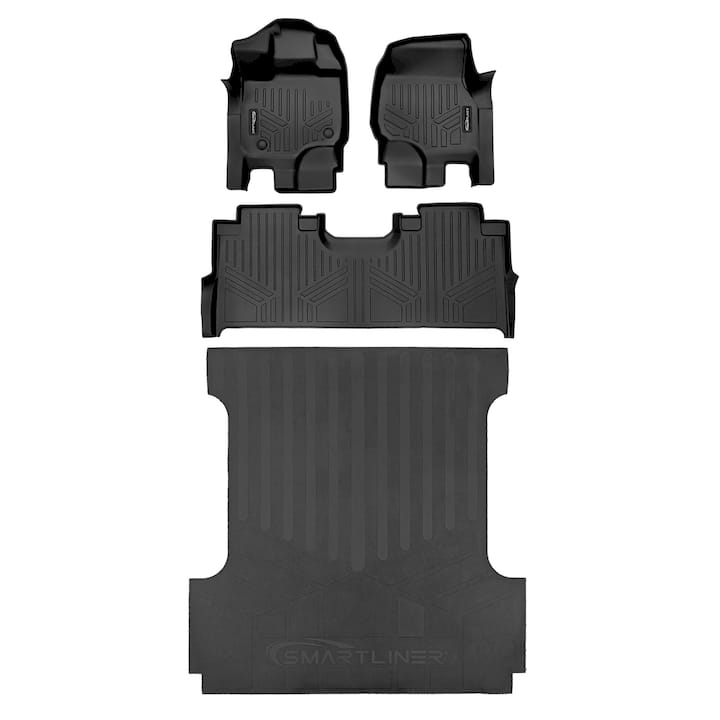
The material stays flexible in cold weather and resistant to softening in heat, a stability range that MotorTrend’s testing highlights as one of TPE’s clearest advantages over older foam and carpet-backed mats. A mat that turns stiff in January and gummy in July isn’t protecting anything, it’s just occupying floor space.
TPE is also non-porous. Liquids sit on the surface instead of soaking in, which is why it resists the moldy, sour odor that carpet mats develop after a wet winter or a spilled coffee. Compare that to older foam or XPE composites, which absorb moisture and hold smells long after they dry.
Why TPE outperforms older mat materials:
- Non-porous surface blocks liquid absorption and mold growth
- Stable across a wide temperature range without cracking or turning gummy
- Recyclable composition with no added plasticizers, a point material primers note resonates with buyers who transport kids or pets
- Raised channel edges contain spills instead of letting them run to the carpet
Pro Tip: Check that raised edges run continuously around the mat’s perimeter, not just at the front. A gap near the door sill is exactly where road slush finds its way onto the carpet.
One safety note deserves attention here: a mat is only safe if it stays anchored. Retention points that don’t line up with your factory hooks let the mat slide toward the pedals, which is a real interference risk on hard braking. Any TPE mat worth buying locks into existing anchor points rather than relying on friction alone to stay put.
Heavy rubber commercial mats can still out-survive TPE in extreme, high-abrasion settings like fleet vehicles or job trucks, according to B2B material comparisons. For daily drivers, though, TPE’s combination of fit, comfort, and recyclability wins out.
How Do You Know a TPE Mat Is Actually Good?
Not every mat labeled “TPE” delivers the same protection, and the differences show up in details that are easy to miss on a product page. Here’s what actually separates a mat that lasts five years from one that curls up at the edges after five months.
- Confirm it’s custom-fit, not universal. Universal mats are cut to a generic template and leave exposed carpet along the console and door sills, exactly where spills land. Custom-fit liners like Smartliner’s Toyota Prius V design are laser-scanned to a specific model and trim.
- Check retention anchor compatibility. The mat should list which factory hook pattern it uses. If a listing doesn’t mention retention points at all, that’s a red flag, not an oversight.
- Look for heel-zone reinforcement. Uniform-thickness mats wear thin under the driver’s heel long before the rest of the mat shows any damage. Variable-thickness molding in that zone extends service life considerably compared to flat designs.
- Measure edge height and channel depth. A quarter-inch lip does little against a spilled 32-ounce drink. Deeper channels hold more liquid before it overflows toward the carpet.
- Ask about material disclosures. A brand that states its TPE is recyclable and free of added plasticizers is telling you something concrete, not just marketing copy.
- Weigh the price against carpet repair. Professional carpet replacement or deep-cleaning after a stain sets in typically costs multiples of what a quality mat set runs. The mat pays for itself the first time it catches something the carpet would have absorbed.
Pro Tip: If a product page doesn’t show a photo of the underside anchor system, ask customer service for one before you buy. Retention design is the single biggest predictor of whether a mat stays in place or slides.
How Do You Clean and Maintain TPE Floor Mats?
TPE’s biggest maintenance advantage is speed. Cleaning a full set takes minutes, not the scrub-and-wait routine carpet mats demand.
- Remove the mats and hose them off. Because the surface is non-porous, most everyday dirt and mud rinse away with plain water and no scrubbing.
- Use a mild detergent for grease or ground-in grime. Avoid harsh solvents or bleach, which can degrade the polymer’s flexibility over time.
- Spot-treat oil, road salt, or organic stains promptly. Salt residue left to dry can leave a chalky film; a quick wipe with soapy water lifts it before it sets.
- Air dry completely before reinstalling. Trapped moisture between the mat and carpet defeats the entire purpose of the liner and invites the odor problem TPE is supposed to prevent.
- Confirm anchor engagement when you put them back. A mat that isn’t clipped back onto its retention hook has lost its main safety feature, regardless of how clean it is.
Watch for three signs a mat needs replacing: permanent compression marks that don’t spring back, visible cracking along flex points, or a persistent odor that survives a full wash. Any of those means the material has reached the end of its useful life, and no amount of cleaning will reverse it.
Does Smartliner’s TPE Lineup Actually Meet These Standards?
Every buying criterion above maps directly onto how Smartliner engineers its product line, which is the reason the brand leads this recommendation rather than following it.
Precise-fit technology starts with laser-scanning each vehicle’s footwell, so the liner follows the actual contour instead of a generic rectangle. That precision is what closes the gaps at the console and door sills that universal mats always leave open. Every liner is molded from 100% recyclable TPE, spill-containment channels run the full perimeter, and the underside carries a non-slip texture engineered to hold position on factory anchor points rather than relying on friction alone, addressing the pedal-interference risk directly.
- Custom laser-scanned fit for specific model years and trims
- 100% recyclable TPE construction with no added plasticizers
- Continuous raised-edge spill containment
- Non-slip backing engineered for factory retention hook compatibility
Editorial reviewers evaluate mats on the same three axes Smartliner designs around. Car and Driver’s testing ranks products by fit, cleanability, and wear over time, the exact criteria that determine whether a mat still looks new after a winter of salt and slush.
A mat that shifts or compresses at the heel gives up protection right where it matters most, and that failure point separates a mat you forget about from one you’re constantly readjusting.
That’s the standard this entire buying guide is built around, and it’s the standard Smartliner’s heel-zone reinforcement and anchor system are designed to meet.
How Do You Order the Right Fit and Install It Safely?
Getting the correct SKU matters more with custom-fit mats than with almost any other car accessory, because a liner built for the wrong trim year won’t seat correctly no matter how good the material is.
- Confirm your exact model year and trim before ordering, including whether your vehicle has third-row seating or under-seat storage bins that change the footwell shape.
- Check the product page for included hardware. A proper listing states whether retention clips or hooks ship with the mat, like the compatibility details shown on the Equinox and Terrain dual-hook liner.
- Lay the mat and align it to the factory anchor points first, then press down until you feel or hear the clip engage.
- Test for movement before driving. Push down near the heel and toward the pedals; a properly seated mat won’t shift.
- Review warranty and return terms on the product page before checkout, since custom-fit items vary by vehicle and can’t always be exchanged across models.
Why TPE Mats Changed How I Think About Car Ownership
The mess I don’t deal with anymore is the real story here. Winters used to mean scrubbing salt stains out of carpet every few weeks; now it’s a thirty-second hose-off before the mats go back in. That shift in effort, not the material science itself, is why I recommend TPE without hesitation.
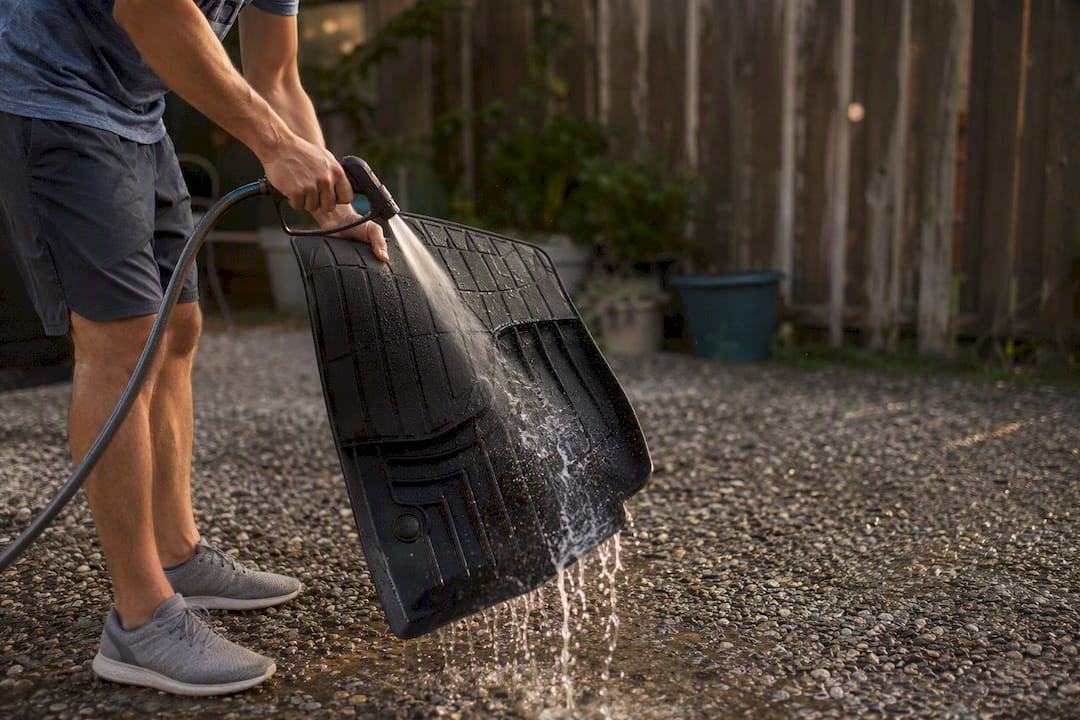
In winter, containment is everything, deep channels and full-perimeter edges matter more than anything else on the spec sheet. In summer, it’s about heat stability, a mat that stays flexible in a parked car at 140 degrees instead of turning stiff or tacky. Different seasons stress different properties, and a well-built TPE mat handles both without you noticing.
If you’re a parent hauling kids and gear, buy the full liner set and consider premium car-protection products like those from XPEL Paint Protection Film & Window Tint | Premium Install to complement your vehicle care. If you’re an outdoor enthusiast with dogs or bikes, add the cargo liner. If you’re just tired of vacuuming carpet, start with the front pair and see how fast it pays for itself.
— Marty
Ready to Protect Your Interior? Here’s Where to Start
Smartliner-usa is the direct-to-consumer alternative to guessing your way through generic mat listings.
Start with the SMARTLINER Floor Liners collection if you’re covering front-and-rear seating. Pet owners and gear haulers should add the Cargo Liners, while off-road and utility drivers will want the UTV Floor Mats or Truck Bed Mat Liners. Homeowners dealing with under-sink leaks can find the same recyclable-TPE protection in the SMARTLINER HOME Under Sink Cabinet Mats line, sized for standard 19.5" x 34.5" cabinets or the narrower 19.5" x 28.5" footprint. Enter your vehicle’s year, make, and model on the product page to confirm exact fit before checkout.
Sources
Readers who want to dig deeper into how these mats get evaluated and what TPE actually is should check the following:
- Best Car and Truck Floor Mats, Tested
- Best Floormats for 2026: These All-Weather Mats Will Save Your Interior
- Heavy Rubber vs TPE Car Mats: A B2B Buyer’s Material Selection Handbook