

For most Chevy Tahoe owners who want maximum interior protection without a complicated buying process, custom-fit floor liners are an excellent option available. They combine edge-to-edge coverage, a raised lip for containment, and a durable, recyclable TPE-style material that resists cracking in cold weather. Before ordering, confirm your Tahoe’s model year and seat configuration so the liner set matches your factory anchor points exactly.
TL;DR:
- Custom-fit floor liners for the Chevy Tahoe are tailored to each model year and seat configuration to ensure optimal coverage and proper engagement with factory retention hooks.
- Materials like TPE and TPO are preferred for their flexibility in cold weather, ease of cleaning, and resistance to cracking, unlike rubber and carpet mats.
- Proper installation, including confirming clips snap securely and checking that liners fit flush against the pedals and seat tracks, is critical for safe, slip-free driving.
- Full coverage sets, including cargo liners, provide significantly better protection against wear and spills, which can help maintain resale value and overall interior condition.
- Accurate model and seat configuration verification before purchase prevents fitment issues, which are the main cause of complaints and improper protection.
Table of Contents
- Which Smartliner Floor Liners Fit Your Tahoe Setup?
- How Do You Choose the Right Tahoe Floor Mats?
- TPE, Rubber, or Carpet: Which Material Actually Holds Up?
- How Should You Clean and Maintain All-Weather Liners?
- How Do You Check Installation Safety Before Your First Drive?
- Does Protecting Your Tahoe’s Interior Affect Resale Value?
- What Do Real Tahoe Owners Say About Their Floor Mats?
- A Publisher’s Take on What Actually Matters in a Tahoe Liner
- Ready to Order? Here’s Which Smartliner Page Fits Your Tahoe
- Sources
Which Smartliner Floor Liners Fit Your Tahoe Setup?
Tahoe owners don’t all drive the same truck. A 2016 model with second-row buckets has different floor contours than a 2022 with a bench seat, and cargo needs shift depending on whether you haul gear, kids, or a dog crate every week. separate liner sets are built around these distinctions rather than forcing one universal shape onto every trim.
For Tahoes built between 2007 and 2014, the 2007-2014 Tahoe / Suburban / Yukon liner set covers the front and rear footwells with a shape matched to that generation’s floor pan. Owners of 2011 through 2014 models can also find dedicated coverage through the 2011-2014 Tahoe / Yukon floor liner and cargo set, which bundles a cargo liner in with the cabin pieces. That bundling matters more than it sounds: full-set coverage that includes cargo and seat-back pieces tends to deliver more real-world value than a front-row-only mat for families and outdoor users, since CarMatLab’s testing approach confirms extra pieces carry outsized protective value for SUV owners hauling gear.
Newer Tahoes, from 2015 through 2020, get their own dedicated match with the 2015-2020 Tahoe / Yukon floor liner set, shaped for that generation’s revised console and floor hooks.
Here’s how to think about which set fits your situation:
- Families with kids and gear: choose a full-cabin set with cargo coverage, not just front mats.
- Winter drivers in snow or slush states: prioritize the raised-lip design over a flatter, carpet-style mat.
- Heavy gear haulers or dog owners: add the matching cargo liner rather than relying on a factory cargo tray alone.
Pro Tip: Double-check your second-row seating, bench or bucket, before ordering. Liner sets are cut to match each layout, and the wrong choice can leave gaps along the console edge.
How Do You Choose the Right Tahoe Floor Mats?
Universal mats are cut to a generic outline that rarely matches a Tahoe’s actual floor pan. Custom-fit liners are molded to the vehicle’s specific contours, which means they reach further into footwells and align with the factory retention hooks instead of sliding around on top of them. CarMatLab’s comparison of custom-fit versus universal mats notes that custom fit provides higher edge-to-edge coverage and closes off the paths slush and spilled liquids use to reach carpet underneath.
Run through this checklist before you buy any set:
- Confirm your exact model year and seat configuration (7 seat versus 8 seat, bench versus bucket second row).
- Verify the liner engages your Tahoe’s factory anchor points rather than requiring aftermarket adapters.
- Check the lip height, since deeper wells contain more mud and water without overflow.
- Look at what’s included: cargo tray, seat-back panel, and third-row piece all add practical value.
- Read the warranty and return policy in case fitment doesn’t match your trim.
Pricing on custom-fit liner sets typically breaks into two bands. Mid-range sets balance price and durability well for most daily drivers, according to GarageGist’s material comparison, while premium laser-scanned sets cost more but hold up better through repeated heavy-winter seasons. A front-and-cargo bundle will usually run for several years of daily use before edges start to show wear, especially if you’re not dragging salt and gravel through the cabin every week.
TPE, Rubber, or Carpet: Which Material Actually Holds Up?
TPE and TPO materials have become the standard for all-weather Tahoe mats because they stay flexible in freezing temperatures, rinse clean with a garden hose, and carry little to no plastic odor even after months of use. GarageGist’s material research points to this flexibility-plus-washability combination as the reason TPE/TPO has replaced older rubber compounds in most premium liner lines, and it’s the same general material family many liners are built from.
Rubber mats can handle heavy abuse but often turn stiff and brittle once temperatures drop below freezing, which is a real problem for Tahoe owners in northern climates. Carpet mats look nicer in a showroom but absorb odor, trap moisture against the floor pan, and wear out faster under repeated mud and snow exposure.
Containment design matters as much as the material itself. A raised lip of sufficient height gives enough depth to hold melting snow or spilled coffee without it sliding onto carpet, particularly valuable if you’re commuting through slush half the winter.
Watch for these aging signs on any all-weather liner:
- Curling edges after repeated temperature swings
- White or chalky mineral residue from hard water buildup
- A stiff, less flexible feel that signals plasticizer loss over time
How Should You Clean and Maintain All-Weather Liners?
Cleaning TPE and TPO liners the wrong way accelerates the exact failures you bought them to prevent. Harsh degreasers strip the plasticizers that keep the material flexible, and silicone dressings fill in the textured channels designed to trap water, according to the cleaning guide from Truck Gear Nation. Both mistakes are common, and both shorten a liner’s usable life.
The cleaning process itself is simple:
- Pull the liners out and shake off loose debris over a trash can or driveway.
- Hose them down or rinse thoroughly in a utility sink.
- Wash with mild soap and warm water, working into the textured channels.
- Rinse again until no suds remain.
- Set the liners face-down on a towel to dry rather than propping them upright.
For mineral deposits left by hard water, skip the harsh chemical cleaners entirely and use a diluted white vinegar solution instead, which cuts through residue without touching the material’s plasticizers.
Heavy-use households, especially those with kids, pets, or a winter commute, should rinse liners every one to two weeks during peak mud or snow season. Fair-weather drivers can stretch that to once a month.
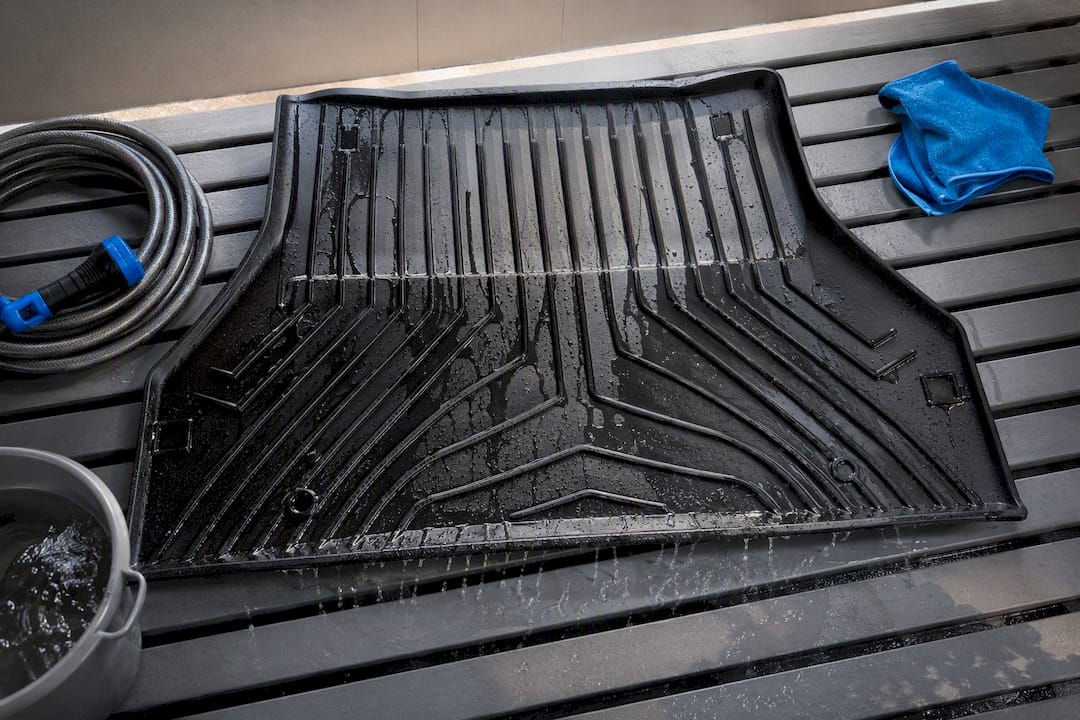
Pro Tip: After rinsing, lay each liner face-down so gravity pulls trapped water out of the textured channels. It cuts drying time noticeably compared to leaning mats upright against a wall.
How Do You Check Installation Safety Before Your First Drive?
A correctly fitted Tahoe liner should snap or clip directly onto your factory retention hooks, the same hooks your OEM mat used. That engagement isn’t cosmetic. Liners shaped to match the vehicle’s floor pan and locked into factory retention points carry a lower risk of shifting toward the pedals, which is exactly the kind of movement you want to rule out before merging onto a highway.
Run these checks after installing any new liner set and before your first drive:
- Confirm each clip or hook audibly snaps or clicks into place.
- Press the accelerator and brake pedal through full range of motion to confirm nothing catches on the mat’s edge.
- Check that the driver’s mat lies completely flat under your heel, with no bunching near the seat rails.
- Look under the seat tracks to be sure no excess material is folded or pinched.
If a liner doesn’t sit flush or a hook doesn’t align, don’t force it. Contact customer support to confirm you have the correct SKU for your model year, since a mismatched seat configuration is the most common cause of a poor fit. Do this safety pass before your first drive, not after you’ve already been driving on it for a week.
Does Protecting Your Tahoe’s Interior Affect Resale Value?
Interior wear is one of the first things a buyer or dealer appraiser checks during a used-vehicle inspection, and a Tahoe with stained carpet, salt residue ground into the floor pan, or worn driver-side upholstery loses negotiating leverage fast. Floor mats take the brunt of that damage before it ever reaches the carpet underneath.
A Tahoe that rolls into a trade-in appraisal with clean, unstained factory carpet reads as better maintained overall, even if the mechanical condition is identical to a similar truck with visible interior wear. Appraisers and private buyers alike use interior condition as a quick proxy for how carefully a vehicle was treated, and a factory floor pan free of salt stains or mildew odor signals the same story about the engine bay and maintenance history you can’t see at a glance.
Full-set coverage, front, second row, and cargo, protects the largest share of exposed carpet, which matters most for Tahoe owners planning to sell or trade in in the next few years. It’s a small, inexpensive habit next to the cost of professional carpet shampooing or a deduction at trade-in time. Owners who plan to keep their Tahoe long-term still benefit, since a fresher cabin also makes daily driving more pleasant regardless of resale plans.
What Do Real Tahoe Owners Say About Their Floor Mats?
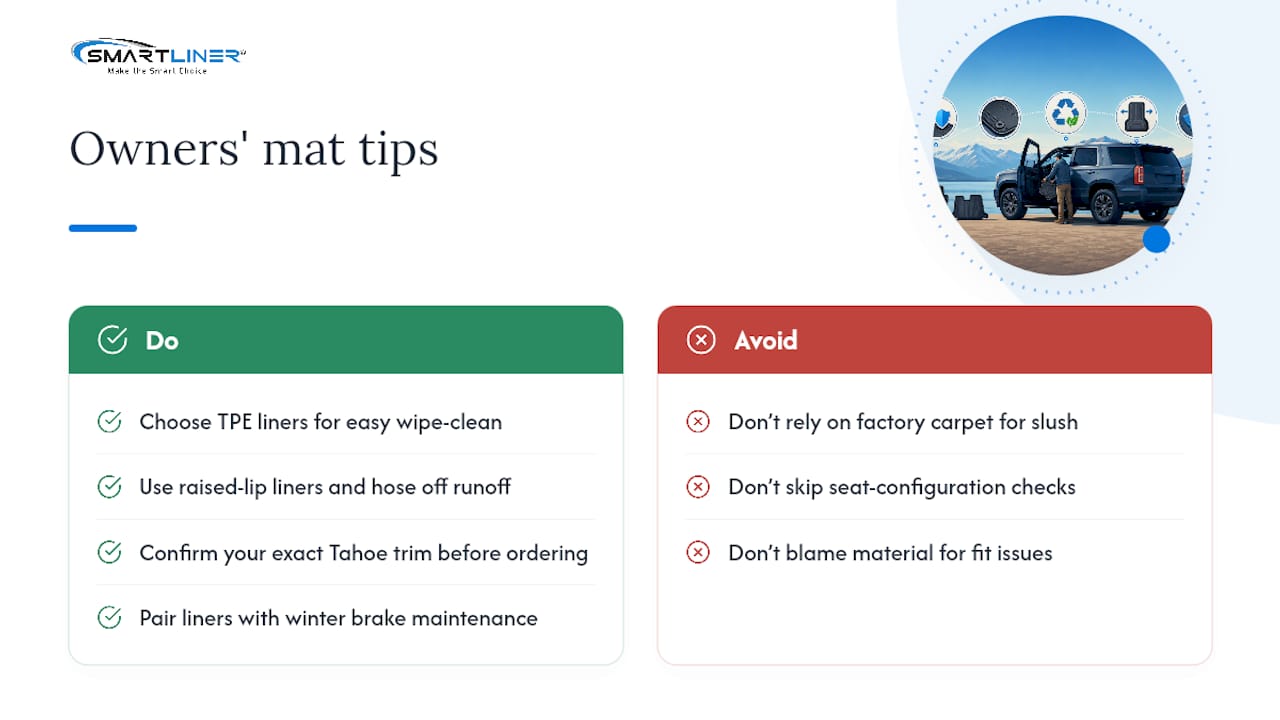
The recurring theme across owner feedback on all-weather Tahoe liners isn’t dramatic. It’s mundane, which is exactly the point. Owners consistently mention how quickly a muddy boot print or spilled drink wipes clean compared to the factory carpet mats that came with the truck, and how the raised lip keeps runoff contained during a quick hose-off in the driveway.
Winter-climate drivers report the biggest before-and-after difference. Factory carpet mats soak up slush and hold onto salt residue for days, while a properly fitted TPE liner rinses clean in minutes and dries without leaving an odor behind. Families running weekend trips with kids and dogs cite the cargo liner as the piece they use most, often more than the front driver’s mat, since it takes direct hits from muddy paws, spilled drinks, and loose gravel that never touches the front seats.
The complaints that do surface almost always trace back to fitment, not the material itself: a buyer ordered the wrong model-year liner or missed a seat-configuration detail at checkout. That pattern reinforces why confirming your exact Tahoe trim before ordering matters more than any other step in the buying process. If you’re prepping your Tahoe for winter driving conditions more broadly, pairing your floor liners with seasonal brake maintenance, like a winter-ready brake kit, rounds out the kind of preparation that keeps both the cabin and the drivetrain ready for rough weather.
A Publisher’s Take on What Actually Matters in a Tahoe Liner
Most of the noise around floor mat shopping focuses on price comparisons that miss the point entirely. The real differentiator isn’t cost, it’s whether the liner was shaped from an actual 3D scan of your Tahoe’s floor pan or stamped from a generic template that “should” fit. Liner sets are built around precise-fit technology matched to specific model years and seat configurations, using recyclable TPE-style material designed to stay flexible through winter rather than crack and curl after a season or two.
What gets underestimated is how much the retention system matters compared to the material itself. A liner made from premium TPE that doesn’t lock into your factory anchor points is arguably more dangerous than a cheaper mat that stays put, because it can shift toward the pedals under braking. Fit precision, backed by attentive customer support when a configuration question comes up, is what actually protects a Tahoe cabin over years of daily use, not marketing language about material grade alone.
— Marty
Ready to Order? Here’s Which Smartliner Page Fits Your Tahoe
If you’ve confirmed your model year and seat configuration, the next step is straightforward. Dedicated fits are offered for nearly every generation, so you’re never stuck adapting a universal mat to a Tahoe-shaped problem, the way owners of trucks, off-road UTVs, and even smaller crossovers often have to.
Start with the SMARTLINER Floor Liners page to browse current front and second-row sets, then add matching SMARTLINER Cargo Liners if you haul gear, kids’ equipment, or pets regularly. Truck owners who also need bed protection can check the SMARTLINER Truck Bed Mat Liners, and anyone running a UTV alongside the Tahoe should look at the dedicated UTV Floor Mats line.
Before checkout, double-check your exact model year and seat count against the product listing, and don’t hesitate to reach out to customer support if you’re unsure which SKU matches your trim. Getting the fit right the first time means the retention hooks click, the pedals stay clear, and the mat does its job for years without a return shipment slowing you down.
Sources
- Custom-Fit vs Universal Floor Mats: Which Should You Buy? | CarMatLab
- Custom-Fit vs Universal Floor Mats: Which Is Best in 2026? | GarageGist
- Stop Ruining Your Mats - The M Buster Guide to Cleaning All-Weather Floor Liners - Truck Gear Nation
Recommended
- Smart Trim™ Floor Liners For 2007-2008 Tahoe (without 3rd Row Seats)
- Smart Trim™ Floor Liners For 2007-2014 Tahoe / Yukon
- Smart Trim™ Floor Liners For 2007-2014 Tahoe / Suburban / Yukon / Yukon XL / Denali (No Hybrid Models)
- Smart Trim™ Floor Liners For 2015-2020 Chevrolet Tahoe / GMC Yukon (2nd Row Bucket)