

For most Toyota Tacoma owners, Smartliner-usa’s custom-fit TPE floor liners are the best Tacoma floor mats available today. Three reasons stand out: they’re precision-molded to the Tacoma’s exact floor pan geometry, the thermoplastic elastomer (TPE) material stays flexible in freezing temperatures without cracking or off-gassing, and the retention clips lock directly into Toyota’s factory anchor points, so the mats never shift under your boots.
- Best overall pick: Smartliner-usa custom-fit TPE liners (Double Cab and Access Cab fitments available).
- Why they win: Edge-to-edge floor pan coverage, raised containment walls, OEM anchor compatibility, 100% recyclable material
- Who might look elsewhere: Owners doing extreme industrial work who want a thick rubber drain-plug mat, or buyers with a strict sub-$40 budget who accept reduced coverage
Key Takeaways
Custom-fit TPE floor liners from Smartliner-usa are the most reliable all-weather protection for Toyota Tacoma owners across cab types, model years, and North American climates.
| Point | Details |
|---|---|
| Fit is the top priority | Edge-to-edge coverage with OEM anchor engagement prevents shifting and carpet exposure. |
| TPE outperforms rubber in cold | TPE stays flexible below freezing, resists cracking, and produces no harsh odor. |
| Generation and cab type determine SKU | Second-gen (2005–2015) and third-gen (2016+) Tacomas require separate liners; cab type and transmission also affect fit. |
| Buy direct for warranty assurance | Direct purchases simplify returns and reduce the risk of receiving a mismatched SKU. |
| Smartliner-usa is the recommended pick | Custom-fit, 100% recyclable TPE liners available for Double Cab and Access Cab Tacoma configurations. |
Table of Contents
- Why Smartliner-usa is the right choice for Toyota Tacoma owners
- What Tacoma owners actually compare when choosing all-weather mats
- Which liner fits your Tacoma — model-year and cab configuration guidance
- How Smartliner-usa answers common complaints owners raise about other big-brand liners
- How to install, clean, and maintain all-weather Tacoma floor mats for long life
- Price expectations and the best places to buy in North America
- What owners report after one to three years of use
- Which floor mat material is the most eco-friendly?
- Which mats work best for your climate and season?
- The case for stopping the search and just ordering the right liner
- Smartliner-usa custom-fit liners: built for your Tacoma, ready to order
- Sources
Why Smartliner-usa is the right choice for Toyota Tacoma owners
Smartliner-usa builds its Tacoma liners around a custom-fit manufacturing process that maps the exact floor pan contours of each cab configuration. The result is edge-to-edge coverage with no gaps at the door sills or around the center console base, which is where universal mats almost always fall short.
The material matters as much as the shape. TPE stays flexible across a wide temperature range, resists deformation, and is often recyclable, making it a strong choice for all-weather liners in climates that swing from desert heat to mountain snow. Cheaper PVC-based mats stiffen in cold weather, which causes edge lifting and cracking over time. Smartliner-usa’s TPE compound avoids both problems and carries no harsh chemical odor when new.
Retention compatibility is a practical detail that separates a good liner from a frustrating one. Smartliner-usa liners are designed to engage Toyota’s factory floor anchor grommets directly, so you’re not improvising with aftermarket clips or relying on friction alone. The raised containment walls hold spills, mud, and melted snow without letting liquid reach the carpet underneath.
Pro Tip: When ordering for a Double Cab Tacoma, confirm whether your truck has an automatic or manual transmission. The center console footprint and floor tunnel shape differ between the two, and the correct SKU accounts for that difference. Smartliner-usa’s 2012–2015 Double Cab liner is a good reference for how the SKU system works.
Key proof points for Tacoma owners:
- Precision-molded fit for Double Cab and Access Cab configurations
- Raised side walls contain spills and mud without overflow onto carpet
- Factory grommet-compatible retention system eliminates mat shifting
- 100% recyclable TPE: non-toxic, odor-free, and durable across seasons
- Straightforward return and warranty process when ordered direct
What Tacoma owners actually compare when choosing all-weather mats
Owner forums and roundups consistently show that fit is the single most important feature for Tacoma buyers. Poor fit means shifting, exposed carpet edges, and eventually stained carpet that’s expensive to replace. Everything else on the comparison list matters, but fit is where the decision starts.
Here’s what experienced Tacoma owners weigh before buying:
- Fit and coverage: Does the liner reach the door sills and wrap the center console base? Gaps at the edges are where dirt and liquid sneak through.
- Material: TPE, rubber, and thermoplastic each behave differently in heat, cold, and under heavy boots. TPE is the most temperature-stable of the three.
- Containment height: Raised walls of 1–2 inches make a real difference when you’re tracking in mud or melted snow. Flat mats hold almost nothing.
- Retention compatibility: Factory anchor grommets are standard on most Tacoma trims. A liner that doesn’t engage them will slide forward under braking.
- Ease of cleaning: Smooth TPE surfaces wipe clean with a damp cloth. Textured rubber traps grit in the channels and takes longer to rinse.
- Foot traction: A non-slip surface pattern on the top face prevents boot slippage, especially when wet. Check that the pattern doesn’t interfere with pedal travel on the driver’s side.
- Odor: Low-quality rubber and PVC mats off-gas noticeably in a hot cab. TPE-based liners are typically odor-free from day one.
- Warranty: A manufacturer warranty signals confidence in the product’s durability. Confirm the terms before checkout.
Custom-fit mats reduce shifting and exposed edges compared with universal mats, and while they cost more upfront, they protect carpet more reliably over the life of the truck. Tacoma owners who use their trucks for trail driving, job sites, or pet transport report the highest satisfaction with molded, raised-wall liners because those use cases generate the most floor contamination.
Forum signals worth knowing: the most common complaints about poorly chosen mats are forward sliding under braking, edge curl that catches boot toes, and driver-side mats that creep toward the pedals. All three problems trace back to either a poor fit or missing retention anchor engagement.
Which liner fits your Tacoma — model-year and cab configuration guidance
Tacoma floor pan geometry changed meaningfully between the second generation (2005–2015) and the third generation (2016 and later). The rear footwell shape, center console tunnel, and anchor grommet locations differ enough that a liner made for one generation will not fit the other correctly.
- Identify your generation. Second-gen Tacomas (2005–2015) have a different rear footwell depth and tunnel profile than third-gen trucks (2016+). Smartliner-usa maintains separate SKUs for each. The 2005–2011 Double Cab liner and the 2012–2015 Double Cab liner are distinct products, not interchangeable.
- Confirm your cab type. Double Cab and Access Cab rear footwells are shaped differently. Access Cab rear seating is more compact, and the liner must account for the reduced floor area behind the front seats.
- Check your transmission. On some Tacoma model years, the manual transmission creates a different center console footprint than the automatic. The correct liner SKU accounts for this. When in doubt, check the product page’s vehicle fitment notes.
- Locate your factory anchor grommets. Most Tacoma trims include OEM floor anchor points. Confirm their position before the liner arrives so you can verify engagement immediately on installation.
- Verify fit on arrival. Once the liner is in the truck, check four things: anchor clips are fully seated, the driver-side mat clears all pedals with at least a half-inch of margin, the liner reaches the door sills without bunching, and the rear liner clears the seat rail adjustment track.
How Smartliner-usa answers common complaints owners raise about other big-brand liners
Tacoma-focused roundups emphasize laser- or 3D-scanned fits, containment walls, and anchor systems as the main differentiators across the mat market. Three broad categories dominate the aftermarket: molded thermoplastic liners (custom-fit, raised walls), flat rubber mats (universal or semi-custom), and universal carpet mats. Each handles real-world Tacoma use cases differently.
| Dimension | Molded TPE liners (custom-fit) | Flat rubber mats | Universal carpet mats |
|---|---|---|---|
| Fit / coverage | Edge-to-edge, door sill to console | Partial; gaps at edges common | Poor; significant gaps |
| Containment height | 1–2 inch raised walls | Minimal lip | None |
| Material flexibility | Stays flexible in cold | Can stiffen below freezing | N/A (fabric) |
| Retention system | OEM anchor compatible | Friction or generic clips | Velcro or friction only |
| Ease of cleaning | Wipe or rinse clean | Rinse clean; channels trap grit | Vacuuming required; stains |
| Odor | Minimal (TPE) | Moderate to strong (rubber) | Absorbs odors over time |
| Recyclability | Often recyclable (TPE) | Rarely recyclable | Rarely recyclable |
| Price range | Mid to premium | Budget to mid | Budget |
Three real-world scenarios show the difference clearly:
- Muddy trail day: Molded TPE liners contain the mud within the raised walls. Flat rubber mats let liquid overflow to the carpet edges. Carpet mats absorb it entirely.
- Melted snow from winter boots: Owners consistently report that raised-wall liners hold a significant volume of snowmelt without reaching the carpet. Flat mats, while easy to hose off, have shallow containment and overflow quickly.
- Heavy work boots on a job site: Molded liners with textured top surfaces provide grip and contain debris. Flat rubber mats shift forward without anchor engagement. Carpet mats trap grit and are nearly impossible to clean thoroughly.
On the environmental side, Toyota lists OEM floor accessories for the Tacoma, but factory accessories typically cost 20–40% more than comparable aftermarket options. TPE-based aftermarket liners like Smartliner-usa’s offer recyclability that older PVC and rubber compounds don’t, making them a more responsible long-term choice.
How to install, clean, and maintain all-weather Tacoma floor mats for long life
Installation takes under ten minutes when done correctly. Maintenance is straightforward, but a few specific habits extend liner life significantly.
Installation steps:
- Remove the existing mats or carpet inserts completely and vacuum the floor pan.
- Place the driver-side liner first. Align the anchor clip holes with the factory grommet locations and press each clip firmly until it seats with a click.
- Check pedal clearance immediately. With your foot on the brake, confirm the liner edge is at least a half-inch clear of the pedal arm at full depression.
- Place the passenger-side liner and engage its anchor clips.
- Install the rear liner, confirming it clears the seat rail adjustment track and lies flat against the rear footwell walls.
- Close each door and check that the liner edge sits flush against the door sill without bunching or riding up.
Cleaning routine:
- Daily dirt: Wipe with a damp microfiber cloth or shake out loose debris.
- Seasonal deep clean: Remove liners, rinse with a garden hose, apply a mild detergent with a soft brush, rinse thoroughly, and let dry completely before reinstalling. Never reinstall a wet liner over carpet.
- Stains: Most stains on TPE surfaces respond to a diluted all-purpose cleaner and a stiff brush. Avoid harsh solvents like acetone or bleach, which can degrade the TPE surface over time.
Pro Tip: Lift each liner every three to four months and check for trapped moisture underneath. Even a well-fitted liner can trap condensation in humid climates, and moisture sitting on carpet backing causes mold. A quick lift-and-dry cycle prevents that entirely.
Price expectations and the best places to buy in North America
Custom-fit TPE liners for the Tacoma typically fall in the mid-tier price band, above budget universal sets but well below premium laser-fit molded options from some specialty brands. Here’s how the market breaks down:
- Budget universal sets ($20–$45): Generic rubber or carpet mats with no vehicle-specific fit. Expect gaps, shifting, and limited containment. Adequate for very light use only.
- Mid-tier custom-fit TPE liners ($60–$120 for a full set): The category Smartliner-usa occupies. Precision-molded, anchor-compatible, raised-wall containment. Best value for most Tacoma owners.
- Premium laser-fit molded liners ($130–$200+): Specialty brands with thick compounds and aggressive marketing. Performance is often comparable to mid-tier TPE liners for everyday use.
Toyota’s OEM accessories page lists factory carpet mats for the Tacoma at MSRP, which owner roundups note runs 20–40% higher than comparable aftermarket options for equivalent protection.
Buying direct vs. marketplace:
- Direct from brand site: Simplifies warranty claims, reduces SKU mismatch risk, and usually offers the most current fitment data. Recommended for custom-fit liners where the exact model-year SKU matters.
- Retail marketplaces: Amazon carries a wide range of Tacoma aftermarket options, but buyers should verify the exact SKU fitment notes and return policy before purchasing. Marketplace listings sometimes bundle incompatible year ranges under a single listing.
Purchase checklist:
- Confirm exact model year and cab type before selecting a SKU
- Verify retention anchor compatibility with your specific Tacoma trim
- Read the return policy before checkout, especially on marketplace orders
- Confirm warranty terms and whether the warranty is honored through the direct brand or a third-party seller
What owners report after one to three years of use
Forum communities for Toyota trucks are active and candid about long-term mat performance. The pattern that emerges across owner reports is consistent regardless of brand: fit quality at installation predicts satisfaction years later.
Owners who installed correctly-fitted, anchor-engaged liners report minimal issues after two or three years of daily use. The most common long-term observations:
- Retention performance: Liners with factory anchor engagement stay in position indefinitely. Owners who skipped anchor engagement report gradual forward creep on the driver’s side within the first year.
- Discoloration: TPE liners resist staining better than rubber, but prolonged exposure to direct sunlight through windows can cause slight fading on the top surface. This is cosmetic only and doesn’t affect function.
- Odor over time: TPE liners that were odor-free at installation remain that way. Rubber mats can develop a stronger smell in hot climates, particularly when wet.
- Cracking in extreme climates: Owners in very cold climates (below -20°F regularly) report that lower-quality rubber mats become brittle and crack at the edges. TPE-based liners handle these temperatures without cracking, which is one of the material’s documented advantages.
- Edge curl: The most common failure mode for any liner is edge curl at the door sills, usually caused by the liner being slightly oversized or installed without proper sill contact. Correct-fit liners installed flush to the sill don’t develop this problem.
Preventive habits owners recommend consistently: rotate front and rear mats every six months to even out wear, hose clean at least twice a year, and avoid petroleum-based cleaners that degrade TPE surfaces. Owners who follow these steps report liners lasting the full ownership period of the truck.
Which floor mat material is the most eco-friendly?
Material choice has a measurable environmental dimension that’s worth understanding before you buy. The three main categories differ significantly in their end-of-life profile.
TPE (thermoplastic elastomer) is the most environmentally favorable of the common mat materials. It’s non-toxic in production, free of PVC plasticizers, and can be recycled through standard thermoplastic recycling streams.
Standard rubber mats, including those made from recycled tire rubber, are more difficult to recycle in a second cycle. The vulcanization process that gives rubber its durability also makes it hard to reprocess. Many rubber mats end up in landfill at end of life.
Universal carpet mats are typically made from nylon or polyester fiber bonded to a rubber or PVC backing. Neither component recycles cleanly with the other, so carpet mats almost always go to landfill. They also absorb moisture and organic material over time, which accelerates degradation and odor.
For Tacoma owners who park outdoors, live in areas with strict waste regulations, or simply prefer a lower-impact purchase, TPE is the clear choice. The durability advantage compounds the environmental benefit: a liner that lasts the life of the truck generates less waste than two or three cheaper mats replaced over the same period.
Which mats work best for your climate and season?
Regional conditions should influence your material and containment choice as much as cab type does.
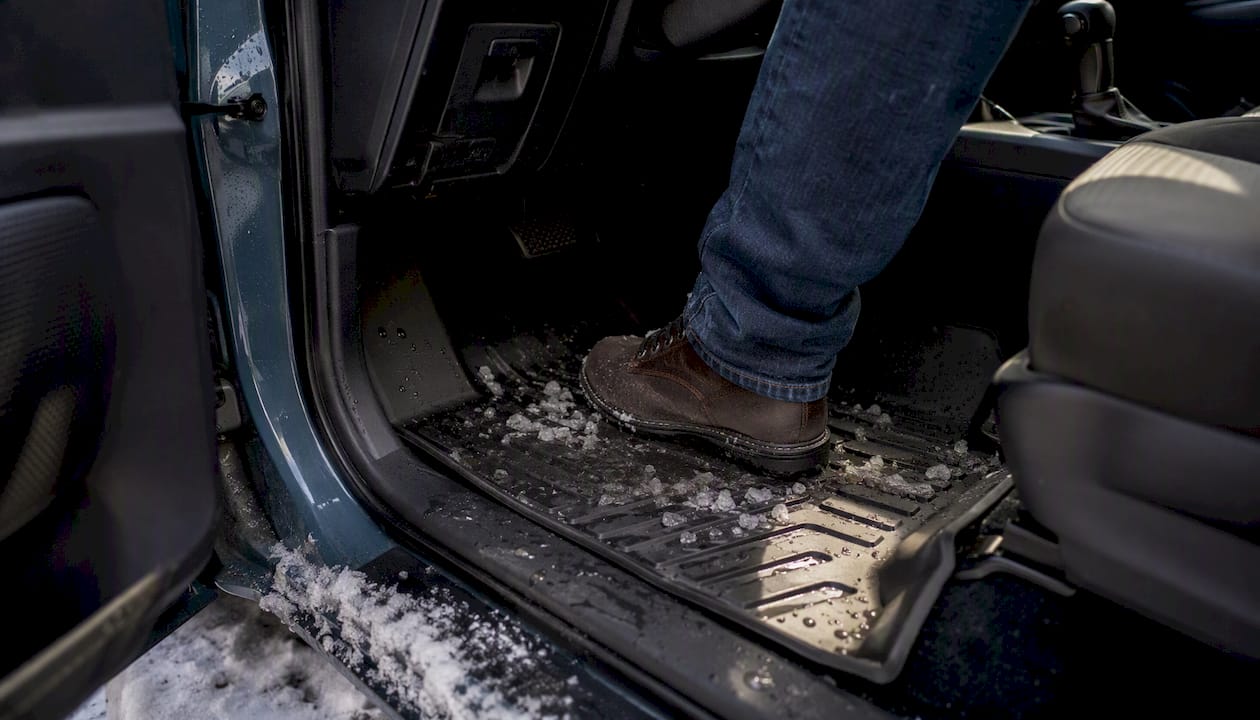
Snow and ice climates (Pacific Northwest, Mountain West, Upper Midwest, Northeast): Raised-wall TPE liners are the right call. Melted snow from boots accumulates quickly, and a liner without containment walls lets that water reach the carpet within a single commute. TPE’s cold-weather flexibility means the liner won’t stiffen and crack during a hard winter.
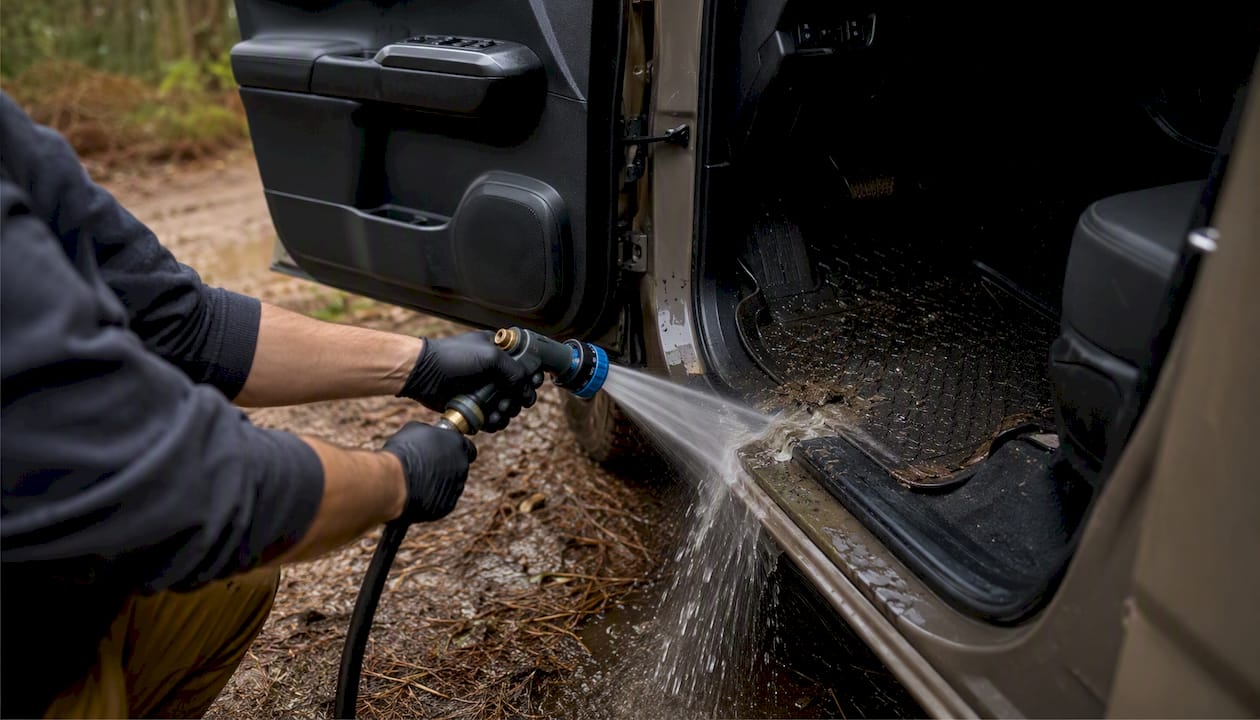
Mud and trail use (off-road, rural, agricultural): Deep containment walls and a smooth top surface that rinses clean are the priorities. Textured rubber channels look aggressive but trap packed mud that’s harder to remove than the smooth TPE surface.
Dust and dry climates (Southwest, Southern California, high desert): Containment height matters less here, but fit quality still matters. Fine dust infiltrates any gap between the liner edge and the door sill. A precision-fit liner with full sill contact keeps dust off the carpet more effectively than a universal mat.
Year-round mixed climates: TPE’s temperature stability makes it the most versatile material across seasons. A single set of custom-fit TPE liners handles summer heat, fall mud, winter snow, and spring rain without needing seasonal swaps.
Pro Tip: If you live in a region with road salt, rinse your liners every two to three weeks during winter. Salt residue trapped under a liner accelerates carpet backing degradation faster than moisture alone.
The case for stopping the search and just ordering the right liner
Most Tacoma owners spend more time researching floor mats than the decision actually warrants. The variables that matter are few: fit accuracy, containment height, material stability, and anchor compatibility. Everything else is marketing.
Smartliner-usa addresses all four directly. For owners who drive in mixed conditions, haul gear, or simply want to protect a truck they plan to keep for a decade, a custom-fit TPE liner is the right answer. The material is durable, the fit is precise, and the environmental profile is better than rubber or carpet alternatives.
Three quick decision tips:
- When daily comfort matters most: Choose a liner with a textured but not aggressive top surface. Smooth TPE with a moderate grip pattern is comfortable underfoot for long commutes and doesn’t fatigue the foot the way heavily ribbed rubber does.
- When heavy-duty containment is the priority: Confirm the containment wall height before ordering. A raised wall of at least one inch is the threshold for meaningful spill containment on trail days or job sites.
- When budget is the constraint: A mid-tier custom-fit TPE liner is a better value than a cheap universal mat. The universal mat will need replacing sooner and won’t protect the carpet as well in the meantime.
Smartliner-usa custom-fit liners: built for your Tacoma, ready to order
Smartliner-usa’s Tacoma floor liners give you precision-molded TPE protection at a price that undercuts premium specialty brands without sacrificing fit quality or containment performance. The liners ship direct, which means the SKU you order is the SKU built for your exact Tacoma year and cab configuration, not a generic fitment stretched across multiple model years.
To order correctly, have four pieces of information ready: your model year, cab type (Double Cab or Access Cab), transmission type, and preferred color. Use the vehicle selector on Smartliner-usa to pull the exact SKU for your truck. Every order comes with Smartliner-usa’s warranty and a return process handled directly, not through a marketplace intermediary. Browse the full Tacoma fitment range and confirm your liner at smartliner-usa.com.
Sources
- Tacoma Floor Mats & Liners: Custom Fit Options Reviewed – Seat Cover Solutions
- Custom Fit vs Universal Car Floor Mats: Which One Should You Choose? | Katamats
- Top 5 Toyota Tacoma All Weather Floor Mats in 2026 | Waterproof & Custom Fit
Recommended
- SmartCoverage™ Floor Liners For 2012-2015 Toyota Tacoma Double Cab | Smartliner USA
- SmartCoverage™ Floor Liners For 2005-2011 Toyota Tacoma Double Cab (No Manuals) | Smartliner USA
- SMARTLINER Custom Fit Floor Liners For 2007-2011 Toyota Tundra Double Cab | Smartliner USA
- SMARTLINER Custom Fit Floor Liners For 2007-2011 Toyota Tundra CrewMax Cab | Smartliner USA