

Custom-fit all-weather liners beat universal mats for nearly every SUV owner, and the difference shows up most in the rear footwell. Smartliner-usa’s Floor Liners and Cargo Liners address the two failure points that generic mats miss: gaps around seat rails and unprotected cargo edges. Raised containment lips and a hose-off surface make them a practical choice for families, pet owners, and anyone hauling gear through a Midwest winter.
TL;DR:
- Custom-fit liners provide better sealing around seat rails and cargo edges than universal mats, especially in complex rear footwells.
- A fit precision achieved through laser scanning ensures taller containment lips and broader coverage, preventing spills and mud from escaping.
- Proper maintenance involves rinsing with water and mild detergent for TPE and rubber, while textile liners require gentle vacuuming and spot cleaning.
- Secure installation with factory anchors and careful fit checks prevent mats from shifting and interfering with pedal travel.
- Rear-floor and cargo coverage should be prioritized over front mats to better protect the areas most exposed to mud, dirt, and heavy wear.
Table of Contents
- What Are the Best SUV Floor Mats for Your Vehicle?
- What Makes a Floor Mat Actually Protect Your SUV?
- How Should You Choose the Right Mat for Your SUV?
- How Do You Clean and Maintain All-Weather Floor Mats?
- How Do You Install Floor Mats and Keep Them from Shifting?
- Why Trust Smartliner-usa’s Fit Data for SUV Owners?
- What Do SUV Floor Mats Typically Cost?
- What Warranty and Support Should You Expect?
- What Do Verified Buyers Say About Their Floor Mats?
- Why Rear-Floor Fit Matters More Than Most Buying Guides Admit
- Where to Buy Custom-Fit Floor Mats for Your SUV
- Sources
What Are the Best SUV Floor Mats for Your Vehicle?
Picking the right liner depends less on brand reputation and more on matching the product family to how you actually use your SUV. Several distinct lines of liners exist, each designed to solve a slightly different problem.
- Top pick for full-coverage family SUVs: SMARTLINER Floor Liners cover front, second row, and often third row in a single laser-matched set, which matters most in vehicles where kids and pets ride in back daily. Model-specific fitments exist for popular SUVs like the Toyota 4Runner, where the sliding rear cargo tray demands a liner that doesn’t bunch up under the mechanism.
- Best for mega-cab and oversized cabin layouts: SMARTLINER Custom Fit Floor Liners for the 2019 to 2026 Ram 2500 Mega Cab with bucket seats demonstrate how Smartliner handles unusual floor geometry. Large SUVs with extended rear legroom and third-row bucket configurations need the same precision, since a slightly-off mat in a spacious cabin leaves more exposed carpet than it would in a compact crossover.
- Best cargo-specific solution: SMARTLINER Cargo Liners trade carpet-style coverage for a tub-like tray that contains muddy gear, spilled dog water, or a leaking cooler. Pair one with a row of floor liners and you’ve sealed off the two zones that see the most abuse.
- Budget-conscious options: A trimmed universal mat costs less upfront, but it rarely seals around the transmission hump or seat anchors the way a vehicle-specific liner does. If your SUV falls outside Smartliner’s current model list, a universal mat is a reasonable stopgap, not a long-term answer.
Owners of compact crossovers have options too. The Subaru Crosstrek fitment shows Smartliner extends precise coverage well below the full-size SUV segment, and compact owners deal with the same spill and mud problems as anyone driving a three-row hauler. The main variable is simply how much floor area needs sealing off, not whether the vehicle qualifies as an SUV in the first place.
What Makes a Floor Mat Actually Protect Your SUV?
Marketing copy on floor mats tends to blur together. What separates a liner that works from one that just looks good in a product photo comes down to four design choices, and most buyers never think to check any of them before ordering.
Fit precision is the first filter. A liner traced from an actual vehicle scan follows the contour around the dead pedal, the seat rails, and the console base without gaps. Road & Track’s testing found that laser-measured, custom-fit liners consistently deliver taller sidewalls and broader coverage than universal mats trimmed to approximate a shape. That gap matters most in SUVs, where rear-floor geometry around center bridges and third-row footwells is more complex than in a sedan.
Raised sidewalls do the actual containment work. A flat mat with no lip just relocates a spill instead of stopping it. Industry testing generally points to containment lips in the 1 to 2 inch range as the sweet spot: tall enough to hold a spilled coffee or a muddy paw print, low enough not to catch your heel when you get in and out.
Material choice changes how the mat behaves over years, not weeks. TPE (thermoplastic elastomer) holds its molded shape and resists cracking in cold weather better than softer rubber blends, which is why most premium custom-fit liners use it. Softer rubber compounds flex more and can be easier to scrub against caked-on mud, but they’re more prone to surface scratching from grit and gravel over time. Neither material is universally better. The tradeoff is rigidity and shape retention versus flexibility and scrubbing ease.
Retention design decides whether the mat stays put. A liner with molded holes that align to factory anchor posts won’t slide forward under braking the way a loose universal mat does. Anti-shift backing texture adds a second layer of security on smooth carpet or vinyl flooring, which matters most under the driver’s seat, where a sliding mat can interfere with pedal travel.
- Fit precision: laser-scanned contours seal gaps around dead pedals and seat rails.
- Containment: raised sidewalls, typically 1 to 2 inches, hold spills and mud.
- Material: TPE for shape retention and cold-weather rigidity; rubber blends for flexibility.
- Retention: factory-anchor alignment plus anti-shift backing keeps mats from sliding.
Cleaning ease is tied directly to surface design. Liners with smooth, channeled floors and raised ridges rinse clean with a garden hose in under a minute. Quilted, carpet-textured surfaces look more upscale but trap grit in the weave, which means more brushing and a longer dry time.
Pro Tip: Before ordering, run your finger along the mat’s edge in any product photo. A visible lip that continues unbroken around the entire perimeter, including behind the driver’s heel, usually signals a properly engineered containment design rather than a flat mat with a token raised border.
How Should You Choose the Right Mat for Your SUV?
Buying a floor mat sounds simple until you’re staring at a dozen near-identical product listings. A short, ordered process cuts through most of the confusion in a few minutes.
- Define your actual use case first. A commuter SUV that rarely sees mud needs less aggressive containment than a family vehicle hauling kids, cleats, and a dog three times a week. Winter driving with road salt and slush pushes the priority toward taller sidewalls and a material that won’t crack in freezing temperatures.
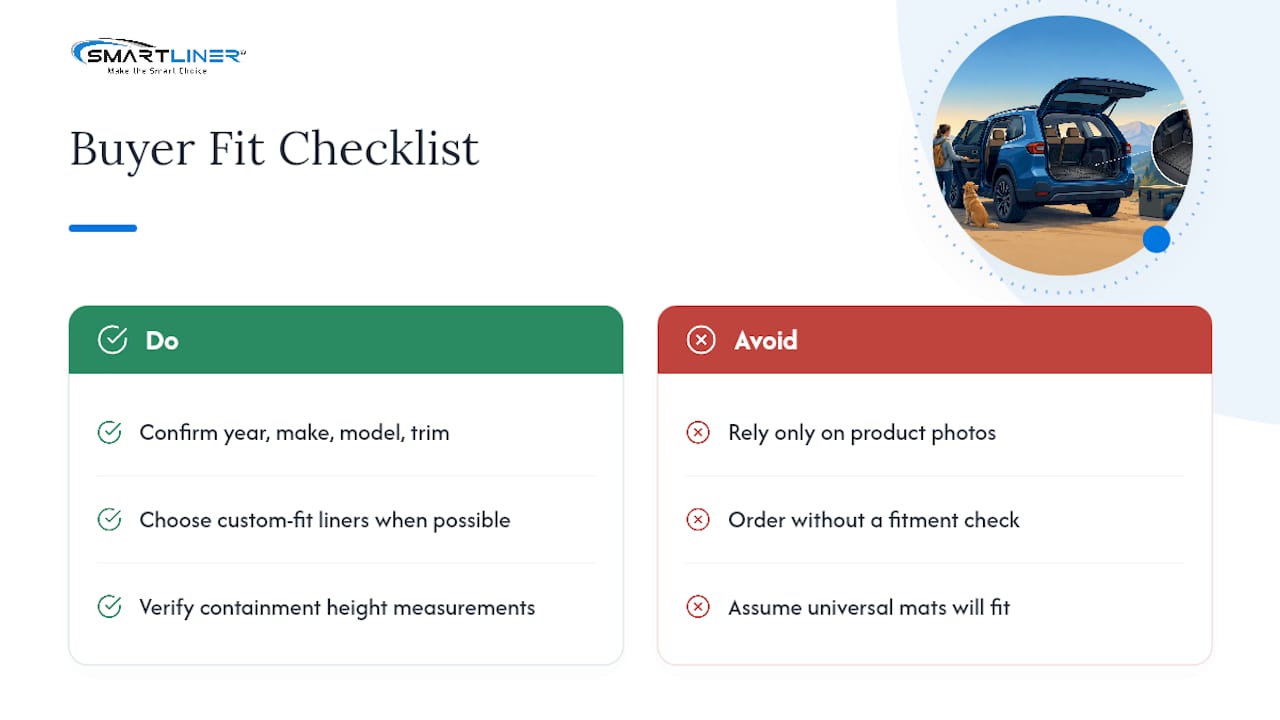
- Confirm fitment before anything else. Match your exact year, make, and model, and check whether the liner’s retention design matches your factory anchor points. A mat listed as “compatible” without naming your specific trim is a guess, not a fitment.
- Rank your priorities in order. Containment height, material type, full rear coverage, and price rarely all win at once. Decide which two matter most for your situation and let the rest be tiebreakers.
- Use return policy and cleaning ease as the final filter. If two options tie on fit and price, the one with a clearer return window and an easier rinse routine wins.
Watch for a few warning signs before checkout. Vague fitment language (“fits most SUVs”) almost always means a universal cut, not a vehicle-specific mold. Listings that never mention anchor or retention compatibility often skip that detail because there isn’t one. And thin sidewalls in the product photos, especially around the driver’s footwell, tend to look worse in person than they do online. MotorTrend’s testing treats fit, slip resistance, and cleaning ease as the three criteria that separate a mat worth buying from one that just fills a listing.
How Do You Clean and Maintain All-Weather Floor Mats?
Material dictates the cleaning routine, and using the wrong method shortens a mat’s useful life faster than daily wear does — learn more about maintaining your vehicle’s interior in top condition with proper ceramic coating care.
For TPE and thermoplastic liners, a garden hose and mild dish detergent handle nearly everything. Spray the mat down, scrub lightly with a soft brush if mud has dried on, rinse, and let it air-dry outside the vehicle rather than reinstalling it wet. Trapped moisture under a mat is one of the more common causes of cabin odor in SUVs that see regular pet or kid traffic.
Road salt and de-icer residue need a slightly different approach. Rinse with plain water first to dissolve surface salt before applying any soap, since scrubbing dry salt crystals directly into the material can dull the surface finish over repeated winters. Car and Driver’s long-term testing of custom-fit mats found that fit and cleanability held up consistently across seasonal use when owners rinsed regularly instead of letting residue accumulate.
Quilted or textile-style liners need gentler treatment. Vacuum first to lift loose grit, then spot-treat stains with a mild upholstery cleaner rather than a hose, since soaking a textile-backed mat can lead to slower drying and a musty smell if it doesn’t fully dry within a day.
- TPE and thermoplastic: hose, mild detergent, air-dry fully before reinstalling.
- Salt and de-icer: rinse with water first, then soap, to avoid grinding residue into the surface.
- Textile or quilted mats: vacuum, then spot-clean with upholstery cleaner, never fully soak.
- Storage: dry flat in a ventilated space, never folded while damp, to prevent mildew.
A liner that’s rinsed and fully dried after every muddy trip typically outlasts one left to dry inside a closed vehicle, where trapped humidity works against the material regardless of how well the mat itself was engineered.
How Do You Install Floor Mats and Keep Them from Shifting?
Installation takes a few minutes, but skipping the alignment check is how mats end up sliding under the pedals within weeks. Line up the mat’s molded anchor holes with your SUV’s factory retention posts before pressing it flat, and confirm the driver’s mat doesn’t ride up under the brake or accelerator pedal through a full range of travel.
If you’re using a trimmed universal mat as a temporary fallback, cut conservatively. Trim a little at a time and test-fit repeatedly rather than cutting to a guessed line, since a mat trimmed too short around the pedal area no longer contains anything.
- Check pedal clearance through full travel, not just at rest.
- Confirm all anchor points engage before driving.
- After one week, inspect for shifting, heel-wear spots, and curling edges near the door sill.
Why Trust Smartliner-usa’s Fit Data for SUV Owners?
Precise fit can be achieved by using a catalog built model by model, using vehicle-specific molds rather than one-size-cut sheets of rubber. This approach helps in fitments for SUVs with unusual floor geometry, where generic mats typically leave gaps.
Custom-fit liners designed around a specific SUV’s floor pan close the gaps around dead pedals and seat rails that universal mats consistently miss, particularly in vehicles with complex third-row or cargo-tray layouts.
The materials themselves are 100% recyclable, which matters to buyers who want durability without contributing another slab of unrecyclable plastic to a landfill in five years. Model-specific examples make the point concrete: the Ram 2500 Mega Cab fitment handles bucket-seat floor contours that a flat universal mat can’t follow, and the Toyota 4Runner fitment accounts for a sliding rear cargo tray most generic mats ignore entirely.
What Do SUV Floor Mats Typically Cost?
Prices for custom-fit SUV liners generally scale with coverage, not just brand name. A front-row-only set sits at the low end of the range, while a full front-to-cargo package covering second and third rows plus a cargo tray costs more simply because it includes more molded material and more precise tooling per vehicle.
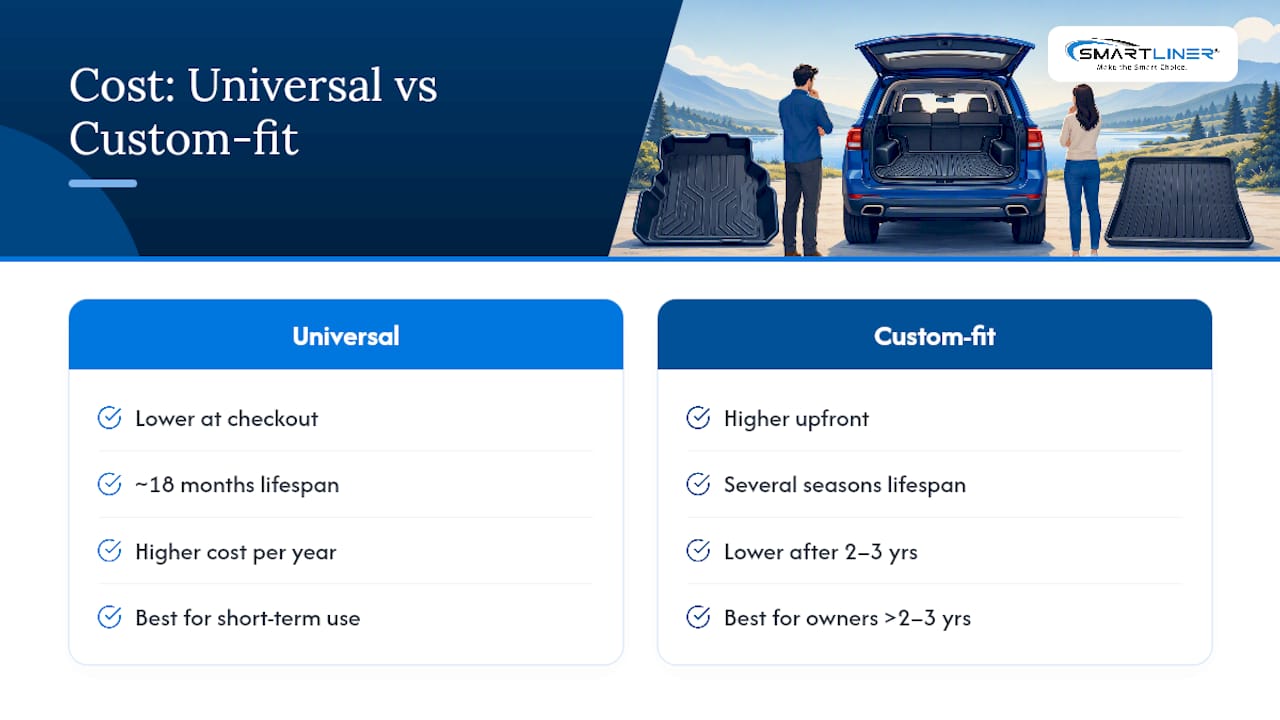
Universal mats undercut custom-fit pricing at checkout, but the value comparison shifts once you factor in lifespan. A universal mat that slides, gaps at the edges, or wears through in eighteen months costs more per year of use than a custom-fit liner that holds its shape and containment for several seasons. The math favors custom fit for anyone keeping their SUV more than two or three years, which describes most owners.
Cargo liners and floor liner sets are typically priced and sold separately, which lets you phase a purchase. Many owners start with front and second-row floor liners, since that’s where most daily wear happens, and add a cargo liner before a camping trip or a move. That approach spreads cost without leaving the highest-traffic zones unprotected in the meantime. Trim level and row count are the two biggest price drivers within any single model’s lineup, more than the SUV’s overall size class.
What Warranty and Support Should You Expect?
A floor mat warranty is really a proxy for how confident a manufacturer is in its own materials. Vague or short-term coverage on a supposedly premium liner is worth noticing before checkout, not after a mat cracks in its second winter.
Custom-fit liner brands generally back their products against manufacturing defects such as improper molding, cracking under normal use, or retention points that fail to align as advertised. That’s different from wear-and-tear coverage, which no floor mat brand offers, since ordinary scuffing and fading from UV exposure fall outside any reasonable warranty scope.
Customer support quality matters just as much as the warranty terms themselves, particularly around fitment questions. Since custom-fit liners are matched to exact year, make, model, and sometimes trim, a support team that can confirm compatibility before you order, rather than after a wrong part arrives, saves a return cycle entirely. Look for a straightforward returns process and support that responds quickly to fitment questions rather than routing you through generic scripted replies. That responsiveness tends to matter more in practice than the specific wording of a warranty policy that most owners never need to invoke.
What Do Verified Buyers Say About Their Floor Mats?
Owner feedback on custom-fit liners tends to cluster around three themes: fit accuracy, cleaning ease, and how the mats hold up after a full winter of salt and slush. Positive reviews consistently mention the moment a liner drops into place and every edge lines up with the factory floor pan on the first try, which is the exact experience a universal mat can’t replicate.
Complaints, when they appear, usually trace back to one of two causes: a buyer who ordered the wrong model year or trim, or expectations set by product photography that oversold the containment height. Both are avoidable with a careful fitment check before ordering, which is why confirming year, make, model, and trim matters more for buyer satisfaction than almost any other single factor.
Independent testing echoes what individual buyers report. MotorTrend’s evaluation ranks fit, slip resistance, and cleaning ease as the deciding factors between mats owners keep using and ones that end up in a garage within a year. Real-world use tends to confirm lab impressions: a liner that fits precisely and rinses clean in a minute or two earns repeat purchases across a household’s other vehicles, while a mediocre universal fit rarely gets a second look at replacement time.
Why Rear-Floor Fit Matters More Than Most Buying Guides Admit
Most floor mat advice focuses on the front row, because that’s where the driver sits and where the marketing photos are shot. That’s backward for SUV owners. The rear floor is where kids track in mud, dogs shed and drool, and cargo overflow from the trunk ends up wedged against the second-row seat backs. A universal mat that fits the front reasonably well and gaps badly in back is solving the easy 30 percent of the problem.
The conventional wisdom of “any all-weather mat beats carpet” undersells how much fit precision matters specifically in the back seat, where floor contours around center bridges and third-row footwells get complicated fast. I’d rather see a buyer spend a little more on custom-fit rear coverage and skip the cargo liner for a year than the reverse. Front mats get replaced more forgivingly. A ruined rear carpet from a season of muddy cleats is a much costlier fix.
Prioritize rear-floor and cargo coverage first, front-row polish second. That order reflects where SUVs actually take damage, not where buying guides traditionally point your attention.
— Marty
Where to Buy Custom-Fit Floor Mats for Your SUV
Once you’ve settled on a use case, the path to checkout is straightforward. For daily-driver SUVs carrying kids or pets, start with SMARTLINER Floor Liners for full front-to-rear coverage in one matched set. If your SUV doubles as a hauler for gear, camping equipment, or a muddy dog crate, add SMARTLINER Cargo Liners to seal off the trunk area separately. Owners with oversized cabin layouts, like the Ram 2500 Mega Cab, get the same laser-matched precision extended to bucket-seat configurations that off-the-shelf mats can’t follow. Anyone running off-road or recreational trips alongside daily SUV duty should also look at UTV Floor Mats for the second vehicle doing the dirty work.
Some brands offer direct-to-consumer sales with listings built around a specific year, make, and model rather than a generic size chart, so customers can order mats that aim to seal gaps a trimmed rubber sheet leaves open. Before you order, confirm your exact year, make, model, and trim, since retention points and floor contours can shift even within the same generation of an SUV. Browse the full Smartliner-usa catalog to find your model’s exact fitment and place your order today.
Sources
This guide draws on hands-on testing and fitment analysis from a handful of automotive outlets that actually put mats through daily use rather than relying on spec sheets alone.
- Best Car and Truck Floor Mats for 2026, Tested
- Best Floormats for 2026 Tested: The Best Mats, Ranked
- Best Car Floor Mats of 2026, Tested
Recommended
- Smart Trim™ Floor Liners for 2007-2014 Suburban / Yukon XL
- SMARTLINER Custom Fit Floor Liners For 2013-2024 Toyota 4Runner (5 Passenger without Sliding Rear Tray)
- Smart Trim™ Floor Liners For 2007-2014 Tahoe / Suburban / Yukon / Yukon XL / Denali (No Hybrid Models)
- 2011-2014 Chevrolet Tahoe Floor Liners | Custom Fit | SMARTLINER