

For most Silverado owners, vehicle-specific TPE custom-fit liners deliver the best combination of coverage, durability, and cleanup, and Smartliner Floor Liners are built specifically to that standard. Quick picks worth knowing before you shop: an all-around option for daily drivers and families, a heavier-duty option for work trucks, and a budget-conscious option for owners who just need reliable protection without the premium price tag. The right pick depends less on brand loyalty and more on matching material, cab type, and retention system to how you actually use your truck.
TL;DR:
- Custom-fit TPE liners are the best all-around choice for Silverado owners, offering flexibility, durability, and resistance to temperature changes.
- Heavy-duty work trucks benefit from liners with tall walls and reinforced materials to trap debris and prevent shifting during use.
- Accurate fitment requires matching the liner to your exact cab type, model year, and factory retention system, especially for crew cabs with underseat storage.
- TPE surpasses rubber and PVC in seasonal flexibility, low odor, and ease of cleaning, making it ideal for daily drivers in variable climates.
- Proper installation involves confirming that liners support factory anchor posts and do not obstruct underseat storage or pedals.
Table of Contents
- Best Silverado Floor Mats by Use Case
- TPE vs. Rubber vs. PVC: Which Material Actually Wins?
- Which Floor Liner Fits Your Silverado’s Cab Type?
- How to Choose the Right Floor Mats Without Guessing
- Which Smartliner Products Match Your Silverado Use Case?
- How to Clean and Maintain Your Floor Mats
- The Bottom Line on Choosing Silverado Floor Mats
- Why Most Buying Guides Get This Half Right
- Get the Right Fit From Smartliner-usa
- Sources
Best Silverado Floor Mats by Use Case
Picking the right liner starts with being honest about how you use your truck, not what looks best in a showroom photo. A contractor hauling drywall five days a week has different priorities than a parent shuttling kids and groceries, and the “best” mat for one is often the wrong call for the other.
Best overall: TPE custom-fit floor liners. For the majority of Silverado owners, a full set of TPE liners covering the front and rear footwells is the safest bet. TPE holds its shape in Texas summers and Minnesota winters alike, and it does not carry the stiff, plasticky feel of older rigid liners. Field testing across a dozen liner sets found that redesigned TPE-style liners outperformed rigid plastic mats on flexibility, grip, and edge containment, which matters most for families dealing with spilled drinks and muddy cleats.
Best for heavy-duty work: deep-well rubber or reinforced TPE liners. If you run your Silverado on job sites, deep raised edges matter more than a soft touch underfoot. Look for liners with tall retaining walls (1.5 inches or higher) that trap gravel, wet boots, and concrete dust before it reaches the carpet.
Best budget-conscious pick: virgin-PVC or entry-tier TPE liners. Not every owner needs premium-grade everything, and a well-made budget liner still beats bare carpet by a wide margin. The catch is quality consistency, since cheaper PVC blends can crack in cold climates faster than TPE.
Best for crew cab with underseat storage: this is where fitment gets specific. Crew cabs with a folding rear bench and underseat storage bins need a one-piece rear liner cut to preserve access to that storage, not a generic mat that blocks the bin or leaves gaps around it. A Silverado buyer’s roundup points out that vehicle-specific molds, ideally laser or 3D-scanned, are what separate liners that actually clear underseat storage from ones that fight it.
- Family or daily driver: TPE custom-fit liners with moderate wall height for easy in-and-out cleaning.
- Work truck: reinforced TPE or rubber with tall walls and aggressive underside grip.
- Budget-focused: quality PVC or entry TPE, checked carefully for cold-weather flexibility.
- Crew cab with storage: one-piece rear liner engineered around the underseat bin, not over it.
TPE vs. Rubber vs. PVC: Which Material Actually Wins?
TPE (thermoplastic elastomer) is the material most buyer guides now recommend for mixed-use trucks, and the reasoning holds up. Rubber is the old standard, heavy and tough but prone to a factory smell and stiffening in cold weather. PVC sits at the budget end, with performance that swings wildly depending on resin quality.
Here’s what separates them in daily use:
- TPE: Waterproof containment, strong chemical resistance, better UV stability than rubber, and a hose-rinse cleaning routine instead of scrubbing, according to durability comparisons between TPE and rubber.
- Rubber: Still the choice for extreme, high-abuse work environments where raw toughness outweighs comfort, but it can carry an odor and loses some flexibility in freezing temperatures.
- PVC: Can be a reasonable budget alternative when made from virgin PVC, but quality varies enormously between manufacturers, so cheap blends may crack or become brittle within a season or two.
TPE holds its flexibility across a far wider temperature range than standard rubber or low-grade PVC, according to material durability testing, while remaining largely odorless. That combination is why it has become the default recommendation for owners who drive year-round in variable climates.
A closer breakdown from material comparison research confirms TPE stays odorless and pliable across seasons, while rubber remains the better call only for the heaviest-duty, high-abuse applications. Families and daily commuters gain the most from TPE’s low off-gassing and easy maintenance. Work-truck owners hauling gear daily may still prefer rubber’s raw abrasion resistance. Budget shoppers can go PVC, but should confirm it is virgin material rather than a cheaper regrind blend before buying.
Which Floor Liner Fits Your Silverado’s Cab Type?
Fitment mistakes are the number one reason Silverado owners end up returning floor mats, and most of them trace back to one of three issues: wrong cab type, wrong body style year, or ignoring the factory retention system.
- Match your cab configuration exactly. Regular Cab, Double Cab, and Crew Cab each have different floor pans, pedal spacing, and rear seat layouts. A Double Cab liner will not sit flush in a Crew Cab, and vice versa.
- Confirm your body style generation. The Silverado shifted to a new body style for the 2019 model year onward, meaning older Classic and LD trims use a different floor contour than newer trucks. Always verify liners are listed for your exact model year range, not just “Silverado 1500” generically.
- Check retention post compatibility. Your factory floor has anchor posts designed to lock mats in place. Liners without matching retention holes can shift under braking, which creates a real safety hazard if a liner slides forward and interferes with the pedals.
- Never stack a liner over the factory carpet mat. Layering an aftermarket liner on top of the factory mat prevents the retention clips from seating correctly, and the extra material underneath can bunch up and jam the accelerator or brake pedal.
Pro Tip: After installing new liners, press firmly on each corner and tug toward the pedals to confirm the retention posts have fully engaged. If a liner shifts more than half an inch, it is not seated properly.
Crew cab owners have one more variable: underseat storage. A Silverado-specific fitment guide notes that a one-piece rear liner is typically necessary to maintain full coverage without blocking that storage bin, since a two-piece design often leaves gaps or covers the latch mechanism entirely.
How to Choose the Right Floor Mats Without Guessing
Comparing listings gets a lot faster once you know exactly what to check before adding anything to your cart. Treat this as a checklist you run through on every product page, not a one-time decision.
- Vehicle selector accuracy: Confirm the listing asks for your exact year, make, and model, not just “fits most Silverados.”
- Cab type: Regular, Double, or Crew, specified explicitly.
- Underseat storage support: Especially critical for Crew Cab trucks with folding rear seats.
- Retention compatibility: Confirm the liner is designed to use your truck’s factory anchor posts.
- Wall height: Taller walls trap more debris but can look bulky; shorter walls clean faster but hold less.
- Material spec: TPE, rubber, or PVC, and whether the PVC is virgin material.
- Warranty and return policy: A liner that doesn’t fit should be easy to return without a fight.
On trade-offs: prioritize price only if your truck sees light, occasional use. If you drive daily in mud, snow, or job-site conditions, durability pays for itself within a year or two. When deciding between wall height and easy cleaning, remember taller walls mean more surface area to rinse, not necessarily more effort, just a slightly longer hose-down.
Before buying, ask the seller directly: Does this liner clear underseat storage on my trim? Is the material virgin TPE or a blended compound? Does it use my truck’s factory retention posts, or does it rely on friction alone?
Which Smartliner Products Match Your Silverado Use Case?
Smartliner-usa builds its liner families around the exact use cases covered above, using laser-measured, custom-fit molds rather than universal shapes. That precision is what closes the gap between “close enough” and a liner that actually clears your pedals, sills, and storage bins.
- Family and daily drivers: Smartliner Floor Liners for 2019 to 2023 Silverado 1500 Double Cab offer full carpet-flooring coverage designed around the factory bench seat layout.
- Older Silverado and Sierra generations: Smartliner Custom Fit Floor Liners for 2014 to 2018 Silverado/Sierra 1500 and 2015 to 2019 2500/3500 HD cover the previous body style, including HD trims.
- Full-truck protection: Smartliner also produces cargo liners and truck bed liners for owners who want the whole vehicle covered, not just the cabin floor.
Every Smartliner liner is made from recyclable TPE material, which lines up with the durability and eco-friendly advantages material research on TPE already backs. Confirming fit is straightforward: select your exact model year and cab configuration on the product page before ordering.
How to Clean and Maintain Your Floor Mats
TPE liners are low-maintenance by design, but a little routine care keeps them looking new for years instead of months.
- Remove the liners and shake out loose debris.
- Hose them down, front and back, rather than scrubbing dry dirt into the material.
- Use a mild soap and a stiff brush only on dried mud spots that the hose alone won’t clear.
- Air dry completely before reinstalling to avoid trapping moisture against the carpet.
Avoid high-heat drying, which can warp TPE over time, and skip aggressive solvents that can degrade the surface finish. Never fold liners for storage since permanent creases affect how flush they sit later.
Pro Tip: In winter, rinse road salt off your liners every week or two. Left to sit, salt residue can corrode both the mat edges and the metal floor pan underneath.
For broader interior care beyond the floor, safe rinsing and protective cleaning techniques used elsewhere on the vehicle apply the same basic principle: rinse first, avoid harsh chemicals, and let things dry fully before closing everything back up.
The Bottom Line on Choosing Silverado Floor Mats
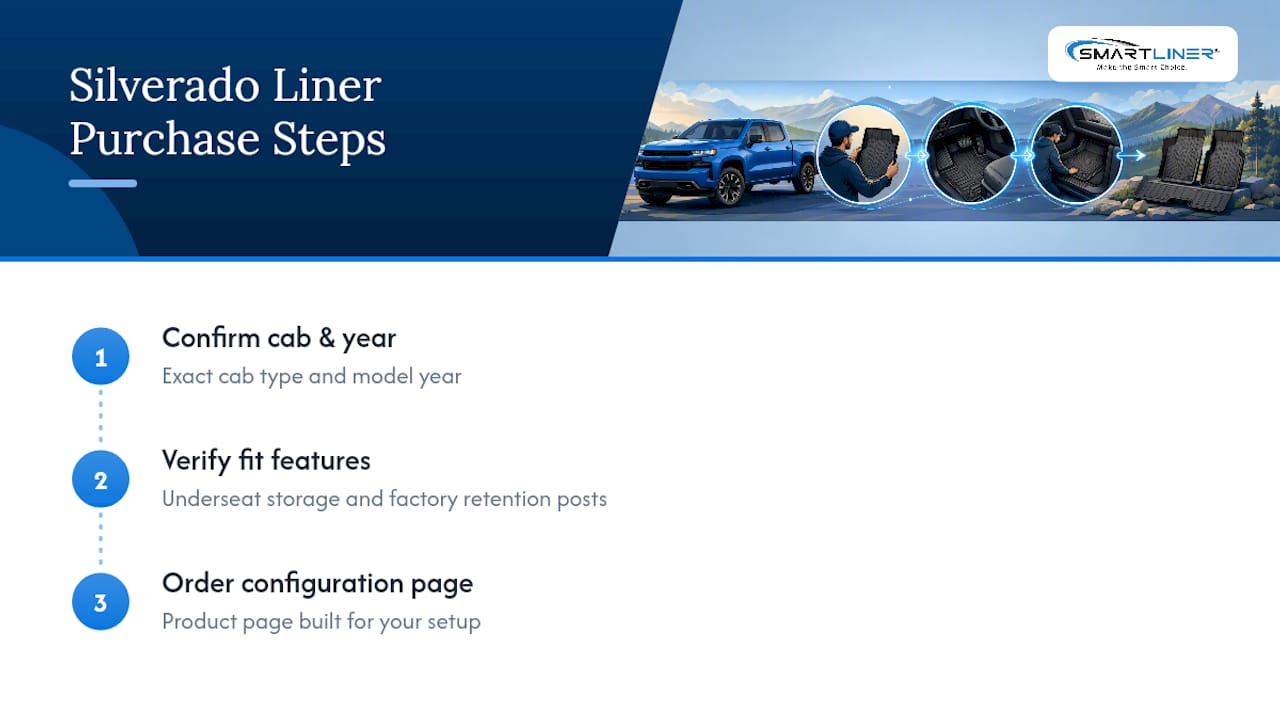
TPE custom-fit liners remain the strongest all-around choice for Silverado owners, balancing durability, easy cleanup, and a material that won’t turn brittle in a cold garage. Three steps turn that recommendation into an actual purchase: confirm your exact cab type and model year, verify the liner supports your underseat storage and factory retention posts, and then order directly from a product page built around your specific configuration. Skipping any one of those steps is how owners end up with a liner that looks right in photos but doesn’t sit flush in the truck.
Why Most Buying Guides Get This Half Right
Most roundups treat floor mats as a commodity decision, rank five products by price, and call it a day. That misses the part that actually causes problems: fitment. A liner can be made from the best TPE compound on the market and still be the wrong choice if it blocks your underseat storage bin or ignores your truck’s retention posts.
Conventional advice also tends to oversell rubber’s toughness. Rubber still wins for extreme, high-abuse work environments, but for the average Silverado owner splitting time between job sites and school pickup, TPE’s flexibility and odorless composition make it the more practical daily material. The overrated factor in most buying decisions isn’t material at all. It’s price. A liner that saves you $20 upfront but doesn’t clear your storage bin or slips under braking isn’t a bargain.
What should come first is a five-minute fitment check: cab type, model year, storage configuration, retention system. Everything else, wall height, color, price tier, is secondary once fit is confirmed.
— Marty
Get the Right Fit From Smartliner-usa
Smartliner-usa builds every liner around your Silverado’s actual cab configuration instead of a one-size-fits-most mold, which is the exact gap that causes most fitment complaints with generic mats. Laser-measured patterns mean the liner clears your underseat storage, seats against factory retention posts, and covers pedal wells and sills that stock carpet mats leave exposed. The recyclable TPE construction holds up through winter salt, summer heat, and daily hauling without the odor or stiffening that lower-grade rubber and PVC develop over time.
If you’re ready to stop guessing at universal-fit mats, browse Smartliner Floor Liners and select your exact year, model, and cab type to confirm fit before you order. Own a UTV alongside your Silverado? Smartliner also makes UTV floor mats built to the same custom-fit standard.
Sources
- TPE vs Rubber Floor Mats: Durability & Fit Comparison (2026) | GarageGist
- Best Car Floor Mats for Chevrolet Silverado 1500 - Accessories Tested
- 7 Best Floor Mats for Chevy Silverado (1500, 2500 & All-Weather Floor Liners) | MyDriveCar
- TPE vs Rubber vs PVC Floor Mats: Which Material Is Actually Best? | Katamats
Recommended
- SMARTLINER Custom Fit Floor Liners For 2007-2013 Silverado/Sierra 1500/2500/3500 HD Extended Cab
- SMARTLINER Custom Fit Floor Liners For 2014-2018 Silverado/Sierra 1500 - 2015-2021 2500/3500 HD
- SMARTLINER Custom Fit Floor Liners For 2007-2013 Chevrolet Silverado/Sierra 1500/2500/3500 Extended Cab
- 2019-2026 Chevrolet Silverado 1500 Floor Liners | Smart Trim