

Vehicle-specific, custom-fit all-weather liners with OEM-compatible retention are the safest and most effective non-slip car mats you can buy, and Smartliner-usa builds its entire catalog around that standard. Commuters do best with the SMARTLINER Floor Liners, truck owners need the bed mat liners, and cargo haulers or UTV drivers have dedicated liners built for their footprint. Whichever model you choose, seat the retention posts and run a pull test before you drive.
TL;DR:
- Custom-fit TPE liners with OEM-compatible retention posts provide the strongest securement and are suitable for all vehicle types, ensuring safety during hard braking.
- Proper installation requires removing existing mats, aligning anchor holes, fully seating retention hardware, and performing a pull test to confirm zero forward movement.
- Universal mats lack secure retention and should only be used in rear seats or light-duty applications, never as daily driver footwell mats.
- Rinsing the underside of mats regularly and avoiding oily cleaners maintain grip, especially in winter, reducing the risk of slippage.
- Choosing a well-fitted, mechanically-retained mat reduces environmental impact by lasting longer and being more recyclable than cheaper universal options.
Table of Contents
- What Are the Best Non Slip Car Mats for Your Vehicle?
- Custom-Fit, Trim-to-Fit, or Universal: Which Category Actually Stops Sliding?
- How Do You Test a Car Mat’s Retention Before Driving?
- Why Do Some Car Mats Slide and Others Don’t?
- How Do You Install a Non-Slip Car Mat Correctly?
- Does Choosing Non-Slip Car Mats Affect Your Environmental Footprint?
- Retention First, Brand Second
- Ready to Upgrade? Here’s How to Buy the Right Fit
- Sources
- FAQ
What Are the Best Non Slip Car Mats for Your Vehicle?
Picking the right mat starts with matching the product to the job, not the price tag. Smartliner-usa organizes its lineup by use case, and each family solves a slightly different traction and containment problem.
SMARTLINER Floor Liners are the best all-weather, custom-fit option for most daily drivers. They use laser-measured patterns that follow the exact contour of your footwell, precision-cut anchor holes that align with factory retention posts, and a raised lip around the perimeter that keeps runoff from a wet boot or spilled coffee contained instead of spreading across the carpet. The textured top surface adds mechanical grip so a heavy winter boot does not skate across the mat when you press the brake. Expect mid-range pricing here, and cleaning is a rinse-and-wipe affair since the TPE material sheds mud rather than absorbing it.
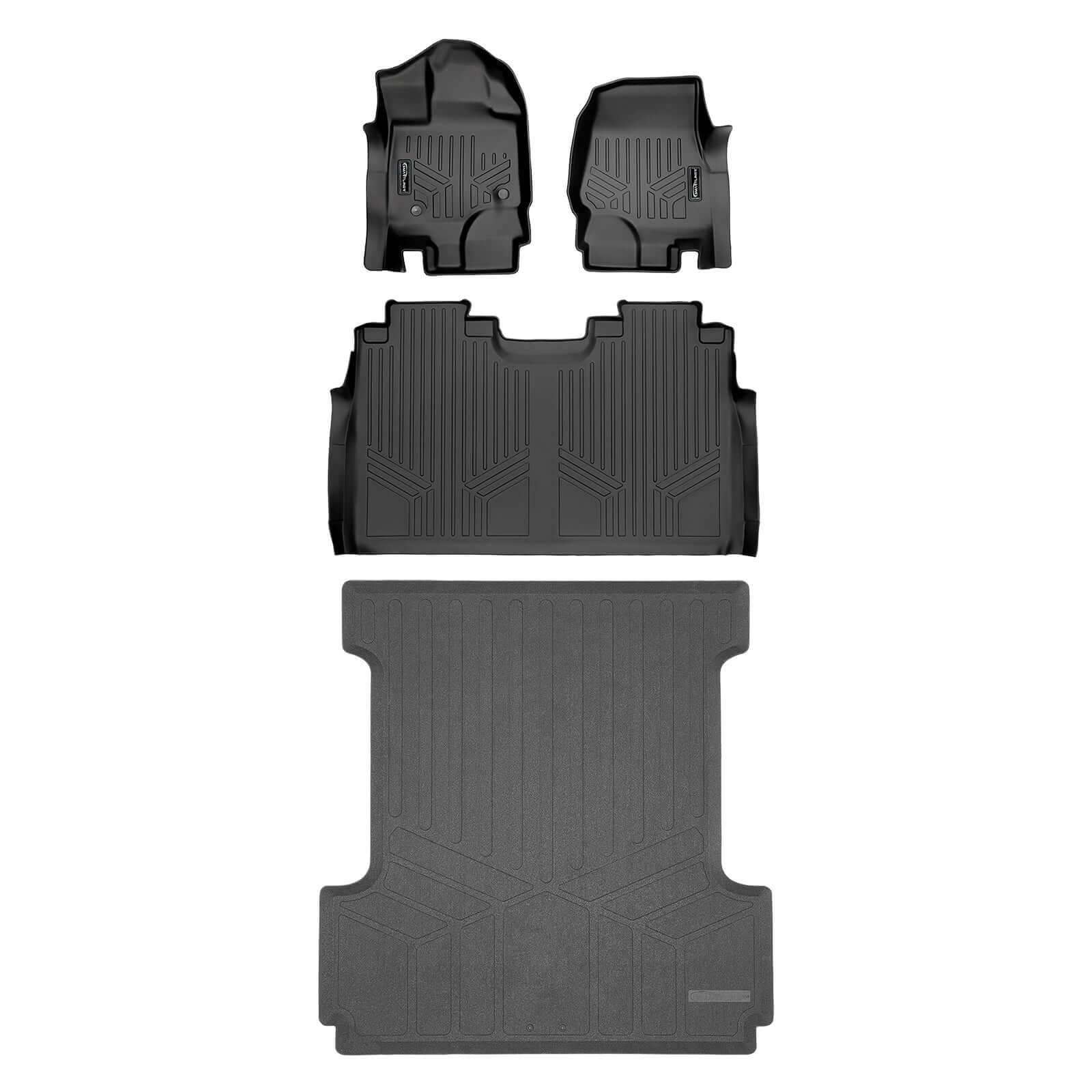
SMARTLINER Truck Bed Mat Liners target the cargo bed instead of the cab, and they solve a different problem: protecting the bed floor from tools, gravel, and cargo shift during hard braking. The non-skid surface texture keeps loose items from sliding forward on a highway stop, and the material resists the gouging that plywood or bare bed liners suffer over years of hauling. This is a mid-to-premium purchase, justified by the fact that a damaged truck bed is expensive to repair or refinish.
UTV Floor Mats are built for off-road punishment: mud, water crossings, and constant vibration. These liners skip carpet backing entirely in favor of a rugged rubber composition that will not soak up water or hold odor, with raised channels that let debris and moisture drain rather than pool underfoot. Pricing sits in the budget-to-mid range, and hosing them down is typically all the maintenance they need.
SMARTLINER Cargo Liners protect the trunk or rear cargo area, and buyers cross-shopping vehicle mats often add one to cover the full footprint. SMARTLINER HOME™ Under Sink Cabinet Mats solve a related but different problem indoors, catching leaks and drips beneath kitchen and bathroom sinks so cabinet floors do not rot from slow, unnoticed water damage.
- Best overall for daily driving: SMARTLINER Floor Liners
- Best for truck bed protection: SMARTLINER Truck Bed Mat Liners
- Best for off-road use: UTV Floor Mats
- Best for cargo and trunk space: SMARTLINER Cargo Liners
- Best for home leak protection: SMARTLINER HOME™ Under Sink Cabinet Mats
Custom-Fit, Trim-to-Fit, or Universal: Which Category Actually Stops Sliding?
The category you choose matters more than the brand name on the box. Each type secures differently, and that difference determines whether a mat stays put or becomes a hazard.
Custom-fit TPE liners are molded to a specific make, model, and year, so the edges tuck against the console, transmission tunnel, and door sills with almost no gap. They secure through reinforced holes that slide directly onto OEM anchor posts, which means the mat cannot creep forward under braking the way a loose mat can. Slip resistance is generally strong because the nonporous TPE surface grips shoe soles even when wet, and coverage extends wall-to-wall with a raised lip on most designs. Cleaning is simple since nothing absorbs into the material, and pricing runs mid-to-premium given the manufacturing precision involved.
Trim-to-fit rubber mats offer a middle ground. They come oversized and rely on the owner to cut them down around the pedals and console, then anchor them through factory posts or aftermarket clips. Done carefully, they can perform close to custom-fit liners, but a sloppy trim job leaves excess material near the pedals, which is exactly the scenario safety guides warn against. Trimming and anchoring correctly takes patience, and slip resistance depends heavily on the backing texture the manufacturer chose. Coverage is decent but rarely matches a molded liner at the edges, and pricing sits in the budget-to-mid range.
Universal mats are the least secure option because they are not shaped to any particular floor pan and often lack retention holes that match your vehicle’s anchor points. Loose universal mats are a frequent cause of unsafe driver footwells because they shift under braking and acceleration, and that shifting is precisely how a mat can bunch up under the accelerator or brake pedal.
Here is the practical rule: if your vehicle has factory anchor points, a vehicle-specific liner is worth the investment for the driver’s seat, full stop. If your car has no anchors at all, choose a trim-to-fit mat with an aggressive, high-friction backing rather than a plain universal mat, and still test it before relying on it.
- Custom-fit TPE: best retention, best coverage, mid-to-premium price
- Trim-to-fit rubber: decent retention if trimmed correctly, budget-to-mid price
- Universal mats: weakest retention, acceptable only for rear passenger rows or occasional light-duty use, never for a daily driver’s footwell
How Do You Test a Car Mat’s Retention Before Driving?
Retention hardware is not a nice-to-have. It is the single feature standing between a floor mat and a jammed accelerator pedal, and it deserves the same attention you would give a seatbelt click. OEM-compatible anchor systems, whether posts, hooks, or twist-locks, exist specifically to keep a mat from traveling forward when you brake hard.
Skipping the check is not a rare mistake. Owners who stack a new mat directly over the factory mat, rather than removing the original first, create one of the most common and most preventable pedal obstruction risks on the road, because a stacked mat has no reliable anchor point holding either layer in place.
Run this five-step pull test every time you install a new mat, and repeat it after the first few drives once the material has settled:
- Remove the factory mat completely. Never layer a new mat over an old one.
- Locate the anchor posts or hooks in the footwell and confirm your new mat’s holes align with them.
- Push the retention hardware fully through the mat until it seats flush against the floor pan.
- Grip the heel pad area of the mat and pull firmly toward the driver’s seat. Zero measurable forward movement is the pass condition — any creep means the mat is not seated or not compatible.
- Sweep your foot through the full range of the accelerator and brake pedals to confirm nothing obstructs travel at any point.
Statistic Callout: Retention testing is not a formality. A mat that passes a visual check but fails the pull test can still travel far enough under hard braking to wedge beneath a pedal, which is why safety guides treat the pull test as the actual pass/fail line, not the installation itself.
If your vehicle lacks factory anchors, use manufacturer-approved aftermarket clip retainers or twist-lock fasteners rather than trusting the mat’s backing alone to hold it in place. Backing friction helps, but it is a supplement to mechanical retention, never a replacement for it.
Why Do Some Car Mats Slide and Others Don’t?
The material under your feet and the technology bonded to its underside determine whether a mat stays anchored or slowly walks across the floor pan over weeks of driving.
Thermoplastic elastomer (TPE) has become the material independent testers favor over older rubber compounds, largely because it is nonporous. Rubber can absorb oils and road grime over time, which softens its surface and reduces grip. TPE resists that breakdown, holds its slip resistance longer, and happens to be more readily recyclable, which matters if you care about what happens to the mat once it wears out.
Backing design is where the real engineering lives. Manufacturers typically combine a few approaches:
- Mechanical nibs or cleats that bite into carpet fibers for physical grip
- High-friction coatings that add tack against hard flooring like vinyl or composite truck beds
- Reinforced retention holes that let the mat lock onto anchor posts instead of relying on friction alone
A multi-technology backing that layers all three tends to perform best across wet, dry, and dirty conditions, because no single grip method has to do all the work. Relying on friction coating alone, for example, works fine on a dry day but can lose effectiveness once slush or fine grit gets between the mat and the floor.
Maintenance keeps that backing working. Avoid oily or silicone-based cleaners on the underside, since they leave a slick film that undermines the very grip you are trying to preserve. Never stack a second mat on top of a liner for “extra protection.” It defeats retention and adds the pedal-obstruction risk the pull test exists to catch.
Pro Tip: Rinse the underside of your mat with plain water and a stiff brush every few weeks in winter. Road salt residue builds up faster than most drivers expect, and it can gradually reduce backing grip long before the mat looks visibly dirty on top.
Cleanability and slip resistance sometimes pull in opposite directions. Mats with deeper traction channels can trap more debris, which means the most aggressive grip pattern is not always the easiest to hose off. Decide which matters more for your driving conditions and shop accordingly, and if road salt is a regular concern where you live, a salt-resistant care routine extends the life of both the mat and the carpet underneath it.
How Do You Install a Non-Slip Car Mat Correctly?
Installation is where most retention failures actually happen, not in the mat’s design. A liner engineered with reinforced anchor holes still fails if those holes never meet the factory posts.
Follow this sequence for any vehicle-specific liner, including Smartliner-usa’s own lineup:
- Pull out the factory mat and vacuum the footwell so no debris interferes with the new mat’s seating.
- Confirm your vehicle’s anchor post locations, referencing the installation guidance if your model has an unusual mounting point.
- Lay the new liner in place and check that every edge, especially around the pedals and console, sits flush against the floor pan.
- Push each retention hole down over its post until it clicks or seats fully, not just partially.
- Run the pull test described earlier, then sweep the pedals through full travel one more time before driving.
If the mat still shifts after seating, do not accept it in the driver’s footwell. Trim slightly around a post that is catching the material, switch to the clip retainers the manufacturer supplies, or move that mat to a rear seating position where the stakes are lower.
Laser-scanned, vehicle-specific patterns exist for exactly this reason: a mat cut to your floor pan’s precise contour has far fewer gaps for creep to start, and far less trimming guesswork for the owner to get wrong.
Smartliner-usa’s precision-cut fit lookup is built around matching year, make, and model before the mat ever reaches your car, which removes most of the trial-and-error that trim-to-fit installation demands.
Does Choosing Non-Slip Car Mats Affect Your Environmental Footprint?
Material choice has downstream consequences that go beyond the showroom. Rubber mats, once worn out, are difficult to recycle because vulcanized rubber does not break down or reprocess cleanly, so most end up in landfill or get incinerated.
TPE changes that equation. It is a thermoplastic, which means it can be reheated and reformed rather than chemically locked into a single shape the way vulcanized rubber is. That property is a meaningful part of why testers now favor TPE for both performance and end-of-life handling. Smartliner-usa manufactures its liners from materials the brand describes as 100% recyclable, which lines up with the broader shift the mat industry has made toward TPE over the past several years.
There is a durability angle here too, and it works in the environment’s favor. A mat that lasts longer because it resists cracking, fading, and oil absorption gets replaced less often, which means fewer mats manufactured, shipped, and eventually discarded per vehicle over its lifetime. Buying one well-made, correctly fitted liner instead of cycling through three cheap universal mats is, in a very literal sense, the lower-waste choice, even before recyclability enters the conversation.
Retention First, Brand Second
Most buying guides for car mats spend their energy comparing thickness, color options, and price per set, and almost none of that matters if the mat is not anchored correctly. The research on this is consistent: loose, unanchored mats create real pedal obstruction risk, and that risk exists regardless of how good the mat looks or how many five-star reviews it has.
The conventional advice treats retention as a footnote, something to check “if you have time” after you’ve picked colors and decided on carpet versus rubber. That ordering is backwards. Fit and anchor compatibility should eliminate half your options before you ever think about texture or price, and only then should material and coverage decide the rest.
If you take one thing from this guide, take the pull test. It costs nothing, takes thirty seconds, and it is the only step that actually proves a mat is safe rather than assumes it. Buy for your vehicle’s anchor points first. Worry about everything else second.
— Marty
Ready to Upgrade? Here’s How to Buy the Right Fit
Smartliner-usa builds every liner around the two things this guide keeps coming back to: retention that matches your factory anchors and coverage that actually contains spills, slush, and mud instead of letting them creep to the edges. The raised lips, precision-cut anchor holes, and 100% recyclable TPE construction aren’t add-ons. They are the baseline the entire catalog is built on, at prices that don’t carry a premium-brand markup.
Start by finding your vehicle’s exact fit through the SMARTLINER Floor Liners collection, or check the Truck Bed Mat Liners if cargo protection is the priority. Measure your footwell, confirm your anchor style, and order the liner built for your exact make and model. Once it arrives, run the pull test before your first drive. It’s the final step that turns a good mat into a safe one.
Sources
- Car Floor Mats: Run This Retention Check First | DriveScored
- Best Floormats for 2026 Tested: The Best Mats, Ranked | MotorTrend
FAQ
Is Anything Better Than WeatherTech?
Several custom-fit liner brands compete closely on containment and retention, and the deciding factor should be fit precision and anchor compatibility rather than brand recognition alone. Smartliner-usa’s laser-measured liners target the same OEM-anchor compatibility and raised-lip containment that top-tested liners rely on, often without the premium-brand price markup.
What Are the Best Anti-Skid Mats for Cars?
The best anti-skid mats combine OEM-compatible retention holes with a multi-technology backing of mechanical nibs and high-friction coating. Custom-fit TPE liners consistently test better for slip resistance than universal mats because they seat against factory anchor points instead of relying on friction alone.
What Is the Best Anti-Slip Mat?
For a vehicle’s driver footwell, the best anti-slip mat is a vehicle-specific liner with reinforced anchor holes that lock onto your car’s factory retention posts. Backing technology matters too, but no coating fully replaces mechanical retention when it comes to preventing pedal obstruction.
What Company Makes the Best Car Floor Mats?
No single brand wins every category, but companies that offer laser-measured, vehicle-specific fit lookups tend to outperform generic universal-mat sellers on retention and containment. Smartliner-usa’s custom-fit floor liners are built specifically around that fit-first standard, using recyclable TPE and OEM-compatible anchor points.
Do I Need to Run the Pull Test Every Time I Install a Mat?
Yes. Run it immediately after installation and again after the first few drives once the mat has settled into place. A mat that shows zero forward movement during the pull test and allows full, unobstructed pedal travel has passed; any creep means it needs reseating or replacing before you drive again.