

For most Tesla Model 3 owners, Smartliner-usa custom-fit all-weather floor liners are the clear recommendation. Three reasons drive that verdict: laser-measured tooling that matches Model 3 footwell geometry precisely, raised containment lips that keep slush and spills from ever reaching the carpet, and TPE-based materials that rinse clean in minutes with no harsh odors.
- Fit accuracy: Custom tooling means no shifting, no bunching, and no gap at the edges where liquid sneaks through.
- Containment: Raised perimeter lips and deep drainage channels route liquid away from heel areas and toe boxes, not just slow it down.
- Maintenance: A quick hose-down restores the liner to near-new condition. No scrubbing, no staining, no replacement cycle.
Key Takeaways
Custom-fit all-weather TPE liners are the most reliable floor protection for Tesla Model 3 owners across all climates, and Smartliner-usa is the recommended option to evaluate first.
| Point | Details |
|---|---|
| Choose custom-fit over universal | Custom tooling matches Model 3 footwell geometry; universal mats gap, slide, and underperform on containment. |
| Match material to your climate | TPE and TPO for year-round and winter use; EVA foam only for dry, light-use conditions. |
| Verify year-range compatibility | Floor geometry changes between Model 3 generations; always confirm your exact year before ordering. |
| Test pedal clearance after installation | Press every pedal fully after installing the driver-side liner to confirm no mat edge restricts travel. |
| Smartliner-usa is the recommended first look | Precise-fit tooling, 100% recyclable materials, and OEM anchor compatibility make it the top pick for most owners. |
Table of Contents
- What makes the best Model 3 floor mats worth the upgrade?
- How to choose Model 3 floor mats: a buyer’s checklist
- Which material fits your climate, pets, or daily use?
- Do mats for older Model 3s fit the latest models?
- How to install, anchor, and clean Model 3 mats
- What should Model 3 floor mats cost, and when does spending more pay off?
- Why Smartliner-usa is the recommended pick for Model 3 owners
- The case for custom all-weather liners, from where we stand
- How to buy Smartliner-usa Model 3 floor liners
- Sources
What makes the best Model 3 floor mats worth the upgrade?
A universal mat from a big-box store costs less upfront. It also slides, gaps at the edges, and absorbs every coffee spill into the carpet underneath. For a Model 3, that tradeoff rarely pays off.
Custom-fit all-weather liners solve three problems that universal mats cannot. First, containment. Molded liners with a raised lip and deep drainage channels prevent slush, salt, and liquid from overflowing onto the carpet, routing it away from toes and heel areas where it would otherwise pool. Second, safety. A mat that fits the Model 3 footwell precisely does not slide toward the pedals during braking or acceleration. Third, long-term cost. Replacing stained or saturated OEM carpet costs far more than a quality liner set. Owner communities consistently report that custom-fit all-weather liners reduce long-term interior damage and are worth the upfront cost, especially for owners dealing with rain, snow, or daily heavy use.
A few owner-reported details that matter in practice:
- Odor: TPE and TPO materials off-gas far less than cheaper PVC or rubber blends. If a new mat has a strong smell after 48 hours, that is a material quality signal.
- Retention system compatibility: Model 3 OEM anchor points are specific. Confirm the liner uses compatible clips or hooks before ordering.
- Coverage gaps: Some two-piece rear sets leave the center tunnel exposed. A one-piece rear liner eliminates that gap entirely.
How to choose Model 3 floor mats: a buyer’s checklist
Start with your exact vehicle before evaluating any product feature.
- Confirm your Model 3 generation and year range. Floor geometry has changed across production runs. A liner built for a 2019 Model 3 may not seat correctly in a 2024 refresh. Always check the vendor’s compatibility chart against your specific year and trim.
- Verify left-hand vs. right-hand drive. Pedal placement differs, and a mat designed for LHD will not anchor correctly in an RHD car.
- Check coverage area. Does the rear set come as one piece or two? One-piece rear liners cover the center tunnel; two-piece sets often leave it exposed.
- Measure edge height and channel depth. Taller lips contain more liquid. For winter driving or pet owners, prioritize liners with at least a moderate raised perimeter.
- Confirm retention anchors and anti-slip backing. The liner must engage the Model 3’s OEM floor hooks or include compatible clips. Anti-slip backing on the underside prevents migration on smooth EV-spec carpet.
- Check material type and odor rating. TPE and TPO are the preferred choices for year-round protection. Avoid unlabeled “rubber” blends that may contain high PVC content and off-gas noticeably.
- Review warranty and return policy. A vendor confident in fit accuracy will offer a clear exchange policy. If the policy is vague, that is a risk signal.
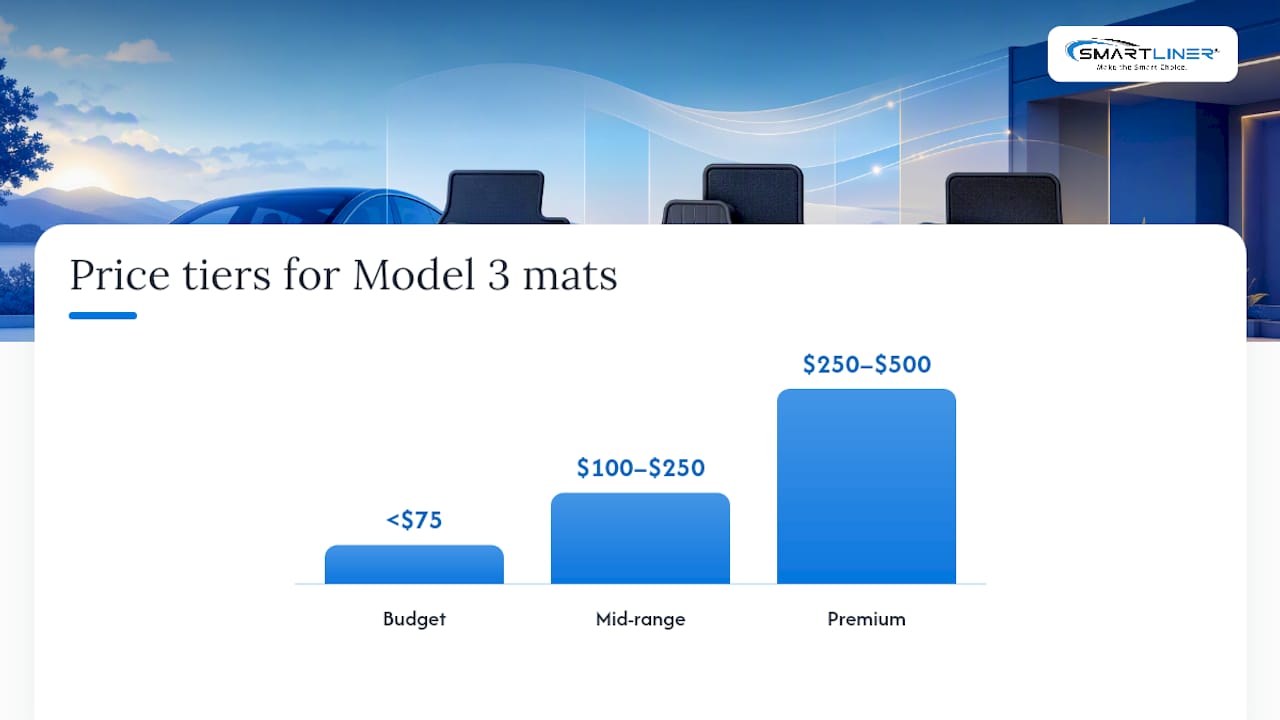
Pricing guidance: Budget sets (typically under $75) are usually universal-fit with minimal containment. Mid-range custom-fit sets run roughly $100–$250 and cover most owner needs well. Premium OEM-style or specialty TPE liners commonly reach $250–$500 and typically carry longer warranties with tighter tolerances. Owner reports and materials guides consistently place the mid-range custom-fit tier as the best value for most climates.
Safety note: Always test driver-side pedal clearance after installation. Press each pedal fully and confirm the mat edge does not contact or restrict travel.
Which material fits your climate, pets, or daily use?
Material choice is the single most consequential decision after fit. The right material for a Minnesota winter is not the right material for a Phoenix commuter.
| Material | Key Properties | Best For | Tradeoff |
|---|---|---|---|
| TPE (thermoplastic elastomer) | Flexible in cold, heat-resistant, low odor, hose-washable | Year-round, mixed climates, winter salt | Slightly heavier than EVA |
| Thermoformed TPO | Rigid molded shape, excellent chemical resistance, retains form | Hot climates, precise fit retention | Less flexible in extreme cold |
| Rubber (natural/synthetic) | Durable, heavy, excellent grip | Extreme cold, heavy mud/off-road use | Heavier, can stiffen in cold |
| EVA foam | Lightweight, soft underfoot, budget-friendly | Light use, dry climates, temporary protection | Low containment, absorbs moisture |
| Carpet/fabric hybrid | Plush feel, OEM aesthetic | Comfort-focused, dry climates only | Stains, absorbs odors, hard to clean |
TPE and thermoformed TPO offer heat resistance, good chemical resistance to road salt, and remain flexible across wide temperature ranges, while EVA foam and carpet hybrids are lighter but deliver less waterproof containment. Custom-molded 3D TPE liners with high edges are hose-washable and represent the recommended all-season choice for most Model 3 owners.
A few use-case notes:
- Winter and road salt: TPE or TPO, full stop. The chemical resistance matters as much as the containment.
- Hot climates: Thermoformed TPO holds its molded shape better under sustained heat than softer TPE blends.
- Pets: One-piece rear liners in TPE are easiest to shake out and hose down. Carpet hybrids trap hair and dander.
- Budget or temporary use: EVA foam works for short-term coverage in dry conditions, but it is not a substitute for a proper all-weather liner in any climate with real weather.
Do mats for older Model 3s fit the latest models?
Not always, and this is where buyers make expensive mistakes. Small but meaningful changes to floor geometry, console design, and seat mount positions across Model 3 production runs can break interchangeability between year ranges. Generation and model-year differences mean mats that fit one Model 3 year range may not fit another, so confirming generation-specific compatibility before buying is non-negotiable.
Follow these steps before completing any order:
- Check the vendor’s fitment chart. Look for your exact model year, not just “Model 3.” Reputable vendors list specific year ranges, not broad “fits all Model 3” claims.
- Identify your generation. The 2024 refresh introduced console and trim changes that affect rear liner fit. Earlier 2017–2023 cars share more interchangeability, but not universally.
- Inspect anchor locations. Driver-side floor hooks moved slightly between some production runs. Confirm the liner’s anchor pattern matches your car’s hook positions.
- Test rear seat and tunnel coverage. Sit in the rear seat with the liner installed and check that the center tunnel section lies flat and the seat base does not lift the liner edge.
- Order from vendors with clear exchange policies. If fit is uncertain, a no-hassle return or exchange policy is the safety net. Avoid vendors whose return terms require the mat to be unused and in original packaging only.
The safest approach: contact the vendor directly with your VIN or production date if the year-range listing is ambiguous. A vendor that cannot answer a fitment question confidently is not one to trust with a precision product.
How to install, anchor, and clean Model 3 mats
Installation takes under five minutes when done correctly. Maintenance takes even less.
Installation:
- Lay the liner flat in the footwell and align the edges with the carpet perimeter before engaging any anchor.
- Engage OEM floor hooks or the supplied retention clips firmly. A liner that sits on top of the hook without locking is not secured.
- Press the anti-slip backing flat against the carpet across the full surface area.
- Perform a pedal clearance test: press the accelerator, brake, and dead pedal fully and confirm no mat edge contacts the pedal travel path.
- For rear liners, verify the center tunnel section lies flat and the seat base does not lift any edge.
Cleaning:
All-weather TPE mats require only a hose-down to look near-new, making them the easiest-care option by a wide margin over carpet. Remove the liner, rinse with water, apply mild soap for stubborn grime, rinse again, and dry fully before reinstalling. Avoid petroleum-based solvents or bleach, both of which degrade TPE and TPO over time and can cause surface cracking.
Maintenance schedule:
- Rinse every two to four weeks during winter or in salty climates.
- Inspect the anti-slip backing for wear every few months. A worn backing is a sliding risk.
- Check retention clips or hooks for deformation after any hard cleaning session.
- Replace liners when the containment lip shows cracking or the backing no longer grips.
Pro Tip: Mark the driver-side mat with a small piece of tape on the front edge before your first installation. After any cleaning or removal, that mark confirms correct orientation instantly, and you will re-check pedal clearance as a habit rather than an afterthought.
What should Model 3 floor mats cost, and when does spending more pay off?
Price bands for Model 3 floor liners break down cleanly into three tiers.
| Tier | Typical Price Range | What You Get | Expected Lifespan |
|---|---|---|---|
| Budget | Under $75 | Universal fit, minimal containment, basic anti-slip | 1–2 years |
| Mid-range | $100–$250 | Custom-fit TPE/TPO, raised lips, OEM anchor compatibility | 3–5 years |
| Premium | $250–$500 | Tight-tolerance molding, extended warranty, full coverage | 5+ years |
Budget universal sets typically cost under $50 with limited containment and poor fit, mid-range custom-fit sets run $100–$250, and premium OEM or specialty TPE liners commonly reach $250–$500 with longer warranties.
The mid-range tier delivers the best value for most owners. At $100–$250, you get custom tooling, real containment, and a material that lasts multiple years without degrading. The premium tier makes sense when you want the tightest possible fit tolerance, a multi-year warranty with clear terms, and full-coverage options including cargo liners. Budget sets make sense for temporary use or a secondary vehicle in a dry climate.
Value checklist before buying:
- Material durability: will it crack, stiffen, or warp in your climate?
- Containment performance: does the lip height match your worst-case spill or slush scenario?
- Warranty terms: is the coverage period and claim process clearly stated?
- Fit accuracy: is the product listed for your exact year and trim?
- Return policy: can you exchange for fit issues without a restocking fee?
Why Smartliner-usa is the recommended pick for Model 3 owners
Smartliner-usa builds its floor liner line around precise-fit tooling, meaning each liner is engineered to the specific footwell dimensions of the vehicle it covers, not adapted from a near-fit template. For Model 3 owners, that distinction matters at the edges, where a generic liner gaps and a custom liner seals.
Key product facts:
- Precise-fit technology: Custom tooling matches the Model 3 footwell geometry, including the angled rear floor and the specific anchor positions for OEM retention hooks.
- 100% recyclable materials: Smartliner-usa uses eco-friendly resins across its product lines, supporting both performance and responsible manufacturing.
- Containment design: Raised perimeter lips and deep channels keep liquid contained and away from carpet, consistent with what molded liner guides identify as the most effective containment geometry.
- Retention compatibility: Liners are designed to engage OEM floor hooks, eliminating the need for aftermarket clips in most Model 3 configurations.
- Easy cleaning: The TPE-based surface rinses clean with water and mild soap, with no special products required.
- Product range: Beyond floor liners, Smartliner-usa offers cargo liners for full-cabin protection, truck bed mat liners, and UTV floor mats including the Can-Am Maverick R all-weather protection for four-seat configurations.
Smartliner-usa’s precise-fit technology and 100% recyclable materials reflect a commitment to both fit accuracy and eco-friendly manufacturing across its full product line.
Warranty and support details are listed on the Smartliner-usa product pages. The brand’s customer service team handles fit questions and exchange requests directly, which matters when you are confirming compatibility for a specific Model 3 year or trim.
[Product installation photo placeholder — CMS will insert Smartliner Model 3 liner installation image here.]
The case for custom all-weather liners, from where we stand
There is a version of this buying decision that gets oversimplified: “just get the cheapest mat that fits.” The problem is that “fits” does almost no work in that sentence. A mat that sits in the footwell without anchoring is not a fit. A mat that covers the center of the floor but leaves the edges open is not a fit. A mat that holds its shape in July but stiffens and cracks by February is not a durable product.
What owners actually need is a liner that was designed for their specific car, made from a material that performs across their actual climate, and backed by a vendor who will stand behind the fit. The custom-fit all-weather category exists precisely because the OEM carpet and universal mats fail on at least one of those three counts for most real-world use cases.
The recyclable materials angle is worth noting too. For EV owners who chose the Model 3 partly for its environmental profile, that alignment is not incidental.
How to buy Smartliner-usa Model 3 floor liners
Precision protection for your Model 3 starts with the right liner, and Smartliner-usa makes the buying path straightforward. The Smartliner-usa floor liners product page lists Model 3-compatible options with explicit year-range fitment details so you can confirm compatibility before adding to cart.
Ordering steps: select your Model 3 year and trim from the fitment selector, confirm the liner set covers front and rear (and cargo area if needed), add to cart, and review the return and exchange policy before checkout. Smartliner-usa’s customer service team is available for fit questions before and after purchase. If you are uncertain about your specific production year or trim variant, reach out directly with your VIN for a definitive fitment answer.
Sources
- Tesla Model 3 All Weather Floor Mats Guide
- How to Use Tesla Model 3 Car Mats (Installation & Cleaning Guide) | Gluebar
- Tesla Model 3 All-Weather Floor Mats: Ultimate Guide
- Tesla floor mats: TPE, PVC or carpet? (2026 guide)
Recommended
- SMARTLINER Floor Liners for 2011-2017 BMW X3 | Smartliner USA
- SMARTLINER Floor Liners for 2018-2023 Hyundai Kona (No Electric Models) | Smartliner USA
- SMARTLINER Custom Fit Floor Liners For 2013-18 Santa Fe with 3rd Row Seat / 2019 Santa Fe XL | Smartliner USA
- 2015-2018 Audi Q3 Floor Liners | Custom Fit | SMARTLINER | Smartliner USA