

Custom-fit floor liners can be among the best F150 floor mats for many owners because they address common problems that generic mats often don’t fix: loose fit, weak spill containment, and material that cracks in cold weather. A combination of a precise fit, TPE construction, and raised-lip coverage matched to your cab and model year is important for effective protection.
TL;DR:
- Matching the floor liner to your specific F-150 model year and cab configuration ensures proper fit and effective spill containment.
- TPE material offers superior resistance to temperature extremes, odors, and allows for quick cleaning compared to rubber and PVC options.
- Full-cabin coverage is crucial for regular hauling with family or pets, especially in winter conditions where cold weather stiffens inferior materials.
- Proper installation and regular winter maintenance, such as hoses and inspections, extend the lifespan and effectiveness of custom-fit liners.
- Buying from brands that provide detailed fit notes and easy return policies minimizes the risk of a mismatch and costly returns.
Table of Contents
- What Are the Best F150 Floor Mats for Your Cab Type?
- How Do You Choose the Right F150 Floor Mat?
- What Makes TPE the Best Material for All-Weather Mats?
- How Do You Confirm Fitment Before You Buy?
- How Do You Install and Maintain All-Weather Liners?
- What Do Long-Term F150 Floor Mat Owners Actually Report?
- What Should You Know About Warranty and Support Before Buying?
- Why Fit Beats Brand Name Every Time
- Where to Buy the Right Smartliner Set for Your F-150
- Sources
What Are the Best F150 Floor Mats for Your Cab Type?
Matching the right liner set to your F-150 starts with your cab configuration, not your budget. A SuperCrew owner hauling kids and gear needs different coverage than a Regular Cab contractor tracking mud and gravel five days a week, and buying the wrong SKU is the single most common return reason in this category.
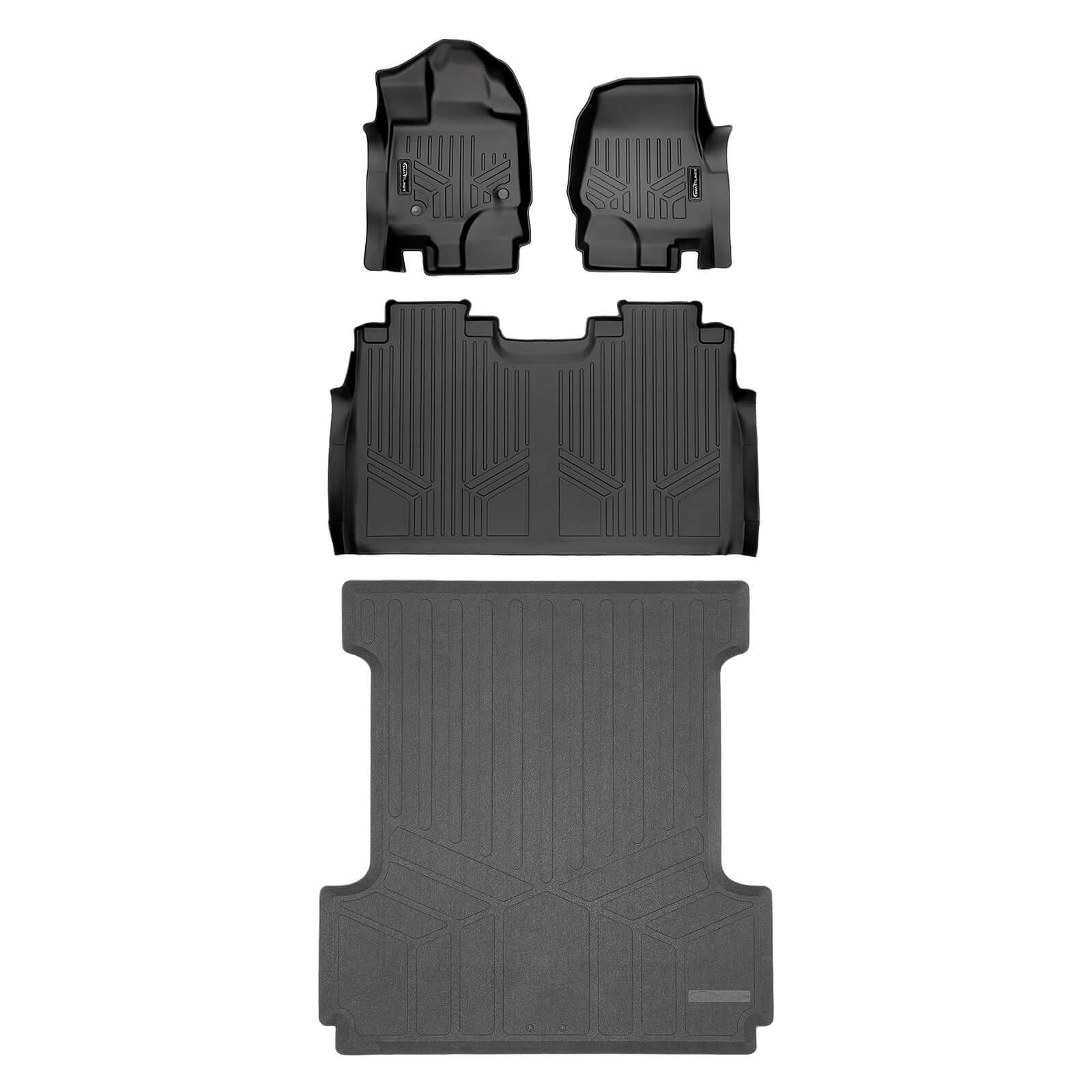
SuperCrew Cab owners get the most floor area to protect, including a full second row that sees the heaviest boot and paw traffic in the truck. A front-and-rear liner set with raised channel walls handles spilled coffee, melted snow, and dog claws without letting any of it reach the carpet underneath. The SMARTLINER Custom Fit Floor Liners For 2011-2014 Ford F-150 SuperCrew Cab fits this exact footprint.
Regular Cab and work-truck setups usually carry a bench seat and a wide-open floor with no rear row to protect, which changes what “full coverage” even means. Contractors and landscapers should prioritize a thicker core and reinforced corners over cosmetic finish, since abrasion resistance matters more than looks when tools and boots are the daily payload. The SMARTLINER Custom Fit Floor Liners For 2011-2014 Ford F-150 (Regular Cab) covers that layout, while the 2015-2024 Regular Cab option with over-the-hump coverage adds protection across the center hump for bench-seat trucks without a 4x4 shifter.
Here’s how the main use cases typically break down:
- Work trucks with bench seats: prioritize thicker core density and full hump coverage over color matching.
- Family SuperCrew trucks: prioritize front and rear coverage with raised lips to contain kid and pet messes.
- Winter daily drivers: prioritize TPE material that stays flexible below freezing rather than a rigid rubber blend.
- EV Lightning cabins: prioritize odor-neutral TPE, since a sealed cabin holds smells longer than a gas truck.
Each set typically includes front-row liners as the base purchase, with a matching second-row piece sold as an add-on for SuperCrew and SuperCab configurations. Expect the price to land in the mid-range compared with dealer-branded OEM mats, with the gap justified by tighter edge-to-edge fit.
How Do You Choose the Right F150 Floor Mat?
Picking the correct liner is less about brand reputation and more about matching five variables to your specific truck. Skip any one of them and you risk a mat that shifts under braking or leaves gaps where road salt collects.
- Confirm your model year and cab configuration first. Ford changed floor pans, pedal placement, and console shape multiple times across F-150 generations, so a 2013 fit note does not guarantee a 2018 fit.
- Decide how much material trade-off you’re willing to accept. TPE and TPO resist temperature swings and stay odor-free, while carpet traps moisture and rubber can stiffen or crack in deep cold, according to material comparisons of TPE and TPO liners.
- Pick full-cabin coverage if you haul kids, pets, or work gear regularly. A front-only set leaves the second row exposed, which matters more than most buyers expect until the first muddy boot print lands on factory carpet.
- Check retention hardware compatibility before you order. Liners with vehicle-specific snap points anchor to factory posts, while universal nib-backed mats tend to slip under heavy pedal use, which is a real safety concern near the accelerator and brake.
- Run the resale math. A liner set that costs a few hundred dollars can preserve factory-fresh carpet through years of daily use, which often shows up as a stronger trade-in offer than the mat itself cost.
Pro Tip: Measure the depth of your factory floor channel before ordering a deep-lip liner. Trucks with in-floor storage bins or a raised driver pedal sometimes need a shallower profile to avoid interference.
What Makes TPE the Best Material for All-Weather Mats?
TPE (thermoplastic elastomer) and its close relative TPO are the materials behind nearly every serious all-weather liner sold today, and for good reason. TPE holds its shape at highway speed yet flexes enough to survive a Minnesota winter without splitting, a balance rubber alone rarely achieves.
Reviewers who compare materials head-to-head consistently point to a few structural advantages:
- Temperature range: proprietary TPE/TPO compounds resist roughly negative 20 to 110 degrees Fahrenheit without cracking or warping.
- Odor resistance: unlike lower-grade PVC blends, TPE doesn’t off-gas or hold that “new mat” smell for weeks.
- Cleaning speed: smooth channel patterns and raised lips let water and grit rinse off in seconds rather than pooling in textured grooves.
- Cold-weather flexibility: TPE stays pliable in freezing temperatures, while vinyl and cheap rubber can stiffen and crack.
For EV cabins specifically, TPE’s odor-neutral profile matters more than it does in a gas truck. A sealed Lightning cabin recirculates air differently, and TPE keeps pliability in heat better than PVC or basic rubber, which also avoids the off-gassing that lower-grade materials are prone to. Core density is worth checking too: a denser core holds its raised walls under boot pressure, while a thin core can compress flat within a season of daily use.
How Do You Confirm Fitment Before You Buy?
Fit is the single biggest source of buyer complaints in this category, and most dissatisfaction traces back to a mismatched fit rather than a material problem. A few minutes of checking before checkout saves you a return shipment later.
Start by confirming these details against the product’s fit notes:
- Model year range: Ford’s floor pan and console shape shifted at several points, so a listing covering 2015 to 2024 won’t automatically fit a 2013.
- Seat configuration: bench seats and bucket seats change the center console footprint, and a liner built for one won’t sit flush in the other.
- Under-seat and center hump features: fold-flat storage bins, a raised center hump, or an in-floor lockbox all change how a liner needs to be molded.
- Pedal and shifter layout: a raised driver pedal or a floor-mounted 4x4 shifter needs a liner with a matching cutout, or it can interfere with pedal travel.
Laser-measured and 3D-molded liners account for these variations far better than trim-to-fit universal mats, which is why Smartliner’s catalog breaks fits down by cab type and generation rather than selling one shape for every F-150 on the road.
How Do You Install and Maintain All-Weather Liners?
Installing a custom-fit liner takes a few minutes once you know what to check. Getting it right the first time keeps the liner from shifting later.
- Set the liner in place and align retention posts before pressing down, so the snap points seat into the factory anchor holes rather than resting loosely on top.
- Push firmly at each corner until you hear or feel the retention clip engage.
- Tug gently on each edge to confirm the liner doesn’t lift or slide before you drive.
For cleaning, a hose and mild detergent handle most of the job. Smooth channel patterns and raised lips let debris rinse out quickly, and letting liners air dry fully before reinstalling prevents trapped moisture from turning into odor or mold. Winter driving deserves extra attention, since trapped road salt accelerates corrosion if it sits against metal floor pans for weeks.
Pro Tip: Pull your liners out and hose down the actual carpet underneath once a month in winter. Salt and grit can work past even a well-fitted liner’s edges over time.
Watch for fading, cracked corners, or a core that no longer springs back after pressure. Those are signs it’s time to replace the set rather than keep patching it.
What Do Long-Term F150 Floor Mat Owners Actually Report?
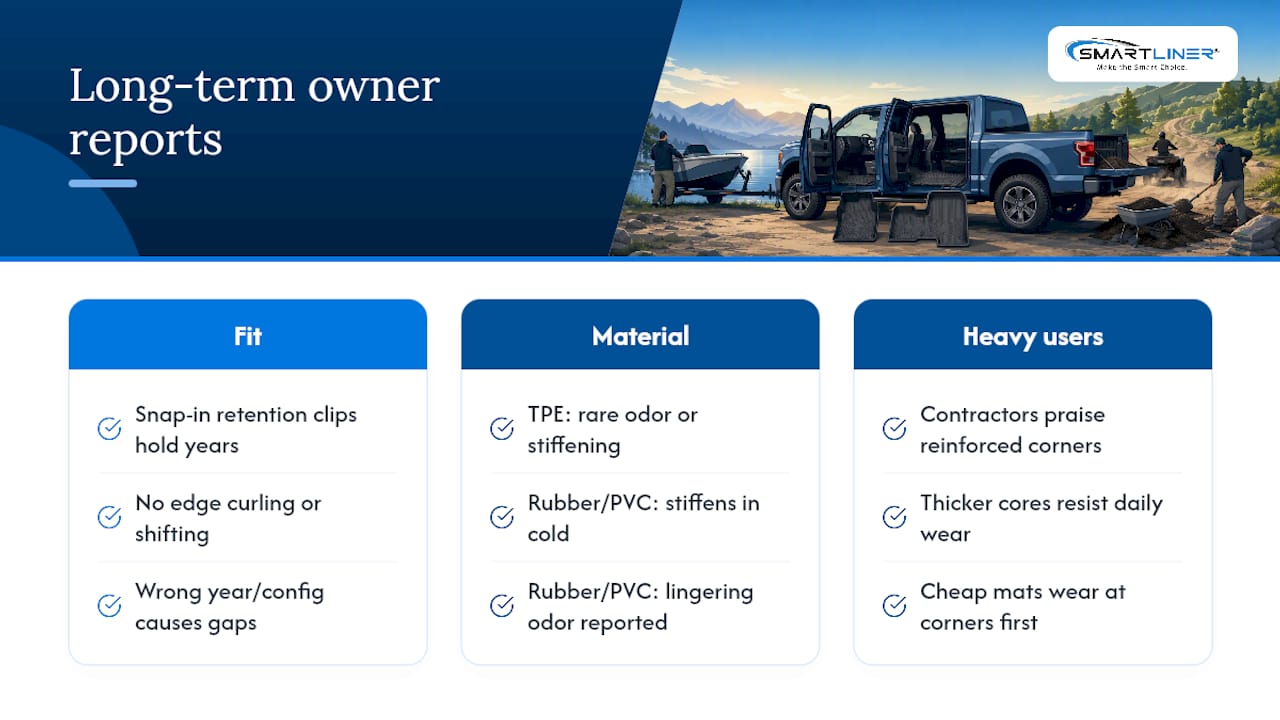
Long-term feedback on all-weather liners tends to split along two lines: fit satisfaction and material durability, and the two aren’t always the same conversation. Owners who bought a liner matched to their exact cab and model year report that retention clips still hold tight years later, with no curling at the edges or shifting under braking. That single detail, snap-in retention versus a loose nib backing, shows up repeatedly as the difference between owners who love their liners at year three and owners who’ve already replaced a cheaper set.
Material complaints follow a predictable pattern too. Buyers who chose a basic rubber or PVC blend more often mention stiffening in cold weather or a lingering odor that never fully faded, while TPE owners rarely report either issue. Contractors and landscapers, the heaviest daily users in this category, tend to praise reinforced corners and thicker cores specifically because those are the first points to wear through on cheaper mats.
Where reviews get less favorable is almost always tied to a fit mismatch rather than the material itself. A liner ordered for the wrong model year or the wrong seat configuration leaves gaps at the edges, and once moisture or dirt finds that gap, the liner stops doing its job regardless of what it’s made from. That pattern reinforces why checking cab type and floor layout before ordering matters more than brand loyalty alone.
What Should You Know About Warranty and Support Before Buying?
Warranty coverage on floor liners is one of the least glamorous parts of the buying decision, but it’s often the detail that separates a good purchase from a frustrating one. Before ordering, check whether the seller backs the product against manufacturing defects like cracking, warping, or premature curling under normal use, since that’s the failure mode that actually shows up over a few years of ownership.
Return and exchange policies matter just as much as warranty length, especially given how often fit issues drive returns in this category. A seller that makes it simple to exchange for a different cab or model-year fit removes most of the risk of ordering the wrong SKU by mistake. That’s worth confirming before checkout rather than after a liner arrives and doesn’t sit flush.
Customer support responsiveness is harder to quantify but easy to notice once you need it. Questions about whether a liner clears a raised driver pedal, fits around a center console lockbox, or works with an aftermarket shifter are common enough that a seller with clear fit documentation and accessible support saves you a guessing game. Look for sellers who publish detailed fit notes per model year rather than a single generic description covering a decade of F-150 changes, since that level of documentation usually signals the support behind it is just as specific.
Why Fit Beats Brand Name Every Time
Most buying guides rank floor mats by brand reputation, then mention fit as an afterthought. That gets the priority backwards. A liner from a well-known name that doesn’t match your exact cab and floor layout will underperform a lesser-known set that was actually measured for your truck, every time.
The real skill in buying floor mats isn’t picking a trusted name. It’s reading fit notes carefully enough to catch the details that trip up rushed buyers: a bench seat instead of buckets, a raised pedal, an over-the-hump variant. An approach of building separate SKUs for these variations rather than one universal shape reflects that fit is the harder problem to solve, not the material.
Cost matters too, and I won’t pretend TPE liners are the cheapest option on the shelf. They cost more than a stack of carpet mats from a parts store. But the trade-off is straightforward: pay once for something that fits and holds up, or replace a cheaper set every season or two.
— Marty
Where to Buy the Right Smartliner Set for Your F-150
Once you’ve confirmed your cab type and model year, buying the correct set takes just a few clicks. Smartliner’s full floor liner catalog organizes options by vehicle, so you land on the exact SuperCrew, SuperCab, or Regular Cab fit instead of guessing from a generic listing. If your F-150 doubles as a work truck or tow rig, pair your floor liners with cargo liners for the bed area and truck bed mat liners for exterior hauling protection, since both use the same laser-measured fit approach as the cabin sets.
Before you check out, confirm your model year against the listing’s fit notes one more time and review the return policy in case your cab configuration needs a different SKU than expected. Pick your cab type from the catalog, verify the fit notes match your truck, and place the order.
Sources
- Floor Liners vs. Rubber Mats: Why “Universal Fit” is Ruining Your Carpet - Truck Gear Nation
- 5 Best Floor Mats for Ford F150 for 2026 (All Weather Heavy Duty Protection) - MyDriveCar
- TPE Floor Mats vs Rubber vs All-Weather Liners (2026 Comparison) | GarageGist
Recommended
- SMARTLINER Custom Fit Floor Liners For 2011-2014 Ford F-150 (Regular Cab)
- Smart Trim™ Floor Liners For 2011-2014 Ford F-150 SuperCab Non Flow Center Console
- SMARTLINER Custom Fit Floor Liners For 2011-2014 Ford F-150 SuperCrew Cab
- SMARTLINER Custom Fit Floor Liners For 2015-2026 Ford F-150 SuperCab with 1st Row Bucket Seats Carpeted Flooring