

For most F-150 owners, the best F150 bed mat is a custom-fit TPE or heavy rubber liner built to your exact bed length and model year, with the Smartliner Truck Bed Mat Liners line leading that category. If you own your truck long-term and want permanent rust protection, pair that mat with a spray-in liner underneath. If you drive a leased truck or swap vehicles often, a mat alone does the job without any commitment to the bed itself.
- Choose Smartliner when: you want laser-matched fit for your bed length, a surface that wipes clean in minutes, and materials that are 100% recyclable.
- Choose thicker rubber when: you haul heavy commercial loads daily and impact resistance matters more than weight.
- Choose lighter TPE when: you load and unload often and want something you can hose off and dry fast.
TL;DR:
- Custom-fit TPE or rubber bed mats offer superior long-term performance by preventing gaps, shifting, and edge damage when matched precisely to your F-150’s bed length and model year.
- TPE mats strike a balance between durability and ease of maintenance, making them ideal for daily drivers who require waterproofing, UV resistance, and simple cleaning routines.
- Heavy rubber mats excel for owners hauling heavy, impact-prone loads like gravel or tools, but are heavier to handle and can develop odors in hot weather.
- Pairing a spray-in liner with a removable mat provides the best long-term protection by sealing rust underneath and offering impact cushioning above, especially for owners who keep their truck many years.
- Confirming exact bed length and model-year fit before purchasing is crucial, as universal mats often lead to gaps, interference with accessories, or early damage.
Table of Contents
- What Material Actually Holds Up in an F-150 Bed?
- Does Your Bed Length Actually Match the Mat You’re Buying?
- What Should You Check Before Buying Any Bed Mat?
- Which Smartliner Products Fit Your F-150 Use Case?
- Should You Get a Mat, a Spray-In Liner, or Both?
- How Do You Install and Maintain a Bed Mat the Right Way?
- Why Trust Smartliner-usa for F-150 Bed Protection?
- How Much Cargo Grip Do You Actually Need?
- What Should You Expect to Pay for a Quality Bed Mat?
- How Long Should a Good Bed Mat Actually Last?
- What Do Other F-150 Owners Say About Their Bed Mats?
- Will a Bed Mat Work With Your Toolbox or Bed Cover?
- Why Most Buying Guides Get This Wrong
- Get the Exact Fit for Your F-150 Bed
- Key Takeaways
- Sources
What Material Actually Holds Up in an F-150 Bed?
Rubber, TPE, and composite each solve the bed protection problem differently, and the differences show up fast once you start hauling real cargo.
Rubber is the heavyweight option: dense, textured, and nearly impossible to puncture. It grips cargo well and absorbs impact from dropped toolboxes or shifting equipment, but it’s heavy to lift out for cleaning and can develop a rubber odor in hot weather. TPE, short for thermoplastic elastomer, has become the practical favorite among modern truck owners because it balances durability, waterproofing, and UV resistance while staying light enough to remove with one hand. Composite mats, often a blended plastic, sit at the budget end and work fine for occasional light use, but thinner composite panels under 3/8 inch tend to crack under repeated heavy loads, which rules them out for daily commercial hauling.
TPE mats are the best all-around choice for modern truck owners because they balance durability, waterproofing, UV resistance, and easy cleaning better than rubber’s weight penalty or composite’s fragility, according to comparative testing across cargo liner materials.
- Rubber: best impact absorption, heaviest to remove, can retain odor.
- TPE: best balance of grip, weight, and weather resistance for daily driving.
- Composite: lowest cost, weakest under sustained heavy loads.
Heavy rubber still wins for owners hauling gravel, tools, or livestock gear daily. TPE wins for everyone else.
Does Your Bed Length Actually Match the Mat You’re Buying?
F-150s ship in three bed lengths, 5.5 feet, 6.5 feet, and 8 feet, plus the electric Lightning’s unique bed geometry. A mat sized for the wrong bed length is the single most common return reason on aftermarket bed protection.
- Confirm your bed length first. Check your window sticker or measure from the bulkhead to the tailgate with it closed.
- Match your model year to the correct generation. F-150 bed contours changed across generations, and a mat built for a 2015-2020 truck won’t sit flush in a 2021+ bed.
- Check wheel well and tie-down clearance. Universal mats routinely gap around wheel wells or block factory tie-down loops.
- Verify tailgate clearance. A mat that rides too high can interfere with tailgate latching, especially on trucks with a factory step.
Custom-fit, laser-scanned mats reduce movement and improve containment compared with universal-fit mats, which shift under braking and expose bed edges to scratches over time. That precision matters more on an F-150 than on most trucks because Ford has revised bed contours across nearly every generation since 2015.
What Should You Check Before Buying Any Bed Mat?
Skip the spec-sheet noise and run down this list in order. Each step eliminates a common regret.
- Confirm exact fit. Match bed length and model year before anything else. A perfect fit beats a thicker mat that doesn’t sit flush.
- Check material and thickness. Look for at least 3/8 inch on heavy-duty jobs; thinner composite is fine only for light, occasional use.
- Look for raised edges. A raised wall design contains spills and debris instead of letting them slide onto the bed floor.
- Evaluate surface texture. A high-friction, textured surface keeps cargo from sliding during turns and stops.
- Check the load rating. Ask the seller directly if it isn’t listed. Vague answers are a warning sign.
- Confirm UV and chemical resistance. Materials exposed to direct sun year-round need UV stabilizers or they’ll crack within a couple of seasons.
- Read the warranty terms. A real warranty tells you how confident the maker is in their own material.
Pro Tip: Email the seller and ask which exact bed length and model years the mat is scanned for. A vague answer like “fits most F-150s” is a sign it’s a universal mat, not a custom one.
An insight worth remembering here: fit and surface texture usually matter more than brand name. A perfectly fitting TPE mat with a high-friction surface will outperform a poorly fitting thicker rubber mat every time cargo shifts.
Which Smartliner Products Fit Your F-150 Use Case?
Smartliner-usa builds its bed protection around fit first, and that shows up differently depending on how you actually use your truck.
- Daily drivers: Smartliner Truck Bed Mat Liners built in durable TPE give you a mat that wipes clean after a grocery run or a home improvement trip without adding real weight to lift.
- Outdoor lifestyle owners: the same bed mat line handles muddy gear, wet camping equipment, and dog crates, with raised edges that keep runoff contained instead of pooling against the tailgate seal.
- Light-duty commercial users: heavier-duty configurations in the lineup hold up under tools, ladders, and repeated loading without the cracking risk that plagues thin composite alternatives.
Bed protection is only half the cargo area on an F-150. Smartliner Floor Liners protect the cab from the same mud and spills that end up in the bed, and Smartliner Cargo Liners extend that same precise-fit coverage to SUVs and crossovers in your household fleet. Running all three together closes the gap that a bed mat alone leaves open.
The case for Smartliner comes down to three things: precise-fit technology built from model-specific scanning, materials that are 100% recyclable rather than disposable plastic, and product pages that list exact model-year fitment so you’re not guessing. That last part solves the exact problem covered in the fit section above: buying blind.
Should You Get a Mat, a Spray-In Liner, or Both?
Neither option wins outright. Each solves a different half of the bed protection problem.
- Rust prevention: spray-in liners win outright. They bond to the metal and seal seams permanently.
- Cargo grip and impact protection: a dense mat wins. A spray-in liner alone lacks the cushioning that a rubber or TPE mat provides against dropped tools or shifting cargo.
- Permanence and resale: a spray-in liner is a one-way decision baked into the truck. A mat comes off entirely if you sell or lease-return.
- Cost: a mat costs far less upfront than a professional spray-in application.
The strongest long-term setup pairs a spray-in base layer with a removable mat on top, giving you sealed rust protection underneath and replaceable impact protection above. If you lease your F-150 or swap trucks every few years, skip the spray-in and stick with a quality mat you can move with you. Either way, pull the mat periodically. Trapped moisture between a mat and bare bed metal is the one scenario where a mat can work against you.
How Do You Install and Maintain a Bed Mat the Right Way?
A custom-fit mat installs in minutes and needs almost no tools, but the maintenance habit is what actually protects your bed long-term.
- Lay the mat into a clean, dry bed. Align it against the bulkhead first, then press it flat toward the tailgate.
- Check that it seats flush around wheel wells and tie-down points with no lifting edges.
- Rinse monthly, or after any wet or muddy load. Pull the mat out fully rather than hosing it in place.
- Dry both the mat and the bed floor before reinstalling. This single step prevents most rust complaints owners report.
- Inspect for cracking or UV fading each season and replace the mat once edges become brittle.
Pro Tip: Keep a shop rag in your truck specifically for wiping down the bed floor after you pull the mat. It takes thirty seconds and eliminates the trapped-moisture problem entirely.
Salt exposure in winter climates accelerates corrosion faster than almost any other factor, so owners in salt-belt states should treat that monthly rinse as non-negotiable rather than optional.
Why Trust Smartliner-usa for F-150 Bed Protection?
Smartliner-usa builds its reputation on precise-fit technology paired with eco-friendly, 100% recyclable materials, backed by product fitment pages you can check against your own VIN and model year before buying.
- Laser-matched fit data for specific truck generations, not universal sizing guesses.
- Materials engineered for longevity and recyclability rather than disposable plastic.
- Direct customer service support for fitment questions before and after purchase.
This article’s recommendations draw on documented material testing, forum-verified owner experience, and Ford-specific fitment data rather than generic accessory advice. That combination is what separates a mat that fits your F-150 SuperCrew Cab from one that merely claims to.
How Much Cargo Grip Do You Actually Need?
Cargo grip isn’t a marketing term. It’s the difference between a toolbox sliding six inches under braking and one that stays put through a hard stop.
Dense rubber and quality TPE both use raised texture patterns, ribs, diamond grids, or nub surfaces, to create friction against boxes, coolers, and loose gear. The deeper and more consistent that texture, the less your cargo shifts when you take a corner too fast or hit a pothole at highway speed. Thin, flat mats without texture look fine in a photo but do almost nothing once weight is on them.
Impact protection works alongside grip rather than separately from it. A dropped generator or a shifting toolbox transfers force straight into your bed floor unless something absorbs it first. Rubber excels here because of its density: it compresses slightly under impact rather than transmitting the full shock to the metal underneath. Heavy rubber mats provide excellent cargo grip and impact protection specifically because that density does double duty, holding cargo in place while cushioning it.
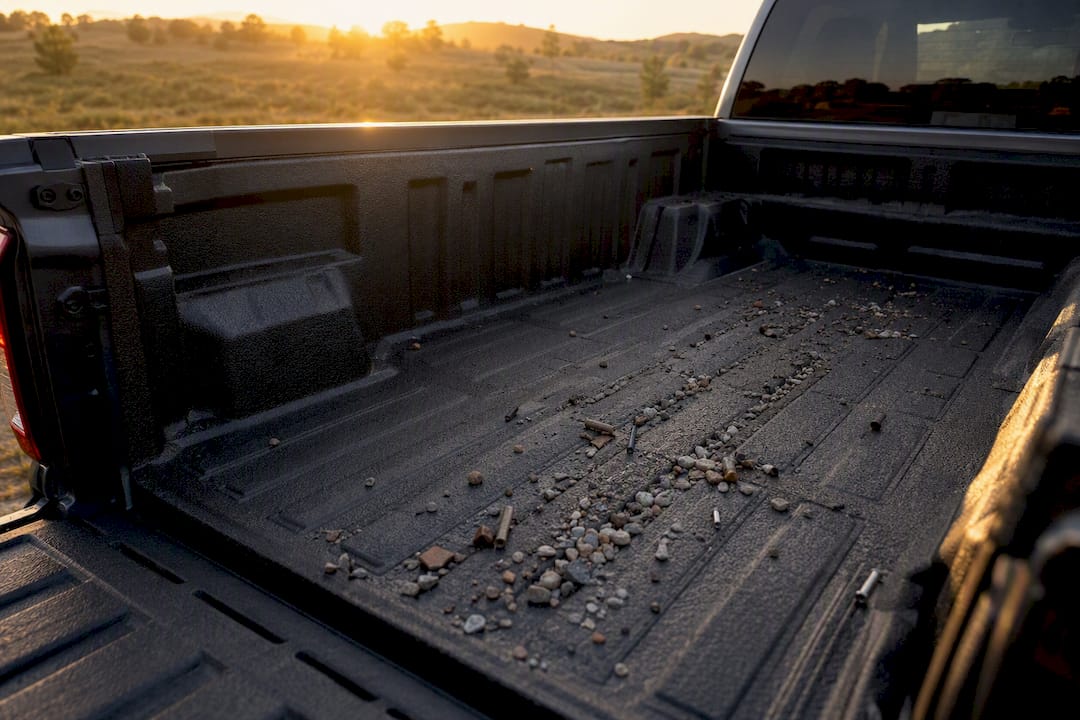
Raised edge walls matter here too, often overlooked in favor of surface texture alone. A mat with a lip around the perimeter keeps loose items, gravel, screws, dropped fasteners, from migrating into wheel well gaps or working their way under the mat itself. Community reports from F-150 and Lightning owners consistently point to edge design as the detail that separates a mat that looks good on day one from one that still performs after a year of real hauling.
What Should You Expect to Pay for a Quality Bed Mat?
Bed mat pricing splits into three rough tiers, and understanding what drives the price difference helps you avoid overpaying for marketing or underpaying for durability.
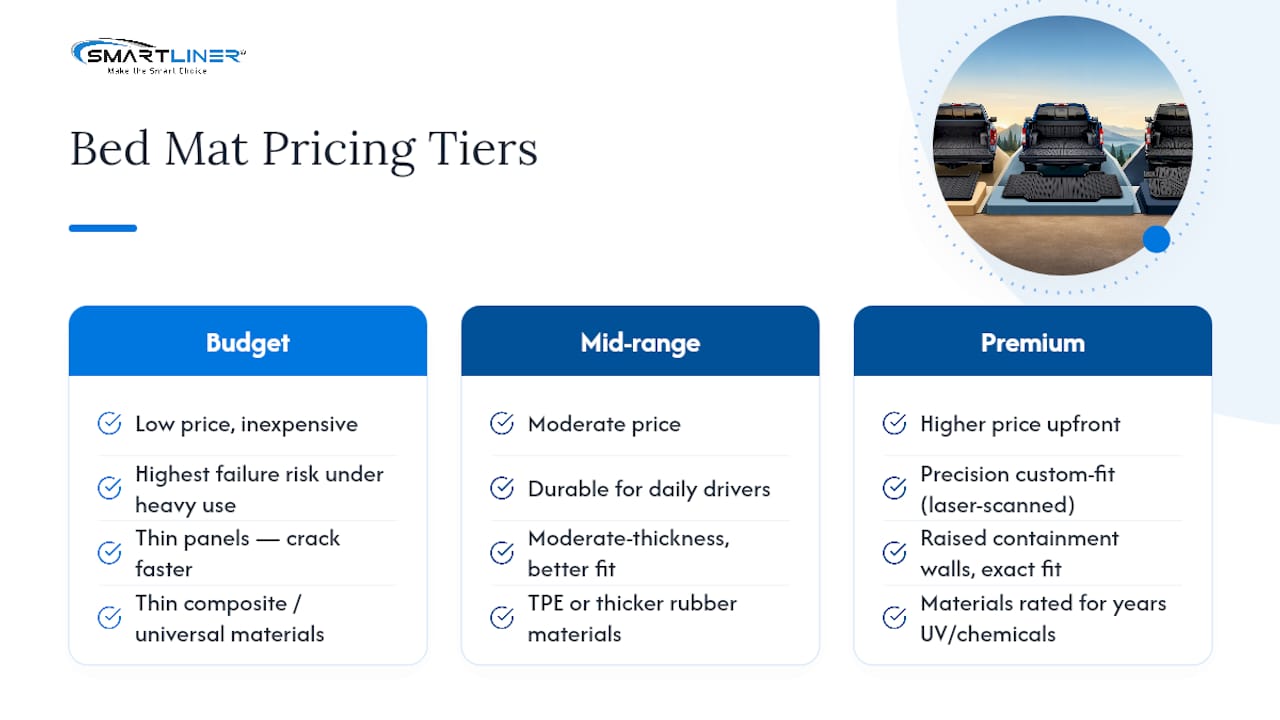
Budget composite and thin universal mats sit at the low end. They’re inexpensive but carry the highest failure risk under repeated heavy use, and thinner panels crack faster than owners expect. Mid-range TPE and moderate-thickness rubber mats occupy the middle tier, offering the durability and weather resistance most daily drivers need without paying for features they won’t use. Premium custom-fit mats, laser-scanned to your exact bed length and generation, sit at the top, and the price premium buys precision fit, raised containment walls, and materials rated for years of UV and chemical exposure rather than months.
The value calculation isn’t just sticker price against sticker price. A universal mat that shifts, gaps around wheel wells, or cracks within a year costs you twice: once on the mat itself, and again when you replace it. A custom-fit mat built for your specific F-150 generation costs more upfront but typically outlasts two or three replacement cycles of a poorly fitted universal option. For owners keeping their truck five years or more, that math almost always favors paying for precise fit the first time rather than buying cheap and replacing often.
How Long Should a Good Bed Mat Actually Last?
Durability comes down to material density, UV stabilization, and how consistently you maintain the mat, not just the price tag on the listing.
A well-built TPE or rubber mat, cared for with the monthly rinse routine covered earlier, should hold up for years of regular use without cracking or losing its texture. UV exposure is the silent killer here. Materials without proper UV stabilizers become brittle within a season or two of direct sun exposure, especially in southern and desert climates where F-150s see heavy outdoor parking. Cracking, fading, and a stiff, chalky surface are the visible warning signs that a mat has reached the end of its useful life.
Warranty terms tell you almost everything you need to know about how a manufacturer expects their product to perform. A mat backed by a real, clearly stated warranty signals the maker trusts the material to hold up under normal use. Vague warranty language, or none at all, is a signal worth taking seriously before you buy. Ask directly what’s covered: cracking, fading, and seam failure are the three most common warranty claims across bed mat categories, and a manufacturer confident in their materials will spell out coverage for all three rather than burying the details.
What Do Other F-150 Owners Say About Their Bed Mats?
Owner communities are blunt, and that bluntness is useful. Long-running threads across F-150 and Lightning forums consistently favor mats that hold up under real-world wear over ones that simply looked impressive on a spec sheet.
Community discussions comparing DeeZee, Husky, and Ford’s own bed mat options reveal a pattern worth paying attention to: owners weight fit and long-term wear far more heavily than brand name alone. A mat that a friend has run for three winters without cracking carries more weight in these threads than any manufacturer claim. Forum-driven buying decisions tend to reflect what actually happens after eighteen months of ownership rather than what a product page promises on day one.
That pattern matters for how you should evaluate brand reputation generally. A company that publishes exact fitment data for your specific truck generation, backs it with a real warranty, and responds to fitment questions before you buy is giving you the same kind of evidence forum veterans rely on, just delivered directly instead of secondhand. Reviews that specifically mention ease of cleaning, edge durability after multiple seasons, and accurate fit against a listed bed length are worth more than star ratings alone. Look for detail, not just sentiment, when you’re reading customer feedback on any bed mat listing.
Will a Bed Mat Work With Your Toolbox or Bed Cover?
Accessory compatibility is where a lot of universal mats fail quietly, months after purchase rather than at checkout.
A crossbed toolbox mounted at the front of the bed needs a mat that either sits below its mounting rails or is cut to clear them entirely. Universal mats often ride too high, creating a gap that traps debris under the toolbox feet or preventing the box from sitting flush. Custom-fit mats built for your specific bed length and generation account for standard toolbox mounting points, which is one more reason model-specific fitment matters beyond the wheel well and tailgate concerns covered earlier.
Bed covers, whether roll-up, folding, or tonneau style, interact with mat height at the bed rails. A mat with raised edge walls that sit too tall can interfere with a cover’s seal along the rail, letting water in exactly where you least want it. Check the mat’s edge height against your cover’s clearance specs before buying if you’re running both together.
Tie-down anchors are the third common friction point. A mat that doesn’t account for factory tie-down loop locations either blocks access to them or forces you to cut through the mat yourself, which voids any warranty protection. This is a detail worth checking directly on a product’s fitment page rather than assuming, since it varies by both bed length and model year.
Why Most Buying Guides Get This Wrong
Most roundup articles rank bed mats by thickness or price, treating a thicker rubber mat as automatically superior to a thinner TPE one. That’s backward. Fit precision and surface texture predict real-world performance far better than raw material thickness ever will. A mat that gaps around your wheel wells or rides too high against your tailgate fails you regardless of how many millimeters of rubber it’s made from.
The conventional advice to “buy the thickest mat you can afford” also ignores maintenance reality. A heavy rubber mat you can’t easily lift out for a monthly rinse is a mat that stays in place trapping moisture against your bed floor, the exact rust risk it was supposed to prevent. TPE’s lighter weight isn’t a compromise. For most owners, it’s the feature that makes the maintenance routine actually happen instead of getting skipped.
What should you prioritize first? Confirm your exact bed length and model year before you look at a single material spec. Everything else on the buying checklist matters less if the mat doesn’t sit flush in your specific F-150. Once fit is locked in, choose TPE for daily driving and reserve heavy rubber for genuine commercial-grade hauling. That order, fit first, material second, price last, is the one conventional guides consistently reverse.
— Marty
Get the Exact Fit for Your F-150 Bed
Smartliner-usa builds bed protection around your truck’s specific measurements instead of a one-size-fits-most guess, which is the single factor this article keeps circling back to as the real predictor of long-term performance. Where universal mats leave gaps at the wheel wells or ride too high against your tailgate, Smartliner’s custom-fit approach starts with your exact bed length and model year, then adds a recyclable TPE or rubber build that holds up through seasons of real use. If you’re also protecting the cab, the Smartliner Floor Liners line extends the same precise fit forward of the bed.
Check your F-150’s model year and bed length against the Smartliner Truck Bed Mat Liners fitment page now, and confirm your exact configuration is in stock before you order.
Key Takeaways
Custom-fit TPE or heavy rubber bed mats outperform universal options because precise, model-specific fit prevents shifting, gaps, and edge damage that shorten a mat’s useful life.
| Point | Details |
|---|---|
| Fit beats thickness | Confirm bed length and model year before comparing material or price. |
| TPE is the modern default | Balances grip, weather resistance, and easy cleaning for most daily drivers. |
| Combine for long ownership | Pair a spray-in liner with a removable mat for rust prevention plus cargo grip. |
| Maintenance prevents rust | Remove and dry the mat monthly to avoid trapped moisture underneath. |
| Smartliner delivers precise fit | Smartliner Truck Bed Mat Liners offer laser-matched fitment and recyclable materials for specific F-150 generations. |
Sources
- Truck Bed Mat vs. Spray-In Liner: Which is Better?
- Cargo Liner Materials Compared: Rubber vs TPE vs Carpet (2026) | GarageGist
- 10 Best Truck Bed Mats For Ford F-150 In 2026: Custom-Fit All-Weather Protection
- Best Truck Bed Mats: Ultimate Guide to Protection & Fit
Recommended
- SMARTLINER Custom Fit Floor Liners For 2011-2014 Ford F-150 SuperCrew Cab | Smartliner USA
- SMARTLINER Custom Fit Floor Liners For 2009-2010 Ford F-150 SuperCrew Cab | Smartliner USA
- Smart Trim™ Floor Liners For 2011-2014 Ford F-150 SuperCab Non Flow Center Console | Smartliner USA
- Smart Trim™ Floor Liners For 2009-2010 Ford F-150 SuperCab Non Flow-Through Center Console | Smartliner USA