

For most drivers who want reliable spill containment and a near-OEM fit, a custom-fit TPE cargo liner beats every universal alternative on the market. It contains messes with a raised lip, matches your vehicle’s exact contours, and hoses clean in minutes. Smartliner-usa builds direct-fit TPE liners for hundreds of vehicle models, so the practical starting point is checking your model’s fit notes on the Smartliner Cargo Liners page before you buy.
TL;DR:
- Custom-fit TPE cargo liners provide superior containment, matching vehicle contours precisely and featuring adequate lip depth for different use cases.
- Fit notes for specific models, trim levels, and seat configurations are essential to ensure the liner performs correctly and avoids gaps or interference.
- Material choice depends heavily on usage; TPE balances waterproofing and temperature resistance, making it ideal for most SUV owners handling weather and chemicals.
- Accurate measurements and checking fit notes, including details about cargo tray position and add-ons, prevent returns and ensure optimal protection.
- Regular cleaning involves rinsing with water and mild soap, and liners should be replaced when the material cracks or the lip no longer functions effectively.
Table of Contents
- Top Cargo Liner Picks for Common Use Cases
- How Do You Choose the Right Cargo Liner?
- Which Cargo Liner Material Should You Buy?
- How Do You Measure and Verify Fit Before You Buy?
- How Do You Clean and Maintain a Cargo Liner?
- Installation Tips and Anti-Slip Safety Notes
- Does Fit Vary by Vehicle Model?
- Why Custom-Fit Recommendations Beat Generic Roundups
- Ready to Order Your Custom-Fit Cargo Liner?
- Sources
Top Cargo Liner Picks for Common Use Cases
Matching your situation to the right SKU matters more than chasing a generic “best cargo liner” label. Here’s how Smartliner-usa’s lineup breaks down by the way people actually use their cargo areas.
- Pet owners hauling muddy dogs or shedding fur: Look for a liner with a deep raised lip and a smooth TPE surface that releases hair without snagging. The 3rd-row cargo liner for the Land Rover Discovery Sport shows how Smartliner-usa extends coverage around folded seatbacks, a common weak spot when a wet dog shakes off in the back.
- Heavy haulers moving lumber, tools, or landscaping gear: Full-size trucks and SUVs need thicker material and reinforced edges. The floor liner line for Silverado, Sierra, Tahoe, and Suburban models uses heavier-gauge TPE built for repeated abuse rather than occasional grocery runs.
- Daily family use with kids, groceries, and gear: Compact crossovers benefit from liners that respect factory cargo trays instead of covering them. The cargo tray-compatible liner for the Nissan Rogue Sport keeps the tray in its lowest position while still adding a protective barrier.
- UTV and off-road recreation: Off-roaders deal with mud, water, and vibration that street vehicles never see, which calls for a liner engineered specifically for that punishment.
Every Smartliner-usa product page lists fit notes for seat configuration, cargo tray position, and factory accessories. Read that section before ordering. It’s the fastest way to confirm you’re buying the version built for your exact trim.
How Do You Choose the Right Cargo Liner?
Fit method decides more of your outcome than material or price. A liner scanned from your vehicle’s actual cargo floor reduces movement and closes gaps that let spills escape, while a universal trim-to-fit mat asks you to guess at contours with scissors. Custom-fit liners built from 3D scans consistently outperform universal mats on coverage and containment, though a trim-to-fit mat still makes sense if you rotate one-liner between multiple vehicles or only need occasional protection.
Once you’ve settled on fit method, compare these specs in order:
- Lip depth. A raised edge under 0.5 inches barely slows a spilled coffee. Anything at or above 1 inch creates enough of a basin to actually hold liquid.
- Material. TPE, rubber, PVC, and carpet each perform differently under heat, cold, and cleaning.
- Anti-slip and anchoring. OEM anchor points or grippy backing keep the liner from sliding when you brake hard.
- Thickness and compatibility notes. Thicker liners resist punctures; compatibility notes flag seat configurations and trim levels that change the shape you need.
Budget tiers track use case more than luxury. Occasional haulers can get by with a mid-range universal mat, but anyone dealing with pets, job-site gear, or year-round weather should treat a premium custom-fit liner as the baseline, not the upgrade.
Pro Tip: Check the product page’s fit notes for language about “cargo tray position” or “3rd row seats” even if your trim seems standard. A single factory option can change which SKU actually fits.
Which Cargo Liner Material Should You Buy?
Material choice comes down to how you use your vehicle and how much abuse the cargo area takes.
- TPE (thermoplastic elastomer): Waterproof, flexible in cold weather, and resistant to cracking over time.
- Rubber: Durable and grippy but can stiffen and crack in extreme cold faster than TPE.
- PVC: Budget-friendly but often thinner, with less resistance to temperature swings.
- Carpet: Comfortable underfoot and quiet, but it absorbs spills instead of containing them.
A custom-fit TPE liner is the tested best-practice for most SUV and cargo owners because it balances waterproofing, temperature resistance, and easy cleaning better than the alternatives. TPE also resists road salt and chemical exposure more effectively than many rubber and PVC options, which matters if you live somewhere winters mean salted roads for months at a time. Carpet still has a place for owners who rarely haul anything messier than luggage and want a quieter, softer surface underfoot. Rubber remains a solid pick if you need maximum grip for heavy equipment that tends to slide.
How Do You Measure and Verify Fit Before You Buy?
Getting the measurement right the first time saves you a return shipment and a week without protection.
- Measure the length, width, and depth of your cargo area with the rear seats in the position you use most often.
- If you’re unsure about tight spots, build a cardboard template of the space and test it for interference before ordering.
- Check the product’s fit notes for mentions of a subwoofer box, 3rd-row seating, or a sliding rear tray, since any of these change the shape you actually need.
- Confirm your exact model year and trim level against the listing, not just the vehicle name.
- Verify the attachment method. OEM anchor points hold more securely than anti-slip backing alone, especially on rough terrain.
How Do You Clean and Maintain a Cargo Liner?
A TPE liner rewards minimal effort. Rinse it with a hose and a mild soap solution, then let it air dry completely before reinstalling it to avoid trapping moisture underneath.
- Wipe up spills as soon as you notice them to prevent staining or lingering odor.
- Pet hair usually lifts off with a stiff brush or a shop vacuum before you even reach for water.
- Road salt should be rinsed off promptly. Left to sit, it can dull the surface finish over a full winter.
- Replace a liner once the material cracks, the lip loses its shape, or the surface no longer releases dirt cleanly.
For dashboard and interior surfaces near your cargo area, this guide to cleaning a car dashboard covers safe products that won’t damage trim while you’re already in cleaning mode.
Installation Tips and Anti-Slip Safety Notes
A liner that shifts under braking isn’t just annoying, it’s a real hazard if cargo slides forward into the cabin. OEM anchor points and anti-slip backing meaningfully reduce liner movement compared with a liner that simply rests loose on the carpet. Smartliner-usa builds anchor compatibility into its precise-fit tech so liners lock into factory hold points rather than relying on friction alone.
Pro Tip: If you’ve added an aftermarket subwoofer or a cargo organizer, measure around it before ordering. Fit problems most often come from these add-ons, not from the vehicle itself.
- Confirm anchor point locations match your trim before installing.
- Press the liner into corners firmly on first install to seat it against factory contours.
- Recheck fit after folding and unfolding rear seats, since repeated use can shift a loosely anchored liner over time.
Does Fit Vary by Vehicle Model?
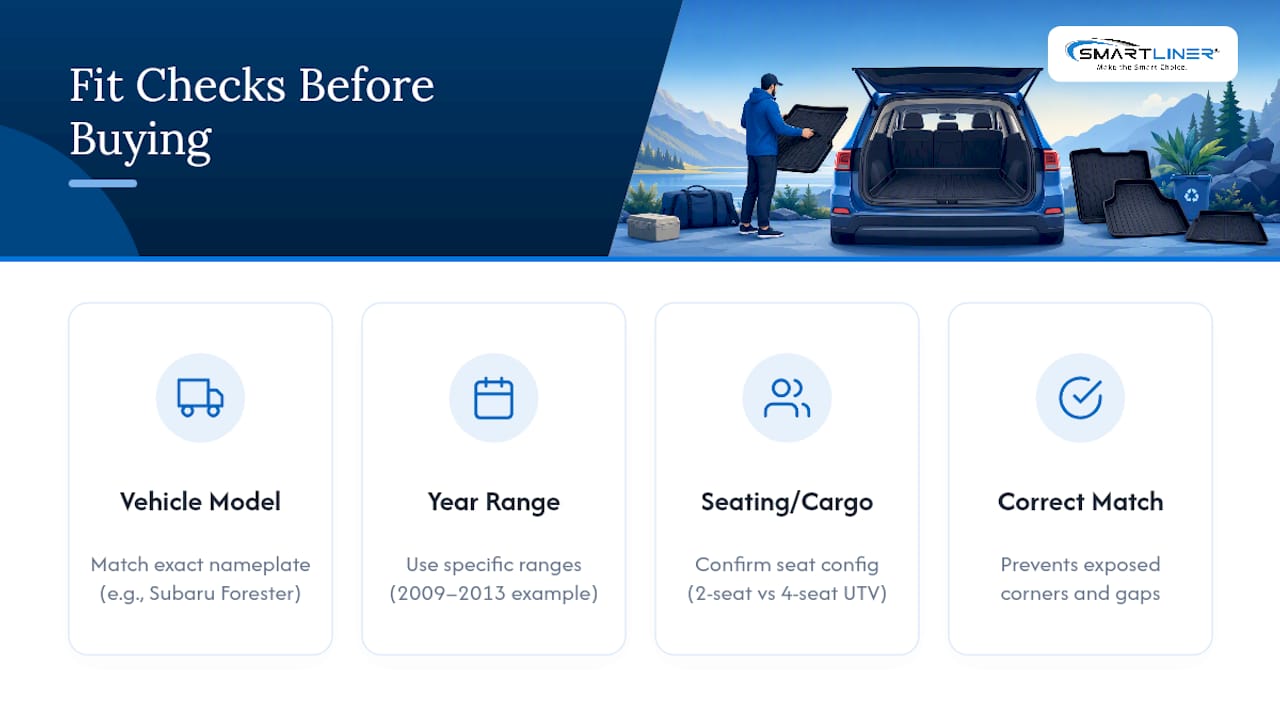
Fit variation between models is the single biggest reason generic mats disappoint buyers. A crossover with a factory cargo tray needs a liner that respects the tray’s lowest position, while a three-row SUV needs coverage that extends behind folded second-row seats without leaving gaps at the seams. Trucks introduce a different problem entirely, since bed liners and cabin cargo areas require separate products built to different specs.
Even within the same nameplate, model years matter. A Subaru Forester from one generation won’t share dimensions with a later redesign, which is why Smartliner-usa lists liners by specific year ranges, like its fit for the 2009 to 2013 Subaru Forester, rather than a single “Forester” catalog entry. UTVs add another layer of complexity, since passenger configurations (2 seat versus 4 seat) change the cargo footprint entirely, as seen in the all-weather protection built for the 2024 to 2026 Can-Am Maverick R in its 4-seater configuration.
The practical takeaway: always match your liner to your exact model, year range, and seating configuration, not just the general vehicle name. A five-minute check against the fit notes prevents a liner that almost fits but leaves a corner exposed to exactly the mess it was supposed to stop.
Why Custom-Fit Recommendations Beat Generic Roundups
Most “best cargo liner” roundups rank products by star ratings without asking whether the liner actually matches the reader’s vehicle. That approach misses the point. The real decision isn’t which brand wins a popularity contest, it’s whether a specific liner’s dimensions, lip depth, and anchor points match your exact trim.
Smartliner-usa’s catalog is organized around that reality: fit notes by model year, trim, and cargo configuration, backed by 100% recyclable TPE construction that holds up across seasons. The trade-off is that shoppers have to spend a few extra minutes confirming their exact vehicle specs instead of grabbing a one-size-fits-all mat off a shelf. That extra step is worth it every time a liner needs to actually contain a spill rather than just cover a floor.
— Marty
Ready to Order Your Custom-Fit Cargo Liner?
Generic mats force you to trim, guess, and hope the edges hold. Smartliner-usa skips that gamble entirely: every liner is built to your vehicle’s specific year, trim, and cargo configuration, using 100% recyclable TPE that resists cracking, road salt, and years of daily use without the price tag of premium competitors. Whether you’re protecting a family SUV, a work truck bed, or a UTV built for mud and vibration, there’s a direct-fit option waiting in the catalog.

Start with the Smartliner Cargo Liners category page and search your exact model and year. Hauling gear in a truck bed too? The truck bed mat liners round out the protection front to back. If you run a UTV, check the UTV floor mats built for off-road conditions standard cargo liners were never designed to handle. Find your fit notes, confirm your trim, and place your order today.
Recommended
- SMARTLINER Custom Fit Floor Liners For 2016-2021 Mazda CX-3 With Cargo Tray
- SMARTLINER Custom Fit Floor Liners For 2007-2011 Toyota Tundra CrewMax Cab
- SMARTLINER Custom Fit Floor Liners For 2007-2021 Toyota Tundra CrewMax Cab
- SMARTLINER Floor Liners for 2017-2024 Nissan Rogue Sport - Factory Cargo Tray in Lowest Position