

For most drivers, the best car floor mats are laser-scanned, custom-fit liners built from TPE (thermoplastic elastomer), and the strongest value in that category comes from Smartliner-usa’s custom-fit floor liners. These liners lock into factory anchor points, hold a significant volume of liquid per square foot before overflowing, and cost less than the premium OEM-branded alternatives without sacrificing fit precision.
That single answer covers most shoppers, but the right pick still depends on your vehicle, climate, and budget. Here’s the shortlist that came out on top after comparing fit systems, containment capacity, and material durability across the current market:
- Best overall mat style: Custom-fit, laser-scanned TPE liners. They match your vehicle’s exact floor contours and connect to factory retention anchors, which cuts the risk of a mat sliding into the pedal area.
- Best value custom-fit pick: Smartliner-usa’s floor liners, which pair vehicle-specific molds with a recyclable TPE-style compound at a price point below most premium competitors.
- Best heavy-duty coverage: Deep-dish, full-coverage liners with raised channeling for owners hauling gear, kids, or muddy boots through Midwest winters.
- Best budget alternative: Trim-to-fit universal mats, acceptable only for short-term use in a rental or a car you’re about to sell.
Three signals separate a genuinely tested mat from a marketing claim: independent containment benchmarks, laser-scanned fit verification against factory anchor points, and multi-season real-world testing rather than a single lab pass. Expert-reviewed test roundups rely on exactly these criteria, and it’s worth holding any mat you’re considering to the same bar.
Key Takeaways
Custom-fit, laser-scanned floor mats with a minimum 2-inch lip height outperform universal mats on containment, safety, and long-term durability.
| Point | Details |
|---|---|
| Fit beats material | A precise, anchor-compatible fit matters more than premium material if the mat doesn’t match your factory floor pan. |
| Minimum lip height | Look for at least a 2 to 3 inch containment edge to handle real spills and winter slush. |
| Verify anchors before buying | Confirm your mat’s grommets align with factory posts to avoid pedal interference risk. |
| Warranty as tiebreaker | When two mats compare evenly, a multi-year warranty against cracking signals stronger material confidence. |
| Smartliner-usa for value custom-fit | Smartliner-usa pairs laser-scanned vehicle-specific fit with recyclable TPE material at a price below premium competitors. |
Table of Contents
- What Makes the Best Car Floor Mats in 2026?
- How We Tested and Evaluated Floor Mats
- How Do You Choose the Right Floor Mats for Your Car?
- SMARTLINER: The Value Custom-Fit Pick
- What Defines a Premium Overall Floor Liner?
- What to Expect From Mid-Tier Heavy-Duty Liners
- What Makes High-End Performance Mats Different?
- Design-Focused Coverage Mats: Style Without Sacrificing Protection
- Are Budget Floor Mats Ever Worth Buying?
- Why Do Custom-Fit, Laser-Scanned Mats Actually Matter?
- Final Verdict: Which Floor Mats Fit Your Situation?
- What Actually Matters After Months of Real Use
- Get a Custom-Fit Liner Built for Your Exact Vehicle
- Sources
What Makes the Best Car Floor Mats in 2026?
The best floor mats for cars share three traits: a fit engineered around your specific make and model, a non-porous material that won’t absorb spills, and a containment lip tall enough to hold real volume rather than a token quarter inch of plastic. Everything else, color options, carpet inserts, and retail packaging, is secondary.
Fit type separates the field faster than any other factor. A mat trimmed to “roughly fit” a category of vehicles will always leave gaps near the pedals or transmission tunnel that a laser-scanned liner won’t. Material matters just as much: TPE and rubber-based compounds stay flexible in cold weather and don’t crack the way cheaper vinyl blends do after a few winters.
Below is a side-by-side look at how the major mat categories stack up on the dimensions that actually affect your daily drive.
| Category | Best For | Price Tier | Fit Type | Material | Containment | Cleaning | Warranty |
|---|---|---|---|---|---|---|---|
| Value custom-fit liners | Budget-conscious buyers wanting real fit precision | Mid-low | Custom (laser-scanned) | Recyclable TPE compound | High (raised lip, full coverage) | Rinse and wipe | Limited manufacturer warranty |
| Premium overall liners | Buyers prioritizing OEM-level precision | High | Custom (laser-scanned) | Advanced TPE compound | Very high (deep-dish edges) | Rinse and wipe | Multi-year warranty |
| Mid-tier heavy-duty liners | Work trucks, high-traffic family vehicles | Mid | Semi-custom or custom | Thicker molded compound | Moderate to high | Hose-off, air dry | Standard limited warranty |
| High-end performance mats | Off-road and severe-weather driving | High | Custom | Specialty cold/heat-resistant compound | High with anti-slip texture | Rinse and wipe | Multi-year warranty |
| Design-focused coverage mats | Buyers who want interior aesthetics plus protection | Mid-high | Custom or semi-custom | Carpet insert over non-porous base | Moderate | Vacuum plus spot clean | Varies by maker |
| Trim-to-fit / universal mats | Short-term or budget use only | Low | Universal | Basic rubber or vinyl | Low | Wipe down | Rarely more than 30-90 days |
A few quick takeaways from that comparison:
- Value custom-fit liners win on price-to-precision ratio; the tradeoff is a slightly thinner edge profile than the priciest premium tier.
- Premium overall liners offer the deepest containment and longest warranties, but you’ll pay for every extra millimeter of lip height.
- Mid-tier heavy-duty liners handle daily abuse well but can feel bulky underfoot compared to a slimmer custom-fit design.
- Trim-to-fit universal mats are the only category where fit isn’t guaranteed, which is exactly why they sit at the bottom for anyone who wants long-term protection.
How We Tested and Evaluated Floor Mats
Reliable mat rankings come down to a handful of measurable criteria, not marketing copy. The tests that matter most are fit and retention, containment capacity, material flexibility across temperature swings, abrasion resistance, ease of cleaning, off-gassing or odor, and pedal interference risk.
Here’s what those evaluations typically involve:
- Containment testing: pouring measured liquid volumes onto a mat to find the point of overflow, which is how the 8 to 12 ounce per square foot benchmark for premium all-weather mats gets established.
- Abrasion cycling: repeated foot-traffic simulation to see how many cycles a compound withstands before cracking or thinning.
- Cold and heat flexibility checks: freezing and heating a sample mat to see whether it stays pliable or becomes brittle, since a mat that cracks at 10 degrees Fahrenheit is a liability in half the country every winter.
- Real-world seasonal follow-up: tracking the same mats through a full winter-to-summer cycle to catch problems that a single lab pass misses, like edge curling or anchor wear.
Representative test vehicles typically span a compact sedan, a midsize SUV, and a full-size truck, since footwell shape, pedal spacing, and cargo floor contours differ enough between those platforms that a mat performing well in one doesn’t guarantee the same result in another.
One caveat worth stating plainly: sample sizes in independent test roundups are often small, a handful of vehicles and a handful of mat sets, so treat any single ranking as a strong data point rather than an exhaustive verdict. Journalist test reports have flagged real safety incidents tied to improperly trimmed or poorly anchored mats, which is exactly the kind of finding that a small but careful test can still catch.
Pro Tip: Before trusting any “tested” claim, check whether the source names its test vehicles and describes a repeatable method. If a review can’t tell you what car it tested a mat in, treat the ranking as opinion, not data.
How Do You Choose the Right Floor Mats for Your Car?
Start with the fit question, because everything else is secondary to it. Choose laser-scanned, vehicle-specific TPE liners for year-round protection unless you’re dealing with a display car, a classic you rarely drive in wet weather, or a leased vehicle you plan to return with factory carpet intact.
Work through this checklist before you buy:
- Confirm fit type. Vehicle-specific beats trim-to-fit every time protection is the goal.
- Check material. Non-porous TPE or rubber compounds resist absorption; carpet-only mats don’t.
- Measure lip height. A deep-dish edge of 2 to 3 inches is the benchmark for real spill containment.
- Verify retention system. The mat should clip into your car’s existing anchor posts, not just sit loose on the carpet.
- Inspect edge consistency. Walk your finger around the perimeter; uneven lip height near the pedals is a design shortcut, not a feature.
- Ask about warranty terms. A manufacturer confident in its material backs it with more than a 30-day return window.
To measure your own vehicle before ordering, check the front footwell width at its narrowest point, the depth from seat rail to firewall, and whether your factory anchors are hook-style or twist-style posts. Most custom-fit sellers, including Smartliner-usa, list compatible years and trims by model, which removes the guesswork; if you’re ever unsure, contact the seller with your VIN and ask them to confirm anchor type before you order.
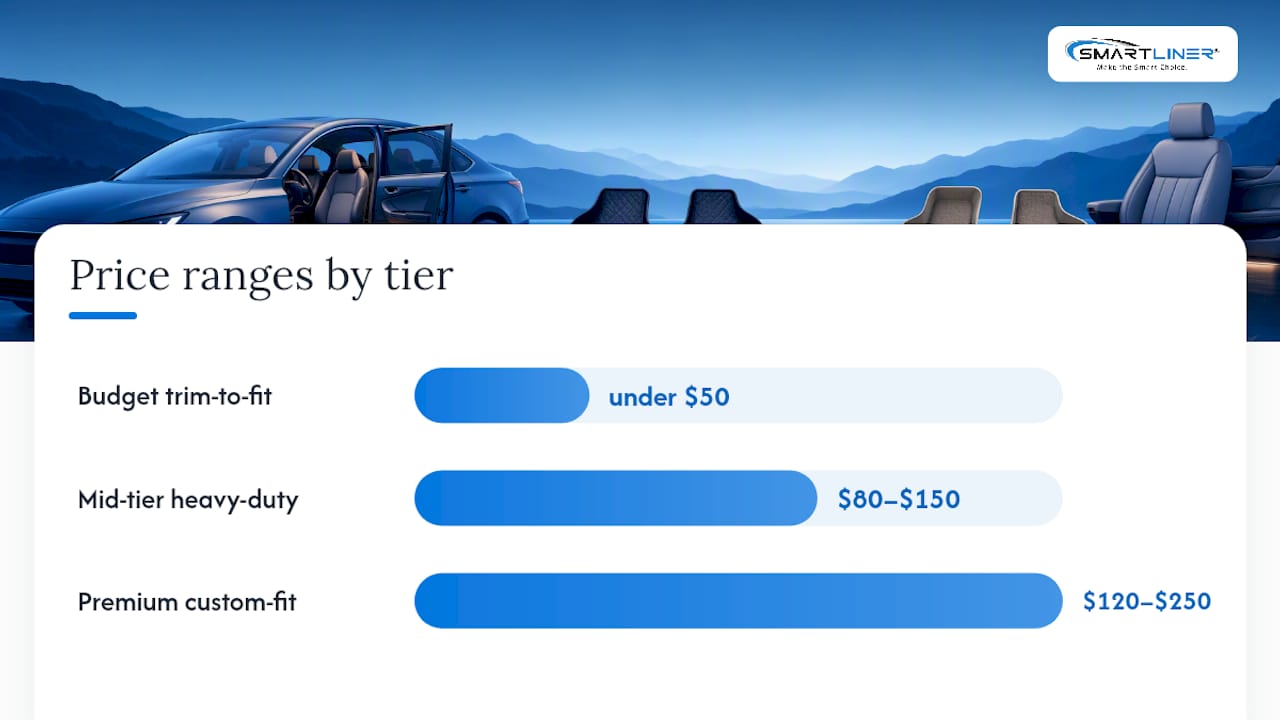
Price ranges vary by tier. Budget trim-to-fit sets run under $50, mid-tier heavy-duty sets typically land in the $80 to $150 range, and premium custom-fit liners span roughly $120 to $250 depending on coverage (front, rear, and cargo). For a leased vehicle, mid-tier coverage is usually enough since you won’t own the car long-term. For a vehicle you plan to keep past 100,000 miles, the higher end of custom-fit is the better investment, since protecting the factory carpet preserves resale value and avoids costly interior replacement.
Watch for these red flags: mats that require you to trim material over an existing factory anchor point, mats that bunch or ride up against the gas pedal within the first week, and inconsistent lip height that’s tall on the sides but nearly flat near the driver’s heel. Any of these is a sign the mat wasn’t engineered for your specific floor pan.
SMARTLINER: The Value Custom-Fit Pick
Smartliner-usa’s floor liners are built around a straightforward proposition: laser-scanned CAD fit for hundreds of specific makes and models, at a price that undercuts the premium OEM-branded competition without cutting corners on containment. That combination is why it tops the value tier of this comparison.
The fit approach mirrors what higher-priced competitors do. Each liner is modeled from an individual vehicle’s floor pan, then produced to match factory contours precisely, including the 2018 to 2024 GMC Terrain’s footwell shape and the tighter, narrower profile of a compact like the 2015 to 2019 Honda Fit. Coverage typically spans front row, rear row, and cargo area as separate pieces, so you can protect the whole cabin or just the high-traffic zones.
Feature highlights worth knowing before you buy:
- Full-coverage sets for front, rear, and cargo, sold together or separately depending on the model.
- Raised edge design built to contain spills rather than let them wick onto carpet.
- Factory anchor compatibility on supported models, including trucks with dual driver-side floor posts like the 2008 to 2019 Nissan Frontier Crew Cab.
- Recyclable TPE-style material that stays flexible in cold and rinses clean with a hose or wipe.
- Straightforward returns process for buyers who select the wrong year or trim by mistake.
Pros: Strong fit precision for the price, genuinely recyclable material, easy cleanup, and a catalog deep enough to cover uncommon trims most competitors skip.
Cons: Edge depth on some models runs slightly shallower than the priciest premium liners, and cargo liners for certain SUVs are sold separately rather than bundled by default.
Pro Tip: When you shop by year, make, and model, double-check your trim level too. Some vehicles change floor anchor placement mid-generation, and a one-year mismatch can mean the difference between a snug fit and a mat that shifts underfoot.
What Defines a Premium Overall Floor Liner?
The premium tier is where fit tolerance gets tightest and containment gets deepest. Expect laser-scanned molds matched almost to the millimeter, deep-dish edges that rival a shallow tray, and an advanced TPE compound engineered to stay rigid enough to hold shape but flexible enough not to crack in sub-zero temperatures.
Buyers who value OEM-level fit and maximum containment get real benefits here: the deepest lip heights on the market, often exceeding the 2 to 3 inch minimum recommended for waterproof performance, and warranty terms that frequently stretch several years rather than a single season. The tradeoff is cost.
To verify a premium claim isn’t just marketing language, ask for the material’s durometer rating (a measure of hardness and flex), the actual measured lip height in inches, and any published containment figures similar to the 8 to 12 ounce per square foot benchmark used across the industry. A manufacturer that can’t produce these numbers is likely relying on brand reputation instead of engineering.
What to Expect From Mid-Tier Heavy-Duty Liners
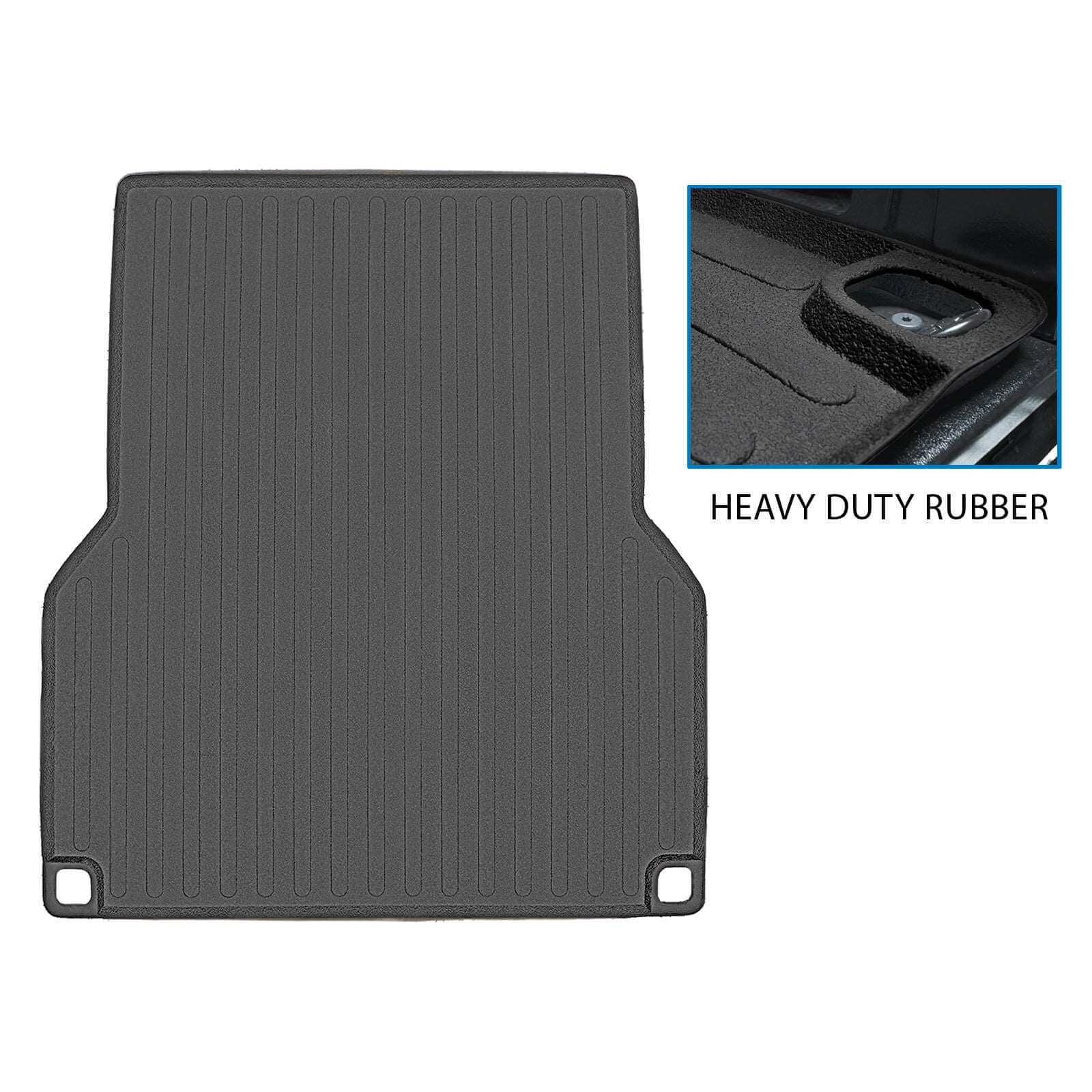
Mid-tier heavy-duty mats occupy the practical middle ground: thicker compound than entry-level mats, molded channeling to direct mud and water toward the edges, and retention systems that hold reasonably well even under repeated boot traffic. They’re not laser-scanned to the same tolerance as premium liners, but the fit is usually close enough for daily use.
These mats make the most sense for work trucks that see constant in-and-out traffic, contractors hauling tools, and family vehicles logging heavy miles with kids, pets, or sports gear. If your vehicle sees mud, gravel, or road salt more days than not, this tier often delivers better cost-per-year value than a premium liner that gets the same abuse.
Pros: Genuinely rugged build, decent containment for the price, and wide availability across popular truck and SUV platforms.
Cons: Bulkier underfoot than a slim custom-fit liner, and the added thickness can occasionally interfere with adjustable pedal assemblies if you don’t check clearance first.
What Makes High-End Performance Mats Different?
High-end performance mats push compound chemistry further than any other tier. Expect specialty formulations engineered to resist cracking at extreme cold and softening at extreme heat, along with aggressive channel designs meant to trap mud, snow melt, and gravel rather than let it slide back onto your shoe.
The anti-slip surface texture on these mats tends to be more pronounced too, often a raised diamond or ridge pattern that keeps your foot planted during hard braking, a detail that matters more than it sounds for anyone driving unpaved roads or steep terrain regularly.
Who should spend the extra money here? Drivers in genuinely harsh climates, ranchers, contractors working rural routes, and anyone whose vehicle sees snow, mud, or gravel more often than clean pavement. For a commuter who parks in a garage and drives paved roads, this tier is often overkill relative to a solid mid-tier or value custom-fit liner.
Common warranty claims in this segment run three to five years. Verify them by checking whether the warranty covers cracking and material failure specifically, not just manufacturing defects, since that distinction determines whether a cold-weather crack actually gets covered.
Design-Focused Coverage Mats: Style Without Sacrificing Protection
Design-focused mats trade some containment depth for interior aesthetics: color-matched trim, integrated carpet inserts, or textured surface patterns meant to blend with factory upholstery rather than look like an aftermarket add-on. They still sit on a non-porous base layer in most cases, so basic spill protection remains intact even if the deepest containment numbers belong to plainer TPE-only liners.
The tradeoff shows up in cleaning and longevity. A carpet insert traps dirt and moisture the way any carpet does, which means more frequent vacuuming and occasional spot cleaning rather than a simple hose-and-wipe routine. Over several years, these inserts also show wear patterns, worn fibers near the heel strike zone, faster than a solid TPE surface would.
These mats suit buyers who care as much about how their cabin looks as how well it’s protected, particularly owners of newer vehicles with distinctive interior color schemes who don’t want a utilitarian rubber floor competing with the rest of the cabin design. Compared to an all-TPE liner at a similar price, you’re accepting somewhat lower peak containment in exchange for a mat that looks intentional rather than purely functional.
Are Budget Floor Mats Ever Worth Buying?
Budget mats have a real place, but only under specific conditions. There’s a meaningful difference between a true vehicle-specific, laser-scanned mat sold at a lower price and a generic trim-to-fit mat that asks you to cut material to approximate your car’s shape. The first is a legitimate value option; the second is a compromise you should understand before buying.
Common failure points in budget products include low lip height that overflows within seconds of a spilled coffee, poor anchor compatibility that leaves the mat free to slide toward the pedals, and material that turns brittle and cracks after a single cold winter. None of these are hypothetical. They’re the same failure modes independent test reports flag repeatedly in universal mat categories.
So when is a budget buy acceptable?
- Temporary use in a rental car where long-term durability doesn’t matter.
- A vehicle you’re actively trying to sell within the next few months.
- A backup mat for a second vehicle that sees minimal use.
If you do go budget, insist on a few minimum specs regardless of price: a lip height of at least an inch, a non-porous material rather than raw carpet, and confirmation that the mat won’t extend far enough forward to contact the pedal pad under full compression. Skipping that last check is how bunched, unsecured mats end up as a documented safety issue in expert test coverage.
Why Do Custom-Fit, Laser-Scanned Mats Actually Matter?
Custom-fit mats that lock into a vehicle’s factory anchor points reduce pedal interference risk and contain liquid more effectively than universal or trim-to-fit alternatives, and the underlying reason is mechanical rather than marketing. A mat anchored at the same points the manufacturer designed for stays where it’s put. A mat that isn’t anchored, or is anchored to the wrong posts because it was designed for a slightly different trim, can migrate forward under braking and vibration.
The containment numbers back this up clearly. Laboratory testing shows that mats with high-profile walls around 2 inches can hold a substantial volume of liquid per square foot, while mats with low-profile edges begin overflowing at much lower volumes and let moisture wick underneath within about 90 seconds. That gap isn’t cosmetic. It’s the difference between a coffee spill staying contained on the mat and the same spill soaking into your factory carpet within a minute and a half.
| Mat Type | Lip Height | Containment Capacity | Overflow Risk |
|---|---|---|---|
| High-profile all-weather liner | 1.5 to 2 inches | Up to 12 oz per sq ft | Low |
| Standard/low-profile mat | Under 1 inch | 2 to 4 oz per sq ft | High, often within seconds |
There’s a corrosion angle here too that most drivers overlook. Road-maintenance brines made from magnesium and calcium chloride are hygroscopic, meaning they pull in and hold moisture rather than drying out. Carpet mats absorb these compounds directly, keeping them damp against your factory flooring for days. Non-porous all-weather liners isolate that brine on the surface until you rinse it off, which is a meaningful difference if you live anywhere that salts winter roads.
Before you trust any mat’s fit claims, run this quick verification:
- Anchor check: Confirm the mat’s grommets align exactly with your factory posts, not just “close enough.”
- Edge height consistency: Run a finger around the full perimeter to confirm the lip doesn’t dip near the pedal zone.
- Movement test: Press firmly with your foot near the heel and toe areas; a properly anchored mat shouldn’t shift more than a fraction of an inch.
Pro Tip: To test for pedal interference at home, push the accelerator to the floor with the engine off and check whether the mat’s edge folds, bunches, or rises anywhere near the pedal’s travel path. If it does, that mat is a liability, not a convenience.
Final Verdict: Which Floor Mats Fit Your Situation?
The right mat depends less on brand loyalty and more on how you actually use your vehicle. Here’s how the recommendations break down by driver profile:
- Daily commuter on paved roads: A value custom-fit liner like Smartliner-usa’s lineup, since daily wear is moderate and precision fit matters more than extreme-duty containment.
- Pet owner: A full-coverage custom-fit liner with raised edges front and rear, since pet hair and mud both benefit from a non-porous, easy-rinse surface.
- Winter driver in salt-belt states: A high-end performance mat or premium all-weather liner with deep-dish edges, since road brine exposure rewards maximum containment and cold-flex material.
- Leased luxury vehicle: A premium overall liner if the lease terms require pristine factory carpet at turn-in, since the deepest containment protects resale-condition flooring.
- Budget buyer or short-term owner: A trim-to-fit universal mat, accepted only as a temporary solution with the minimum specs outlined earlier in this guide.
Each of these choices ties back to the same test criteria: containment capacity, warranty length, and material resilience against temperature swings. When two mats look nearly identical on paper, warranty and return policy become the practical tiebreaker. A three-year warranty against cracking signals more manufacturer confidence than a 30-day satisfaction guarantee, and that’s worth factoring in even when the sticker price looks the same.
What Actually Matters After Months of Real Use
Most floor mat reviews focus on day-one fit and finish, but the real test happens after a full season of temperature swings, road grime, and repeated cleaning. Low-quality mats tend to fail at the edges first. The lip that looked sharp and deep in the box starts to curl or flatten near the heel strike zone within a few months of daily foot traffic, and that’s exactly where containment matters most.
Seasonal performance separates the good liners from the mediocre ones fast. A mat that flexes cleanly in July can turn stiff and prone to cracking at the corners once temperatures drop into the 20s, especially on lower-grade vinyl blends rather than true TPE compounds. If you notice a mat losing flexibility as the weather turns, that’s an early warning sign the material wasn’t rated for genuine four-season use.
One detail that rarely gets mentioned in product descriptions: trapped moisture underneath a liner can be worse than no liner at all if the mat isn’t pulled and dried periodically. Even a non-porous mat can trap condensation against factory carpet in humid climates.
Pro Tip: Pull your floor liners out and let them air-dry every few weeks during wet seasons, especially after heavy snow or rain. Five minutes of airflow prevents the kind of trapped moisture that leads to musty odors and carpet staining underneath.
Smartliner-usa’s approach to fit and material selection reflects the same priorities that matter most after long-term use: durable compounds, consistent edge height, and a design that doesn’t trap moisture against the factory floor.
Get a Custom-Fit Liner Built for Your Exact Vehicle
If you’ve read this far, you already know what separates a mat that lasts from one that curls and cracks by its second winter. Smartliner-usa’s custom-fit floor liners are built around that exact standard: laser-scanned fit for your specific year, make, and model, a recyclable TPE-style material that stays flexible in cold weather, and raised-edge containment designed to keep spills off your factory carpet.
A few things worth knowing before you order:
- Full vehicle coverage available across front, rear, and cargo areas, including popular platforms like the 2017 to 2025 Mazda CX-5 and less common trims other sellers skip.
- Non-slip backing that grips factory carpet rather than sliding when you brake hard.
- Recyclable material that aligns with a lower environmental footprint than disposable carpet mats headed for landfill every few years.
- Straightforward warranty and return process if you order the wrong year or trim by mistake.
To order correctly, select your vehicle’s exact year, make, model, and trim on the product page, since anchor placement and footwell shape can shift even within the same generation. If your specific configuration isn’t listed, Smartliner-usa’s support team can typically confirm compatibility before you check out. For SUV owners who also want the cargo area protected, the cargo liner line pairs directly with the floor liner sets for full-cabin coverage.
Sources
- All-Weather Floor Mats vs. Standard Mats: Why You Need All-Weather Protection in 2026 - Automotive Tools Guide
- How to choose the best waterproof car floor mats
- Reality check: does road salt really affect your car? - NAPA Know How
- Best Floormats for 2026 Tested: The Best Mats, Ranked - MotorTrend
Recommended
- SMARTLINER Custom Fit Floor Liners For 17-18 Armada / 11-13 Infiniti QX56 / 2014-2018 QX80 | Smartliner USA
- SMARTLINER Floor Liners for 2018-2021 Mitsubishi Eclipse Cross | Smartliner USA
- SMARTLINER Custom Fit Floor Liners For 2016-2018 Lincoln MKX / 2019-2023 Nautilus | Smartliner USA
- 2017-2026 Cadillac XT5 Floor Liners | Custom Fit | SMARTLINER | Smartliner USA