

For most budget-conscious buyers, a custom-fit all-weather liner delivers the best protection for the price, and it beats a cheap universal mat on nearly every metric that matters. Custom-fit TPE liners, universal rubber entry mats, and cargo liner sets cover the three practical budget tiers. The reason to lean custom-fit whenever possible comes down to three things: safety, spill containment, and lower total cost over the life of your vehicle.
TL;DR:
- Custom-fit all-weather liners provide better spill containment, secure retention, and last longer than universal mats, making them the best value for daily drivers.
- Proper fitment and anchor compatibility are crucial, as mats that shift can turn into safety hazards, especially near the pedals.
- TPE or all-weather mats offer the best protection and durability for a reasonable price, especially in harsh winter conditions with road salt.
- Universal mats are suitable only for temporary, secondary vehicles, as they often fit less securely and have shallower containment wells.
- Smartliner-usa specializes in custom-fit, recyclable TPE mats that combine safety, durability, and ease of cleaning at an accessible price.
Table of Contents
- What Are the Best Budget Floor Mats for Most Drivers?
- How Do You Choose a Budget Floor Mat That Actually Fits?
- Which Mat Material Gives You the Best Protection for the Price?
- Is Your Floor Mat Actually Safe to Drive On?
- How Do You Keep a Budget Floor Mat Lasting Longer?
- What Makes Smartliner a Trustworthy Budget Pick?
- An Editor’s Take on Budget Floor Mats
- Where to Buy Budget-Friendly Floor Mats That Actually Fit
- Sources
- FAQ
What Are the Best Budget Floor Mats for Most Drivers?
Budget floor mat shopping breaks down into three realistic tiers, and picking the right one depends less on how much you want to spend and more on what you’re protecting against.
-
Custom-fit all-weather floor liners are the strongest overall value. They’re engineered to a vehicle’s exact floor pan, which means the retention hooks line up, the edges seal against the door sills, and there’s no gap for spills to sneak past. Because vehicle-specific mats use precise measurements instead of a generic mold, they hold their position under braking and acceleration in a way universal mats simply can’t match. This is the pick for anyone who drives daily, hauls kids or pets, or lives somewhere with real weather.
-
Universal rubber entry mats work for a narrower use case: a second vehicle, a rental, or a stopgap while you wait for a custom-fit set to ship. Universal mats fit “close enough” rather than precisely, and that approximate fit is exactly where the risk shows up — gaps at the edges, less secure retention, and more shifting under the driver’s feet.
-
Cargo liners paired with a matching cabin set solve the problem people forget about until it’s too late: the trunk or cargo area. A coordinated front, rear, and cargo setup protects resale value more efficiently than replacing stained carpet later, and it costs less over time than buying pieces separately as problems appear.
So when do you skip budget mats altogether and go premium? If you’re running a work truck through mud and gravel every day, or you need a liner rated for extreme industrial wear, a heavier-duty option earns its price. For everyday commuting, school runs, grocery hauls, and the occasional muddy hike gear in the trunk, a custom-fit all-weather set from a line like Smartliner’s Nissan Frontier crew cab liners covers the vast majority of real-world budget needs.
How Do You Choose a Budget Floor Mat That Actually Fits?
Price matters, but the checklist that actually protects your vehicle (and your feet) starts somewhere else entirely.
- Confirm retention and anchor compatibility first. A mat that isn’t held down by your vehicle’s factory hooks or clips can slide toward the pedals, which is a genuine driving hazard, not just an inconvenience.
- Check the containment well depth. Look for language like “deep-dish” or “raised channel walls.” Experts generally look for wells in the 2 to 3 inch range for real spill containment, since shallow trays let liquid run right over the edge.
- Verify front, rear, and cargo coverage. A mat that only covers the driver’s footwell leaves the rest of the cabin exposed to the same mud and salt you were trying to avoid.
- Match your material expectations to your budget tier. A $20 universal rubber mat won’t behave like an $80+ custom-fit all-weather set, and it shouldn’t be marketed like one.
- Read the fine print on the product page before checkout. Fitment year ranges, trim compatibility, and return policy details all matter more on a budget purchase, since a wrong-fit mat is money you can’t easily recover.
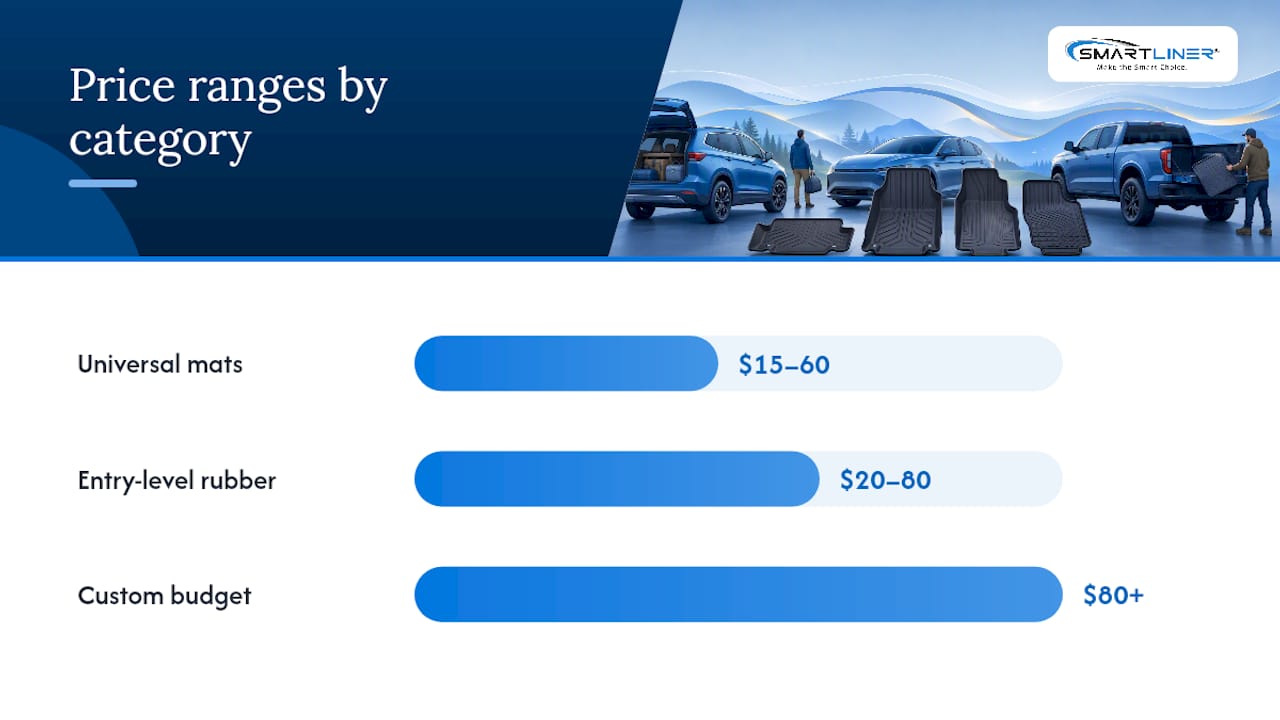
Price ranges tend to run predictably by category: universal rubber or vinyl mats sit around $15 to $60, entry-level rubber sets run $20 to $80, and custom-fit budget all-weather sets typically start above $80 depending on your vehicle. That spread reflects real engineering differences, not just brand markup. A product page like Smartliner’s Toyota Tacoma double cab liners shows how fitment and retention details are usually listed for exactly this reason.
Pro Tip: Before you click buy, search the product page for the words “retention” or “anchor.” If neither word appears anywhere, assume the mat wasn’t designed with your factory hooks in mind and plan accordingly.
Which Mat Material Gives You the Best Protection for the Price?
Material choice decides how long your mats last and how much work they save you on cleaning day. Here’s how the main options stack up.
- Rubber: Tough, cheap, and easy to hose off, but it can stiffen in cold weather and sometimes carries a noticeable odor when new.
- Vinyl: Similar affordability to rubber, lighter weight, but generally less durable under heavy daily wear.
- TPE (thermoplastic elastomer) / all-weather: Combines rubber-like durability with a lighter feel and less odor. TPE stays pliable in cold and resists UV damage in heat, and many product lines are 100% recyclable, which matters if longevity and eco-impact both factor into your buying decision.
- Carpet: Comfortable underfoot and often included as an OEM-style option, but it traps moisture, holds odors, and wears out faster under repeated exposure to mud or snow melt.
- 3D contoured: Molded to hug the actual floor contour of a specific vehicle rather than lying flat, which improves containment regardless of the base material used.
For most budget shoppers, TPE/all-weather mats hit the sweet spot: close to rubber’s toughness, none of the stiffness problems in winter, and a cleaner profile than carpet. Carpet is fine for a mild climate and light use, and vinyl works as a low-cost stopgap, but neither holds up as well in wet or snowy conditions. If you live somewhere winters bring road salt and slush, a deeper all-weather liner is worth the extra spend, since salt exposure accelerates corrosion that a shallow mat won’t stop from reaching your carpet and floor pan underneath.
Is Your Floor Mat Actually Safe to Drive On?
A floor mat that shifts or bunches near the pedals isn’t a minor annoyance. It’s a mechanical hazard, and it’s one of the most overlooked risks in budget mat shopping.
- Check that the mat includes grommets or slots matching your vehicle’s factory retention hooks, not just a generic hole punched somewhere in the middle.
- After installing, sit in the driver’s seat and physically press the brake and gas pedals through their full range of motion to confirm nothing catches or lifts the mat edge.
- Watch for red flags on unboxing: a stiff, curling backing that won’t lie flat, a strong chemical smell that doesn’t fade, or a product listing with no mention of retention compatibility or safety testing at all. Many low-cost mats skip this disclosure entirely, which should give you pause before buying.
- If you’re stuck with a universal mat, aftermarket retention clips can add a second layer of security, and careful trimming (never cutting through structural ribbing) can improve fit around pedals.
Pro Tip: Do the pedal test again after your first few drives. Mats settle and can shift slightly out of position within the first week, so a follow-up check catches problems before they become a habit you stop noticing.
How Do You Keep a Budget Floor Mat Lasting Longer?
Cleaning routine matters almost as much as material choice when it comes to getting years out of a budget purchase.
- Rubber and TPE mats: Pull them out, hose them down, scrub with mild soap and a brush, then let them air dry fully before reinstalling.
- Carpet mats: Vacuum regularly and spot-clean spills immediately, since carpet fibers hold onto moisture and odor far longer than rubber or TPE.
- New mats with a factory smell: Let them air out in a garage or outdoors for a day or two before installing. Off-gassing fades quickly with ventilation.
- Storage between seasons: Dry mats completely and store them flat, not rolled, to avoid warping that can throw off the fit later.
Rubber and TPE mats rinse clean and dry noticeably faster than carpet, which matters most if you’re hauling kids, pets, or gear on a regular basis. Lifespan expectations follow material lines too: quality all-weather mats can run 5 to 7 years with basic care, while carpet mats often need replacing every 2 to 3 years under similar use. If your mat is cracking, losing its retention grip, or no longer sealing at the edges, that’s your cue to replace it rather than squeeze out one more season.
What Makes Smartliner a Trustworthy Budget Pick?
Smartliner-usa builds its custom-fit line around precise-fit technology and recyclable TPE materials, which is exactly the combination this guide has argued for throughout: retention you can count on, containment deep enough to matter, and a material that survives real-world seasons without falling apart. Full product lines are listed at Smartliner-usa, covering everything from floor liners and cargo liners to UTV mats and truck bed liners.
Customers consistently point to two things when describing why a mat earned a repeat purchase: it kept cleaning up easily wash after wash, and it still looked and fit like new well past the point where a cheaper mat would have curled or cracked.
That kind of durability and cleanability feedback is exactly what budget buyers should be listening for, since it confirms a mat performs the way its material promised rather than just on the spec sheet. Editorial testing perspective for this guide comes from Marty, whose focus is matching real buyer needs (safety, fit, and cost over time) to the products that actually deliver on them, rather than chasing the lowest sticker price alone.
An Editor’s Take on Budget Floor Mats
Custom-fit beats universal for nearly every budget buyer, and the conventional wisdom that “cheap means universal” gets this backwards. A well-made universal mat and a well-made custom-fit mat can cost close to the same amount once you account for how often a universal mat needs replacing or supplementing with clips. Three rules of thumb: buy for your worst month, not your average one (that means sizing containment for winter slush, not summer dust); never skip the retention check just because a mat looks fine in photos; and treat cargo and rear seats as part of the cabin, not an afterthought. Budget shopping is smart. Skipping safety checks to save $20 is not. Protect the whole cabin, confirm the fit works with your factory hooks, and the rest of this decision gets a lot easier.
— Marty
Where to Buy Budget-Friendly Floor Mats That Actually Fit
Smartliner-usa gives budget buyers what a generic rubber mat from a big-box store can’t: a custom-fit shape engineered to your exact vehicle, made from recyclable TPE that resists cracking and holds its retention grip for years rather than months. That’s the real gap between “cheap” and “budget-smart.” Start with the floor liners collection to find your vehicle’s exact fitment, then check whether a matching cargo liner or truck bed mat rounds out full-cabin protection. Off-road owners can check the UTV floor mats page, and Lexus LX 600 owners will find a dedicated 7-passenger fitment built for that exact cabin layout. Before checkout, double-check your vehicle’s year range and trim against the listing, and review the return policy so a wrong-fit order is a quick fix rather than a wasted purchase.
Sources
- Types of car floor mats
- 10 Car Floor Mat Mistakes to Avoid This Year (And What to Do Instead)
- Do car floor mats fit all cars? What you need to know
FAQ
What Is a Cheaper Alternative to Premium Name-Brand Floor Mats?
Custom-fit TPE/all-weather liners from a value-focused brand like Smartliner-usa offer similar containment and retention benefits to pricier premium brands, often at a lower price point, since custom fitment rather than brand name is what actually drives protection quality.
What Company Makes the Best Floor Mats for the Money?
The best value comes from brands offering true custom-fit designs rather than one-size-fits-most universal shapes. Smartliner-usa’s custom-fit floor liners and cargo liners are built around your vehicle’s exact floor pan and factory retention points, which is the feature that matters most for both safety and durability.
Where Can You Find Affordable Floor Mats Online?
Smartliner-usa’s floor liners page lists fitments by vehicle year and trim, and most budget-tier universal and custom-fit mats elsewhere run $15 to $80 depending on material and fit.
Are Premium Name-Brand Mats Really Worth the Extra Cost?
Premium mats can offer strong containment, but the underlying value drivers, precise fitment, secure retention, and durable material, are available in budget-tier custom-fit sets too. The price gap often reflects brand positioning more than a meaningful difference in protection.
How Long Should a Budget Floor Mat Last?
A quality all-weather mat with proper care typically lasts 5 to 7 years, while a carpet mat under similar use usually needs replacing every 2 to 3 years.