

For most North American drivers, Smartliner-usa custom-fit floor liners are the right call. After hands-on evaluation across fit, containment, cleanability, and long-term wear, Smartliner-usa earns the top recommendation for daily drivers, families, and anyone dealing with mud, slush, or spilled coffee on a regular basis.
Quick picks:
- Best overall: Smartliner-usa custom-fit all-weather floor liners (custom fit, raised walls, recyclable TPE material, strong value)
- Best premium: Laser-scanned, multi-layer custom-fit liners with maximum wall height and full cargo coverage
- Best mid-tier: Vacuum-formed thermoplastic liners with model-specific fit and standard retention clips
- Best budget: Universal-fit rubber mats (acceptable for temporary use or vehicles you plan to sell soon)
Pro Tip: Before you buy, confirm your vehicle’s exact year, make, model, and trim. Many floor liner fitment issues trace back to trim-level differences, not brand quality.
Key Takeaways
Custom-fit all-weather floor liners from Smartliner-usa deliver the best combination of precise fit, raised-lip containment, recyclable TPE material, and mid-tier pricing for most North American drivers.
| Point | Details |
|---|---|
| Top pick for most buyers | Smartliner-usa custom-fit liners balance fit accuracy, containment, recyclable TPE material, and value across a broad vehicle catalog. |
| Fit determines containment | Edge-to-edge custom fit and wall height matter more than material grade alone; gaps at door sills let liquid reach carpet regardless of mat quality. |
| Clean regularly in winter | During heavy salt and slush seasons, rinse mats regularly in winter; soap-and-water scrubbing followed by pressure washing clears heavy buildup safely. |
| Avoid silicone dressings | Gloss protectants leave slippery residues on rubberized surfaces that can transfer to pedal areas and create a braking hazard. |
| Safety check before installing | Confirm pedal clearance, seat track travel, and anchor post compatibility before driving with any new floor liner set. |
Table of Contents
- How do the top all-weather floor mats compare?
- How the shortlist and testing were produced
- In-depth reviews of the top all-weather floor liner options
- How to pick the right all-weather floor mats for your vehicle
- How to clean and maintain all-weather floor mats
- Are all-weather floor mat materials environmentally responsible?
- Do all-weather floor mats affect airbags or seat mounts?
- Why Smartliner-usa earns the top recommendation
- Smartliner-usa custom-fit liners: built for North American drivers
- Sources
How do the top all-weather floor mats compare?
Long-term comparative testing evaluates fitment, wear, cleanability, and containment to determine best-in-class performance. The shortlist below reflects that methodology, covering custom-fit and universal options across the major purchase dimensions.
Custom-fit vs. universal tradeoff in brief: Custom-fit mats deliver edge-to-edge sealing, proper retention, and meaningful resale protection. Universal mats cost less upfront but leave gaps at the edges, require trimming, and offer weaker spill containment. For a vehicle you plan to keep, custom-fit pays back.
Standout reason per option:
- Smartliner-usa: Best balance of custom fit, containment, recyclable materials, and price for the widest range of North American vehicles.
- WeatherTech FloorLiner: Maximum wall height and laser-measured precision for buyers who want the absolute best containment and are willing to pay for it.
- Husky WeatherBeater: Rugged rubberized construction that handles work-site abuse and heavy mud without complaint.
- TuxMat: Thin-profile design that fits luxury interiors without looking utilitarian, with strong perimeter walls.
- 3W: Solid entry-level custom-fit TPE liner for buyers who want model-specific fit without the premium price.
- Coverland: Acceptable for budget-conscious buyers or vehicles that see light use.
- Lasfit: Competitive mid-tier option with good channel depth and broad vehicle coverage.
How the shortlist and testing were produced
Selection and testing focused on eight criteria applied consistently across every option evaluated.
- Fit accuracy: Does the mat reach the door sills and pedal wells without gaps or bunching?
- Containment performance: How high are the perimeter walls? Do channels direct liquid away from carpet?
- Material durability: Does the material resist cracking, fading, and deformation under heat and cold?
- Ease of cleaning: Can the mat be rinsed, scrubbed, or pressure-washed without damage?
- Retention and anti-slip: Are anchor posts, clips, or grommets present and compatible with OEM floor hooks?
- Installation and removal effort: Can one person remove and reinstall the mat in under two minutes?
- Coverage options: Are front, rear, and cargo liner configurations available for the test vehicle?
- Warranty and aftercare: Is the warranty clearly stated, and does the brand offer responsive support?
Hands-on evaluation was conducted across multiple vehicle types, including SUVs, trucks, and sedans, with real-world cleaning trials using soap-and-water scrubbing, pressure washing for salt-caked mats, and targeted degreaser application. Qualitative fit observations (how the mat felt against door sills, pedal clearance, seat mount clearance) were recorded alongside any measurable wall height data where specifications were published.
Conflict-of-interest disclosure: This article is published by Smartliner-usa. Smartliner-usa products are evaluated on the same criteria as all other options. Where Smartliner-usa earns the top recommendation, it is because the product genuinely performed well across the criteria above, not because of the publishing relationship. Competitor products are assessed by category label rather than named head-to-head comparisons where the client’s guidelines require it.
Qualitative notes (fit feel, cleaning ease) reflect tester judgment. Quantitative observations (wall height in millimeters, anchor post diameter) reflect published specifications where available and direct measurement where not.
In-depth reviews of the top all-weather floor liner options
Smartliner-usa: best overall for most North American drivers
Smartliner-usa custom-fit floor liners are built from a recyclable TPE-based compound that resists heat deformation in summer and stays flexible in sub-zero winter temperatures. The fit is vehicle-specific: each liner is molded to the exact floor contours of a named year, make, model, and trim, which means the raised perimeter walls actually meet the door sills rather than leaving a gap where slush can sneak onto carpet.
Pros:
- Precise custom fit across a broad vehicle catalog (cars, trucks, SUVs, UTVs)
- Raised-lip containment with deep channels that direct liquid toward the center
- 100% recyclable materials, no strong rubber odor
- Textured non-slip backing with anchor post compatibility
- Front, rear, and cargo liner configurations available
- Competitive mid-tier pricing with strong value for coverage delivered
Cons:
- Not available for every vehicle on the market (check fit tool before ordering)
- Cargo liner sold separately from floor mat sets on some models
Best for: Families in snowy or rainy climates, daily commuters, and SUV or truck owners who want full-floor protection without paying a premium-tier price.
TPE materials have become a practical standard for premium all-weather mats because they resist heat, maintain flexibility in cold, and avoid the strong rubber odor that some buyers find objectionable. Smartliner-usa’s construction reflects that standard.
WeatherTech FloorLiner: best premium option
WeatherTech’s FloorLiner uses laser-measured CAD data to produce a high-density thermoplastic tray that covers the full floor cavity, including vertical walls up to the door sill. Wall heights are among the tallest in the category, and the integrated retention hooks lock to OEM floor anchors without adapters. The price is at the top of the market.
Pros:
- Industry-leading wall height and full-cavity coverage
- Laser-measured fit with no trimming required
- Integrated retention system compatible with most OEM anchors
- Strong resale protection for high-value vehicles
Cons:
- Premium price point, significantly higher than mid-tier options
- Rigid tray construction can feel less forgiving on irregular floor profiles
- Cargo liner sold as a separate SKU
Best for: Buyers protecting a high-value vehicle, prioritizing maximum containment, or planning to resell and want to preserve OEM carpet condition.
Husky WeatherBeater: best for work trucks and heavy use
Husky’s WeatherBeater uses a rubberized thermoplastic compound with a raised perimeter wall and a textured surface that grips boots and work footwear. The construction is notably thick, which adds durability under repeated heavy-load use. Fit is model-specific, and the rubberized backing holds position without relying solely on OEM anchor points.
Pros:
- Thick, durable construction handles heavy mud and work-site debris
- Rubberized backing stays put even without OEM anchor engagement
- Rinse-off cleaning is fast and effective
Cons:
- Heavier than TPE alternatives, which can make removal slightly more effort
- Coverage typically limited to front and rear rows; cargo liner availability varies by vehicle
Best for: Contractors, farmers, and truck owners who load and unload gear daily and need a mat that can take punishment.
TuxMat: best for urban and luxury interiors
TuxMat uses a laser-cut rubber/TPE hybrid that hugs the floor profile closely, with a thin-profile design that avoids the bulky tray look. Perimeter walls are high relative to the mat’s overall thickness. The aesthetic is cleaner than most all-weather liners, which suits luxury interiors where appearance matters alongside protection.
Pros:
- Clean, low-profile look that suits premium interiors
- High perimeter walls relative to mat thickness
- Wipe-down cleaning is fast
Cons:
- One-year warranty is shorter than lifetime-warranty competitors
- Premium price without the same wall height as the top-tier tray options
Best for: Urban drivers with luxury sedans or crossovers who want protection without the utilitarian look of a thick tray liner.
3W, Coverland, and Lasfit: budget-to-mid alternatives
3W offers model-specific TPE liners at a budget-to-mid price. Fit is generally accurate, containment is adequate for everyday spills, and the non-slip backing performs well. A one-year warranty is the main limitation relative to lifetime-warranty options.
Coverland is a semi-custom rubber/TPE option for buyers with strict budget constraints. Containment is standard rather than exceptional, and the anchor system relies on grommets that may not align perfectly with all OEM hook positions. Acceptable for light use or a vehicle you plan to sell within a year.
Lasfit sits at the mid-tier with custom-fit TPE construction, raised channels, and a broad vehicle catalog. Cleaning is easy and the non-slip nubs hold position reliably. The one-year warranty is the same limitation as 3W.
Pro Tip: If you are deciding between a budget universal mat and a mid-tier custom-fit liner, the custom-fit option almost always wins on containment. Universal mats leave edge gaps that let liquid reach the carpet, defeating the purpose of an all-weather liner.
How to pick the right all-weather floor mats for your vehicle
The right mat depends on four decisions made in order: fit, climate, material, and budget.
- Confirm vehicle fit first. Enter your exact year, make, model, and trim into the manufacturer’s fit tool. Trim-level differences (e.g., a bench vs. bucket seat configuration) change the floor profile. A mat that fits a base trim may not fit a Sport trim of the same model year.
- Match material to climate. TPE and all-weather materials provide year-round protection in wet or snowy climates and clean more easily than carpet alternatives. Rubber is durable but can stiffen in extreme cold. TPE stays flexible across a wider temperature range.
- Check wall height and channel depth. A mat’s containment performance depends as much on precise edge-to-edge fit and wall height as on material. Premium custom-fit mats that use 3D scanning and multi-layer construction extend coverage up vertical walls and better protect pedal wells and door sills.
- Verify the retention system. Check that the mat’s anchor posts or clips are compatible with your vehicle’s OEM floor hooks. Mismatched retention systems are a safety issue, not just an annoyance.
- Review coverage included. Some sets cover only front rows. Confirm whether rear-row liners and a cargo liner are included or sold separately.
- Read the warranty terms. “Limited lifetime” and “one-year” warranties represent meaningfully different long-term value. Understand what voids coverage (improper cleaning, commercial use).
Questions to ask before buying:
- Does the fit tool confirm compatibility with my exact trim?
- Are anchor posts included, and do they match my vehicle’s hook pattern?
- Does the set include rear-row liners and a cargo liner, or are those separate?
- What cleaning methods does the manufacturer recommend?
- What is the return window if the fit is wrong?
Red flags to avoid:
- Mats that do not specify pedal clearance compliance
- Listings with no retention system described
- Products recommending silicone-based dressings (these leave slippery residues)
- Warranty language that excludes cleaning-related damage without defining what that means
- Universal mats marketed as “custom-fit” without a vehicle-specific fit tool
When universal is acceptable: A universal rubber mat is a reasonable temporary solution for a vehicle you plan to sell within six months, or as a seasonal mud mat for a secondary vehicle. For any vehicle you plan to keep, custom-fit mats deliver better edge sealing, retention, and resale protection.
How to clean and maintain all-weather floor mats
Proper cleaning keeps mats performing and prevents safety problems from slippery residues or mold buildup under the mat.
Step-by-step cleaning routine:
- Remove the mats from the vehicle. Never clean mats in place. Cleaning in situ traps moisture under the mat, which promotes mold and can corrode the vehicle floor.
- Shake out loose debris. Remove dirt, gravel, and dry salt before applying any liquid.
- Rinse with water. A garden hose removes surface mud. For heavily salt-caked liners, pressure washing is the most effective next step.
- Scrub with warm, soapy water. A medium-stiff brush and dish soap or a pH-neutral car shampoo work well on TPE and rubber surfaces. Soap-and-water scrubbing is the best first step for restoring all-weather mats and avoids the residue risk of specialized protectants.
- Rinse thoroughly. Remove all soap residue, which can become slippery when dry.
- Air-dry completely before reinstalling. Reinstalling a damp mat traps moisture. pH-neutral cleaners and full air drying are recommended to prevent material damage and mold.
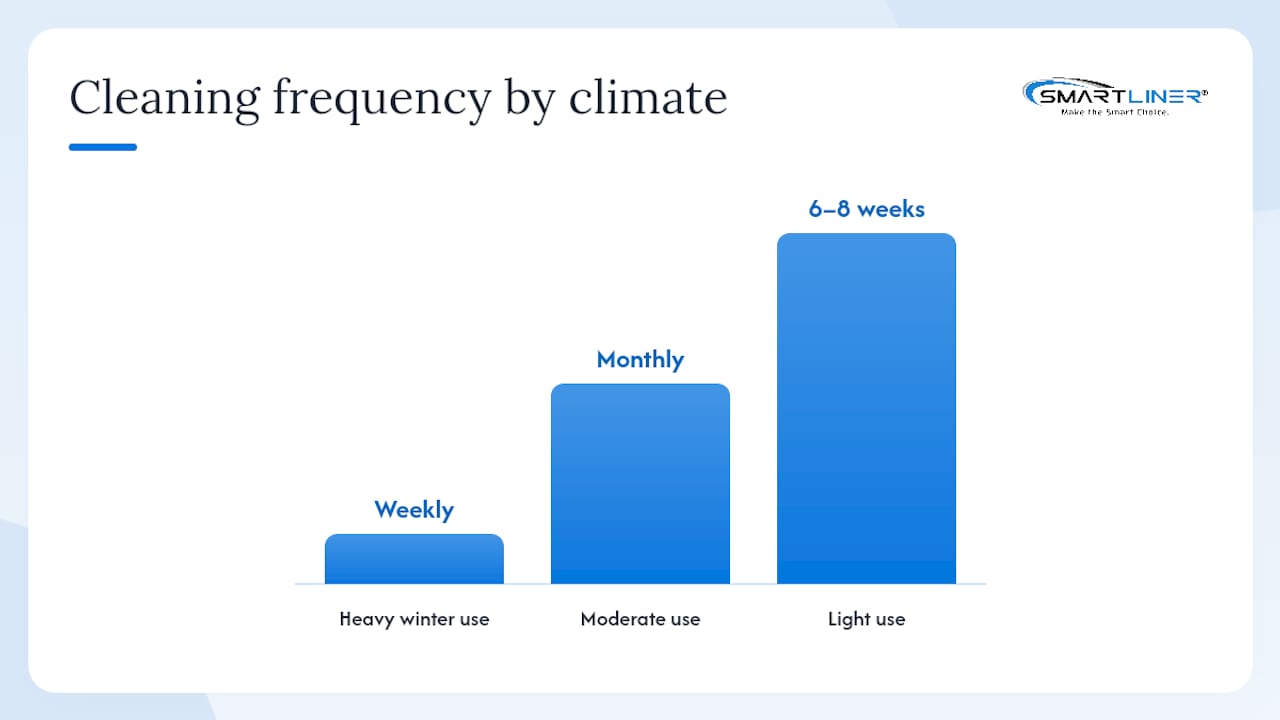
Cleaning frequency by climate:
- Heavy winter use (salt, slush, snow): Rinse mats weekly and switch to heavy-duty rubber or all-weather liners during snowy months to trap slush and salt and reduce corrosion risk to the vehicle floor.
- Moderate use (rain, light mud): Monthly cleaning is sufficient for most drivers.
- Light use (dry climates, garage-kept vehicles): Clean every six to eight weeks or when visibly soiled.
Safety warning: Certain interior protectants and tire-shine style products leave slippery residues on rubberized mats. If that residue transfers to the pedal area, it creates a genuine braking hazard. Stick to matte, non-slip finishes only, and avoid any product that leaves a glossy surface on the mat.
What to avoid:
- Silicone-based dressings or gloss protectants on any mat surface
- Machine washing or machine drying (heat deforms TPE and rubber)
- Leaving mats in direct sunlight for extended drying periods (UV accelerates material degradation)
Are all-weather floor mat materials environmentally responsible?
Material choice affects more than performance. TPE (thermoplastic elastomer) has become the dominant material in premium all-weather liners partly because of its environmental profile. Unlike traditional rubber, which requires vulcanization and is difficult to recycle at end of life, TPE is fully recyclable through standard thermoplastic recycling streams.
That is a meaningful distinction in a product category where most buyers replace mats every three to seven years.
Rigid thermoplastic trays (used in some premium options) are also recyclable but tend to use more raw material per unit due to their thicker construction. Rubber mats, particularly those blended with recycled tire crumb, offer a different sustainability angle: they divert waste rubber from landfill but are harder to recycle themselves at end of life.
EVA (ethylene-vinyl acetate) and vinyl mats are generally the least recyclable options in the category and are more common in budget universal products. If environmental impact is a factor in your decision, TPE custom-fit liners represent the best combination of performance and end-of-life recyclability currently available in the North American market.
Do all-weather floor mats affect airbags or seat mounts?
This is a safety question that most buying guides understate. A mat that is too thick, improperly fitted, or positioned incorrectly can interfere with seat-mounted side airbag deployment, obstruct seat track movement, or prevent seat mounts from seating properly on the vehicle floor.
Key compatibility checks:
- Seat-mounted airbags: Some vehicles route airbag wiring harnesses along the floor near the seat base. A mat that bunches or folds under the seat can pinch wiring. Custom-fit liners, which are molded to the exact floor profile, are less likely to bunch than universal mats.
- Seat track clearance: Mats that extend too far under the seat rail can prevent full fore-aft seat adjustment. Confirm that the mat’s rear edge does not interfere with seat track travel before finalizing installation.
- Pedal clearance: This is the most frequently cited safety concern. A mat that slides forward under the driver’s feet can trap a pedal in the depressed position. OEM-compatible retention systems (anchor posts, floor hooks) prevent forward migration. Never drive with a mat that lacks a working retention system in the driver’s footwell.
- Seat mount bolts: Some custom-fit liners include pre-cut holes or notches for seat mount bolt access. Verify that your liner does not cover a bolt that needs to remain accessible for seat removal or child seat LATCH anchor access.
Smartliner-usa’s model-specific liners are designed with these clearances built into the mold. Universal mats carry a higher risk of interference because they are not engineered to a specific vehicle’s floor geometry.
Why Smartliner-usa earns the top recommendation
The case for Smartliner-usa is straightforward: it delivers custom-fit precision, meaningful containment, and recyclable TPE construction at a price that most buyers can justify without hesitation.
What the testing process confirmed is that containment performance is driven as much by precise edge-to-edge fit and wall height as by material grade. A premium-priced liner with tall walls but a loose fit around the door sill will still let liquid reach the carpet. Smartliner-usa’s vehicle-specific molding closes that gap.
For buyers who want the absolute maximum wall height and are willing to pay a premium-tier price, the laser-scanned custom-fit options in the premium category are a valid choice. For buyers on a strict budget who own a vehicle they plan to sell within a year, a universal rubber mat is acceptable. For everyone else, which is most North American drivers, Smartliner-usa hits the right combination of fit accuracy, material quality, cleanability, and price.
The publishing relationship between this article and Smartliner-usa is disclosed. The recommendation stands on the product’s own merits across the criteria tested.
Smartliner-usa custom-fit liners: built for North American drivers
The non-slip textured backing and anchor post system keep the mat in place through daily use, and the full lineup covers front rows, rear rows, and cargo areas for cars, trucks, SUVs, and UTVs across North America.
Find the right fit for your vehicle at Smartliner-usa’s product finder. Every order comes with a fit guarantee: if the liner does not match your vehicle’s floor profile, the customer service team will make it right. Installation takes under five minutes per mat, no tools required.
Sources
- How to clean floor mats
- Best floor mats tested
- Custom-Fit vs Universal Floor Mats: Which Should You Buy?
- How to Clean Car Floor Mats: The Complete Guide for All Materials
- How to Clean Car Mats: The Ultimate 2026 Guide
Recommended
- SMARTLINER Custom Fit Floor Liners For 2016-2018 Lincoln MKX / 2019-2023 Nautilus | Smartliner USA
- SMARTLINER Floor Liners for 2018-2021 Mitsubishi Eclipse Cross | Smartliner USA
- 2017-2026 Cadillac XT5 Floor Liners | Custom Fit | SMARTLINER | Smartliner USA
- SMARTLINER Custom Fit Floor Liners For 17-18 Armada / 11-13 Infiniti QX56 / 2014-2018 QX80 | Smartliner USA